By Pradeep Pandey · Co-Founder · 25 min read · Updated
4 Best M7 Health Alternatives for Small Hospitals (2026)
M7 now markets to critical access hospitals, so the old question of who each vendor sells to is settled. A narrower one still decides a small hospital purchase. Who is building the schedule in week six, once onboarding is over?

M7 Health used to be straightforward to rule out at 25 beds. Its product pages said health systems, its announced customers were Ochsner and ScionHealth, and a nurse manager at a critical access hospital could stop reading there. That is no longer true. M7 now publishes a page written for small rural hospitals, promising team-led setup, go-live in a few weeks, and a named account manager for every nurse manager.
So the old sorting question, who does each vendor sell to, no longer sorts anything. One better question is left. After the setup help ends, who sits down and builds the schedule every cycle?
This guide compares four M7 Health alternatives on that axis, with honest limitations for each and the situations where staying with M7 is the right call.
Key Takeaways
- The four alternatives worth a small hospital’s time are SimpleScheduleAI, In-House Health, ShiftWizard, and TCP Scheduling (Aladtec). They separate less on features than on who does the scheduling work each cycle.
- For a hospital that wants to keep running its own software, ShiftWizard is the strongest hospital-nursing fit. It also holds the largest independent review base here: 4.3/5 on G2 across 405 reviews, 4.4/5 on Capterra across 723. Its reviewers report a three-month average implementation, which is hospital hours rather than vendor hours.
- TCP Scheduling (Aladtec) is the simpler option for a small facility that wants a self-serve rotation tool and does not need nursing-specific rules. It rates well, at 4.5/5 on G2 across 94 reviews and 4.6/5 on Capterra across just 17, but its Capterra reviewers are mostly fire and EMS rather than hospital nursing.
- In-House Health is worth a look if you already own a scheduling system and want an automation layer on top rather than a replacement. It has no public reviews on G2 or Capterra and no published rural reference customers.
- At a 25-bed hospital, the person who would run the software is usually the nurse manager, who is also taking clinical shifts. SimpleScheduleAI does the scheduling work instead of handing that person a better tool to do it with. Setup takes 3 to 5 business days, and the first schedule arrives inside two weeks.
- M7 itself has no usable third-party reviews. Its Capterra listing exists but shows 0 reviews, and no G2 listing surfaced, so every performance figure it publishes is a vendor claim rather than verified data.[1]
Table of Contents
- What Is M7 Health Built For?
- Why Do Small Hospitals Look for M7 Health Alternatives?
- What Does a Small Hospital Actually Need in an M7 Alternative?
- Quick Comparison: M7 Health vs. The Alternatives
- What Are the 4 Best M7 Health Alternatives?
- 1. SimpleScheduleAI
- 2. In-House Health
- 3. ShiftWizard
- 4. TCP Scheduling (Aladtec)
- When Should You Stay with M7 Health?
- How Does SimpleScheduleAI Compare to M7 Health?
- What to Do This Week
- Frequently Asked Questions
For a 25-bed hospital, the best M7 Health alternatives are the ones that match how much scheduling work your staff can absorb after go-live. ShiftWizard is the strongest self-serve hospital-nursing platform. TCP Scheduling (Aladtec) is the lighter self-serve option for a facility without nursing-specific rules. In-House Health suits a hospital adding automation to a system it already owns. SimpleScheduleAI is the option for a facility where nobody has the hours to own a platform at all.
What Is M7 Health Built For?
M7 Health is an AI-driven nurse scheduling and labor optimization platform, founded in 2022. The name comes from the bone-marrow-transplant unit at Memorial Sloan Kettering where the idea started. That origin is worth knowing: the product was designed by people who had worked a nursing schedule, not only studied one.
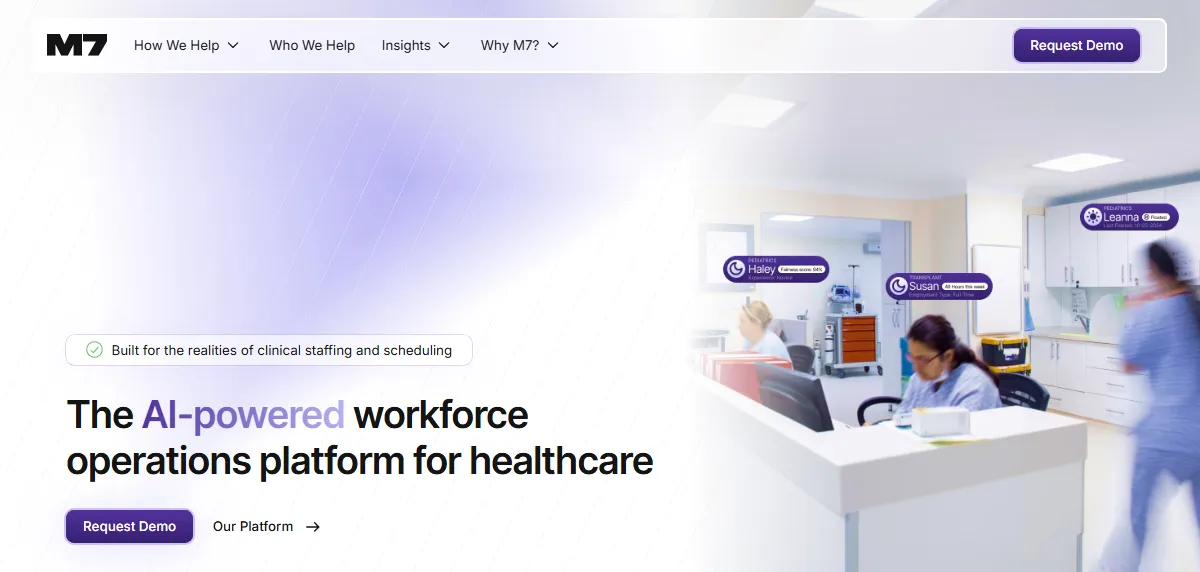
M7 sells to two audiences. Its homepage title still reads “Nurse Scheduling and Labor Optimization for Health Systems,” though the headline on the page now says it is the AI-powered workforce operations platform for healthcare.[2] The announced deployments match the enterprise reading: Ochsner Health, rolling out across all 47 of its hospitals, and ScionHealth, an enterprise of community and specialty hospitals. Those announcements live on the customers’ own newsrooms, so read them as statements of scale rather than as evidence of performance.
M7 also publishes a page aimed squarely at critical access hospitals, written by co-founder Ilana Borkenstein. It promises that its team “handles the setup, trains staff directly.” Most such hospitals are “live within a few weeks, with no IT burden.” Every nurse manager gets “a dedicated account manager,” described as “a real person with a phone number and an email address.” The pricing FAQ says M7 “is priced to be accessible for smaller facilities.”[2]
Take that seriously rather than dismissing it. It is a real offer, and it is close to what a small hospital says it wants.
Two things are worth knowing about the evidence behind it. That page names no individual hospital, describing onboarding “across Utah, Mississippi, and Alabama” through a named member of its activation team.[2] And the individual hospitals on M7’s customer wall reach it through parent health systems rather than as standalone rural facilities. Carolina Pines Regional belongs to ScionHealth; Palestine Regional, Logan Regional and Ennis Regional became Lifepoint Health hospitals when Lifepoint closed its purchase of eight ScionHealth facilities on June 2, 2026.[6] A hospital that a corporate parent onboarded is a different proposition from a standalone 25-bed facility doing it alone.
M7 publishes several performance figures. Among them: “reduced administrative time spent on scheduling by more than 60%,” “lowered premium labor spend by up to 40%,” and an “NPS score of 69, the highest in healthcare.”[2] These are vendor claims. They may well be accurate, and they are not independently verified, so treat them as marketing rather than benchmark data.
What Does M7 Health Do Well?
Two things, and both are worth weighing before you look anywhere else.
M7 builds its scheduling around individual nurse preferences rather than around a fixed grid, and it publishes fairness scoring as a headline metric. That is a harder engineering problem than coverage alone, and most platforms in this category treat fairness as a report you read afterwards rather than as a constraint applied while the schedule is built.
Their small-hospital support model is also a genuine answer to a real complaint. Enterprise software usually arrives with a project plan and leaves with a ticket queue. A named person with a phone number is better than that, and it is more than most vendors in this category offer a 25-bed hospital.
Why Do Small Hospitals Look for M7 Health Alternatives?
Three reasons come up, and none of them is that the software is bad.
Setup help and ongoing operation are different promises. M7’s own wording is that its team “stays close until scheduling feels effortless.” Note the word “until.” The help is designed to end. The rest of that page is about adoption: staff seeing schedules on their phones, nurses picking up the interface quickly, leaders gaining visibility and control. That describes a hospital operating the tool well, which also answers our question. Once onboarding is over, the hospital builds the schedule.
The scheduling job does not end at go-live. When a nurse’s competency changes, someone updates it. When a unit’s coverage requirement moves, someone reconfigures it. When a per diem becomes unreachable midweek, someone remembers. Setup lasts weeks. Those rules surface over months. Every rule the system does not know becomes a manual correction, and corrections accumulate until rebuilding from scratch is faster than fixing the draft.
There is no independent evidence at your size. M7’s Capterra listing exists but carries 0 reviews, and no G2 listing surfaced. Nothing published by a hospital like yours describes what the rollout felt like. For an enterprise buyer with a project team, that gap matters less. For a nurse manager who will personally absorb any distance between the demo and the reality, it matters a lot. The critical access deployments M7 describes are stated by state rather than by named hospital, so ask for a reference at your size, independent of a parent system.
Pricing is not published. Neither is it for most platforms in this category, so this is a category norm rather than a mark against M7. It does mean the evaluation starts with a sales conversation rather than a number, which is slower when the person evaluating is also working clinical shifts.
What Does a Small Hospital Actually Need in an M7 Alternative?
Feature lists are the wrong comparison axis here, because every serious platform in this category has an engine, a mobile view, and a rules layer. Four things separate them at 25 beds.
Who operates it. Software you run yourself needs someone to run it. Ask who that person is by name before you evaluate anything.
What happens at 5am. A schedule that is correct when posted is not the hard part. The hard part is a callout at 5am with four nurses qualified to cover and two already at overtime. Ask to see that workflow specifically, and compare it against the steps in our guide to handling nurse callouts.
Whether charge coverage is enforced. At small scale, only a handful of nurses can hold charge. A schedule that is fully staffed but has nobody charge-qualified on a shift is not a valid schedule. Our guide to what a charge nurse is and who covers the shift explains why that pool is so small.
What the survey record looks like. Ask to see the exact export a surveyor would receive, and how long it takes to produce. The requirements behind that record are covered in our guide to critical access hospital scheduling.
Quick Comparison: M7 Health vs. The Alternatives
The table below sorts the five platforms on the axis that decides a small hospital purchase. Ratings were verified between July and August 2026, and each is listed with its review count, because an average built on 17 reviews carries less weight than one built on 723. Verify anything decision-critical with the vendor directly.
| Platform | Markets to | Who builds the schedule each cycle | Third-party reviews | Pricing |
|---|---|---|---|---|
| M7 Health | Health systems, and critical access hospitals via a dedicated page | Your team, after M7 sets it up and trains you | Capterra: listing exists, 0 reviews G2: no listing found | Not published |
| SimpleScheduleAI | Texas Critical Access Hospitals, 25 beds or fewer | We do; you approve | Pre-launch, no customer reviews | $1,000 to $1,500 a month by roster size |
| In-House Health | Modern nursing teams, larger spans, acuity-driven units | Your team | No G2 or Capterra listing found | Not published |
| ShiftWizard | Mid-market hospitals and systems | Your team | G2: 4.3/5 (405 reviews) Capterra: 4.4/5 (723 reviews) | Not published |
| TCP Scheduling (Aladtec) | Public safety, EMS, small facilities | You do | G2: 4.5/5 (94 reviews) Capterra: 4.6/5 (17 reviews; small sample, mostly public safety) | Not published |
What Are the 4 Best M7 Health Alternatives?
The four strongest M7 Health alternatives for a small hospital are SimpleScheduleAI, In-House Health, ShiftWizard, and TCP Scheduling (Aladtec). ShiftWizard is the established hospital-nursing platform with a real review base. TCP Scheduling comes from public safety and is the lightest to stand up. In-House Health layers automation onto a system you already run. SimpleScheduleAI is the one that takes the scheduling work off the hospital entirely. Which fits depends on how many hours your staff can give the schedule after the vendor’s setup help ends.
Which one to shortlist depends on what you want taken off the nurse manager’s desk.
| If this is what you need | Shortlist |
|---|---|
| The schedule built and checked for you, at a Texas critical access hospital | SimpleScheduleAI |
| An automation layer on top of a scheduling system you already run | In-House Health |
| An established platform aimed at mid-market hospitals and systems | ShiftWizard |
| Strong handling of complex rotating shift patterns | TCP Scheduling (Aladtec), whose heritage is public safety rather than nursing |
1. SimpleScheduleAI
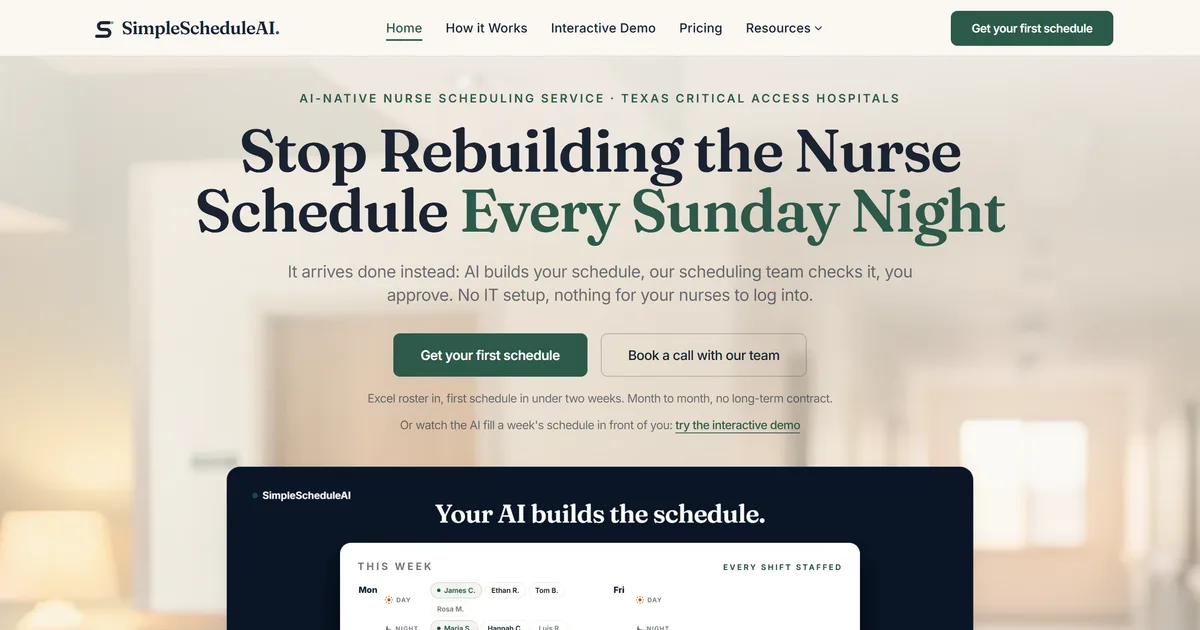
SimpleScheduleAI is nurse scheduling software we build and operate ourselves, delivered as a service: the AI builds the schedule, our scheduling team checks it, your nurse manager approves it. It is built for Texas Critical Access Hospitals of 25 beds or fewer.
What separates this from every other option here is the delivery model rather than the feature set. You send a roster and your weekly inputs. You get a post-ready schedule, and a ranked replacement shortlist when someone calls out. Nobody at the hospital configures rules, maintains the system, or learns an admin console. How the drafts get built is covered in how AI nurse scheduling works, and you can watch a week get built in the interactive simulator.
SimpleScheduleAI is pre-launch, so there are no customer reviews on G2 or Capterra yet. That is a real gap when you are trying to predict a rollout, and it is worth weighing against the review bases ShiftWizard and TCP Scheduling carry.
Best for: a 25-bed hospital where the person who would own scheduling software is the same person taking clinical shifts.
Key advantages:
- Operated for you, so there is no super-user role to staff
- Excel roster upload, with no payroll or HRIS integration required
- Charge coverage is one of the compliance rules every draft is checked against
- Onboarding runs 3 to 5 business days, with your first schedule inside two weeks
- Flat monthly pricing, published, banded by roster size
Key limitations:
- Texas only, and 25 beds or fewer
- Pre-launch, so there are no customer references yet
- No payroll or HRIS integration
- Not right for a hospital that wants to run and configure its own platform
Verdict: The strongest fit when the constraint is scheduling labor rather than software quality. If your nurse manager cannot name a successor for the configuration work, no amount of vendor onboarding closes that gap. A delivery model that removes the work answers it more directly than a better tool does. See how it works.
Cost: $1,000 a month up to 20 nurses, $1,500 for 21 to 40.
2. In-House Health
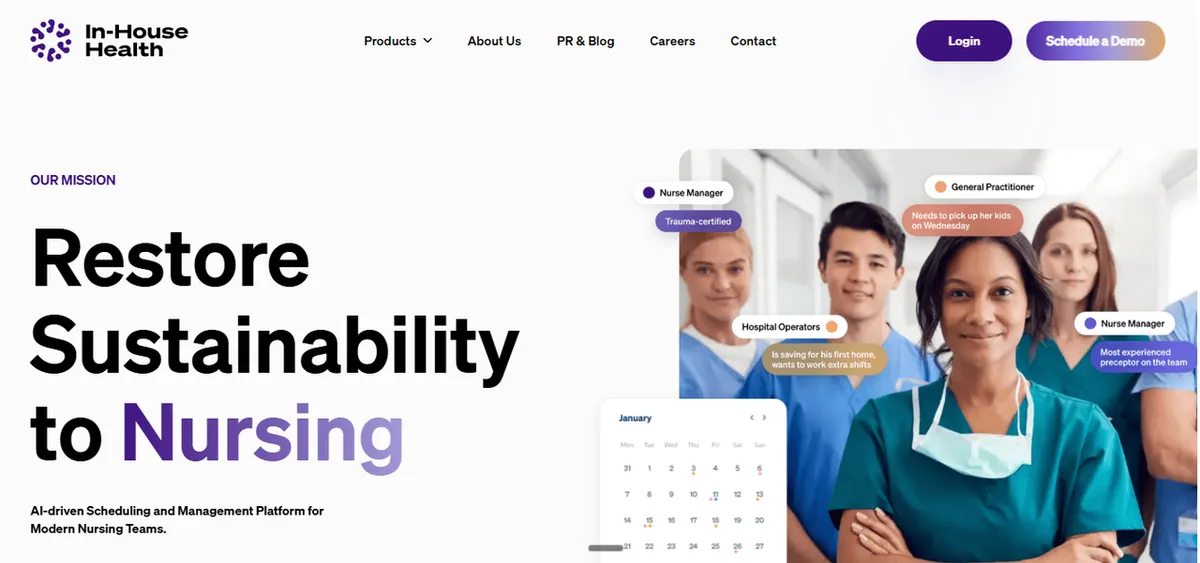
In-House Health is an AI-driven nurse scheduling and workforce platform. It can run as an automation layer on top of an existing scheduling system, or as an end-to-end scheduler. That first option is genuinely useful if you already own something you do not want to replace.
Their positioning describes a product “purpose-built for nursing teams,” combining predictive analytics, workload adjustments and preference tracking. Their AI copilot “balances shifts weeks in advance, automatically adjusting for patient acuity, union rules and regulatory requirements.”[3]
Best for: a hospital that already has a scheduling system and wants an automation layer rather than a replacement.
Key advantages:
- Can layer on an existing system instead of replacing it
- Acuity-adjusted workload forecasting, which most small-hospital tools do not attempt
- Preference tracking built into the model
Key limitations:
- No G2 or Capterra listing found, so no independent reviews at any size
- Positioning targets larger acute-care environments, including union rules and managers with growing spans
- No published Critical Access Hospital or rural reference customers
- Pricing not published
Verdict: The most interesting option if replacing your scheduling system is off the table and automation on top of it is the actual goal. The evidence gap is the same one M7 has, so apply the same test and ask for a reference at your bed count rather than at theirs. Our head-to-head on In-House Health vs SimpleScheduleAI goes deeper on the small-hospital fit question.
Cost: Not listed on the website. Contact for a quote.
3. ShiftWizard
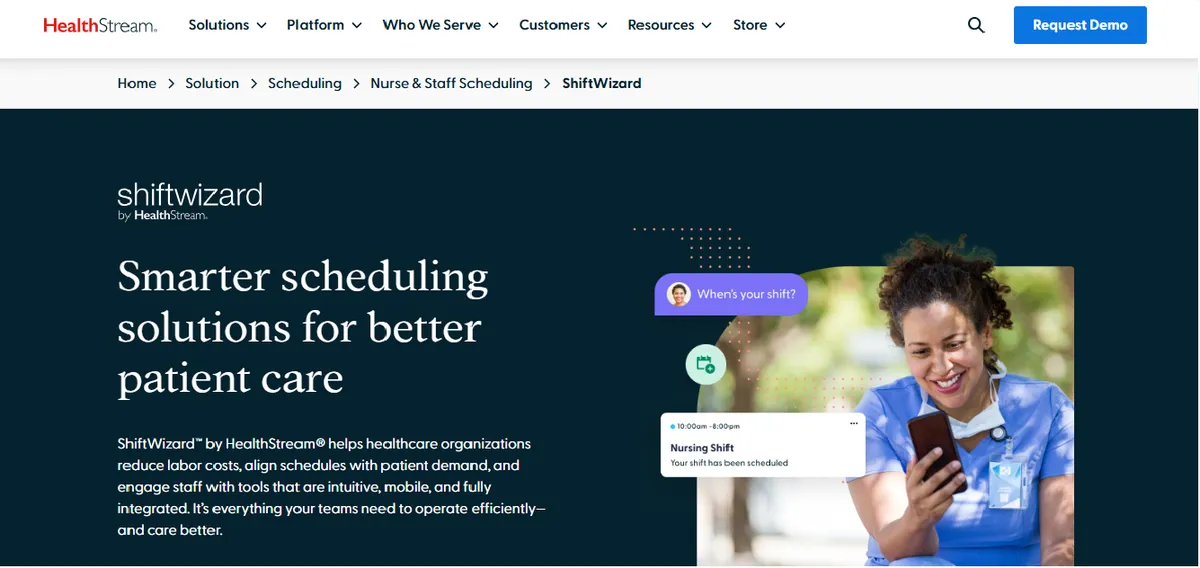
ShiftWizard is an established hospital scheduling platform aimed at mid-market hospitals and systems, owned by HealthStream. Unlike M7 and In-House Health, it has a real public review base: 4.3/5 on G2 across 405 reviews, and 4.4/5 on Capterra across 723.[4] Over a thousand reviews from hospital staff is worth something on its own. It is the closest thing available to a preview of your own rollout.
That review base is also where the honest caution lives. G2 lists an average time to implement of three months, averaged from its own reviewers. Three months of implementation is not three months of vendor work. It is three months of hospital hours from people who already have jobs, which is the cost most small hospitals underestimate. Our guide to how long nurse scheduling software implementation takes works through that in detail.
Best for: a hospital with a project owner who can carry a multi-month implementation.
Key advantages:
- Real independent reviews on two platforms
- Established in hospital nurse scheduling specifically
- Broader feature set than the small-facility tools
Key limitations:
Implementation is a project, not a setup
Assumes someone owns configuration after go-live
Speed complaints from nurses. A large review base surfaces the bad experiences alongside the good ones, and speed is the recurring theme.
“Everything is slow and difficult to use. The app does not work well. The website is slow and takes forever to click on any options.”
Jacob G., Registered Nurse, Hospital & Health Care, July 18, 2024, Capterra
Pricing not published
Verdict: The best self-serve alternative to M7 for a hospital that wants to keep operating its own platform and has the staff to do it. The review base is the strongest argument for it and the three-month implementation average is the strongest argument against it at 25 beds. Our deeper ShiftWizard alternatives guide covers the fit question in more detail, and ShiftWizard vs a managed service puts it head to head with the operated model.
Cost: Not listed on the website. Contact HealthStream for a quote.
4. TCP Scheduling (Aladtec)
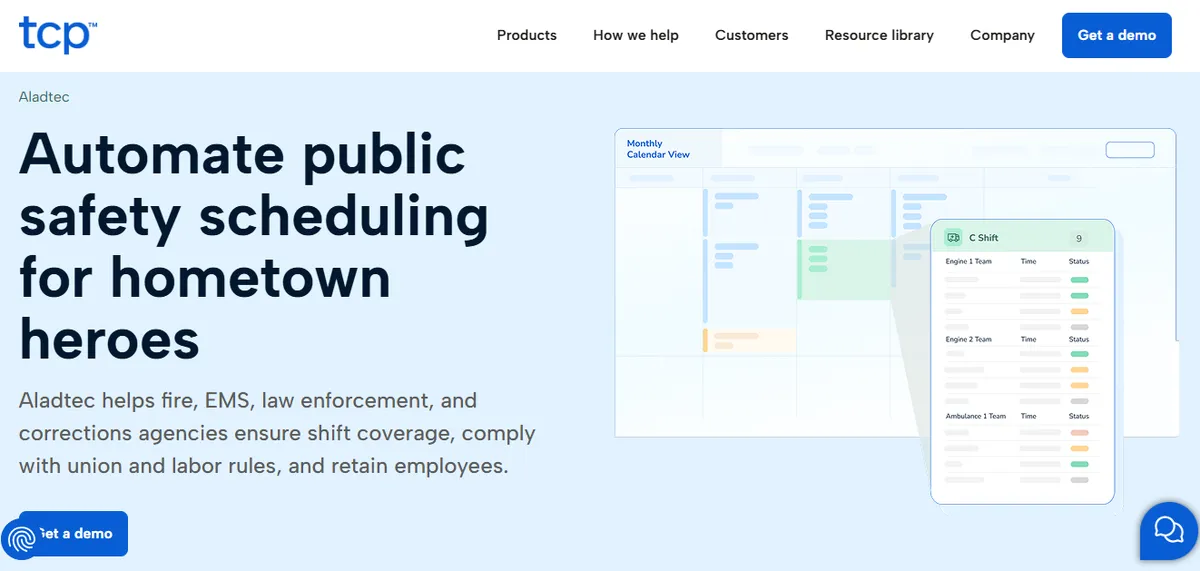
Aladtec, now part of TCP Software, comes from public safety and EMS rather than from nursing. That heritage shows in both directions. It handles rotating shift patterns and 24/7 coverage well, and it is genuinely usable by a small facility without a project team. It also does not carry nursing-specific concepts natively.
It rates well: 4.5/5 on G2 across 94 reviews, and 4.6/5 on Capterra across 17.[5] Read that second number with its sample size in mind, and read both with the reviewer base in mind. Capterra’s Aladtec reviewers skew heavily toward fire, EMS and law enforcement, and the most recent review written from a hospital-nursing seat dates to October 2020.
For a small hospital whose scheduling problem is mostly rotation mechanics, that trade is often acceptable. For one whose problem is unit competency, charge coverage and survey documentation, the workarounds pile up.
Best for: a small facility that wants a simple, self-serve rotation tool and does not need nursing-specific rules.
Key advantages:
- Built for small organizations, so setup is realistic without IT
- Strong at rotating patterns and 24/7 coverage
- Public reviews available on G2 and Capterra
Key limitations:
Not nursing-native, so acuity and competency concepts need workarounds
You still operate it
Click-heavy schedule edits. The one recent hospital-nursing voice in the reviews raises exactly the task a nurse manager repeats weekly.
“When editing the schedule there are a lot of clicks involved.”
Amanda F., Nurse Manager, Hospital & Health Care, October 13, 2020, Capterra
Pricing not published
Verdict: The lightest self-serve option here and a reasonable landing spot for a facility that wants to keep control without an enterprise implementation. It is the weakest fit of the four on nursing-specific compliance work, so read our TCP alternatives guide for small hospitals before deciding, or Aladtec vs a managed service if the real question is whether to operate a platform at all.
Cost: Not listed on the website. Contact TCP Software for a quote.
When Should You Stay with M7 Health?
Four situations, and they are all real.
You are part of a health system. If your hospital sits inside a larger organization standardizing on M7, staying is almost always right. The configuration work happens centrally, which removes the problem entirely.
You have someone who wants the tool. If a nurse leader genuinely wants to own the schedule and has the hours for it, M7 is a strong choice. Their small-hospital support model is better than most vendors offer at this size.
Your nurses want visibility more than your manager wants hours back. M7’s critical access page leans on staff experience: schedules on phones, swaps and time-off handled digitally, adoption inside weeks. If your unhappiness is that nurses cannot see their schedule, that is the problem M7 is describing, and it is a different problem from the manager’s Sunday night.
You need cross-facility optimization. If you are balancing staff across several sites, that is what M7 is built to do, and the small-hospital tools in this list are not.
How Does SimpleScheduleAI Compare to M7 Health?
Both now sell to small hospitals, so the difference is not the buyer. It is what each one takes off the plate.
M7 makes the tool good and helps you run it well. SimpleScheduleAI runs it instead of you, and hands your nurse manager a draft to approve.
| Question | M7 Health | SimpleScheduleAI |
|---|---|---|
| Who builds the schedule each cycle | Your team, using the platform | We do; your nurse manager approves |
| Who maintains the rules as staff change | Your team, with vendor support | We do, as part of the service |
| Getting started | Team-led setup and staff training; live within a few weeks per M7 | 3 to 5 business days from an Excel roster; first schedule inside two weeks |
| Integrations | Payroll, timekeeping, EHR and ERP | None; rosters move by Excel |
| Independent reviews | Capterra listing with 0 reviews; no G2 listing found | Pre-launch, none yet |
| Pricing | Not published | $1,000 to $1,500 a month by roster size |
| Best fit facility | Health systems, plus small hospitals with someone to own the platform | Texas Critical Access Hospitals, 25 beds or fewer |
Two limits decide whether SimpleScheduleAI fits your hospital. We are not right for a hospital that wants to run and configure its own platform, and we do not integrate with payroll or HRIS. Rosters move by Excel, in and out.
Read our full head-to-head on M7 Health vs SimpleScheduleAI for the longer version of this comparison. For the category question underneath it, compare a managed service against scheduling software. And if you are still building a shortlist rather than replacing a specific platform, our roundup of the best nurse scheduling software for critical access hospitals rates ten options on the same test.
Our Take
Every serious vendor in this category is moving toward better support for small hospitals, and M7's critical access page is a good version of it. That is a real improvement for buyers, and it is not the same thing as the work leaving your building. Setup help ends. Somebody still opens the tool in week six, and at 25 beds that somebody is the nurse manager who is also on the floor. Before comparing platforms on features, write down who does the scheduling a year from now, by name. That single line eliminates most of the shortlist faster than any demo.
What to Do This Week
- Write down who will own the scheduling configuration after go-live. Name the person. If the line is blank, the delivery model matters more than any feature comparison.
- Ask every vendor to demo the 5am callout, not the schedule build. Building a clean schedule is the easy half. Ask what a manager does when a nurse calls out and only two people are qualified.
- Ask what independent reviews exist at your size. For M7 and In-House Health the honest answer today is none. That is not disqualifying, but you should know it before you sign.
- Ask to see the surveyor export. The exact report, and how long it takes to produce.
- Price the two models side by side. Put every quote you collect next to a flat monthly figure at your roster size, and include the nurse manager hours each option assumes. Our pricing page gives you one side of that comparison to start from.
Built for 25 beds, not 47 hospitals
SimpleScheduleAI is nurse scheduling software we build and operate ourselves. You send the roster, we build and check the schedule, your nurse manager approves it.
See how it works →Sources
[1] M7 Health product listing: page states “Overall rating, Based on 0 user reviews.” Capterra.
[2] M7 Health product positioning, critical access hospital page, and published customer announcements. m7health.com. Page-verified 2026-08-19.
[3] In-House Health product positioning. inhouse.health. Verified 2026-08-10.
[4] ShiftWizard ratings: 4.3/5 on G2 across 405 reviews; 4.4/5 on Capterra across 723 reviews. Average time to implement of three months is from G2’s Pricing Insights, averaged from reviewer submissions. Verified 2026-08-14.
[5] TCP Scheduling (Aladtec) ratings: 4.5/5 on G2 across 94 reviews; 4.6/5 on Capterra across 17 reviews. Reviewer base skews toward fire, EMS and law enforcement; most recent hospital-nursing review dates to October 2020. Product positioning: tcpsoftware.com. Verified 2026-07-15.
[6] Lifepoint Health completed its acquisition of eight ScionHealth acute-care hospitals, including Palestine Regional, Logan Regional and Ennis Regional, on June 2, 2026. Lifepoint Health; Palestine Regional. Verified 2026-08-19.
Methodology note: Vendor capabilities, pricing and review counts change. Verify anything decision-critical directly with the vendor before signing. Review-platform figures cited here reflect what those listings showed at the time of writing.
Frequently Asked Questions
What is the best M7 Health alternative for a 25-bed hospital?
It depends on who builds the schedule each cycle. If you have someone with the hours and the appetite to own a platform, M7, ShiftWizard and TCP Scheduling are all reasonable, and M7’s support model is the strongest of those three at this size. If that person does not exist, no amount of onboarding help closes the gap, and the delivery model matters more than the feature set. That is what SimpleScheduleAI is built for.
Does M7 Health work for critical access hospitals?
Yes, and they market to them directly. M7 publishes a critical access hospital page promising team-led setup, no IT burden, go-live within a few weeks, and a dedicated account manager. Two things to ask about the evidence. That page names no individual hospital, describing onboarding by state instead. And the hospitals on M7’s customer wall reach it through parent systems such as ScionHealth, Lifepoint and Ochsner. Ask for a reference at 25 beds or fewer that bought on its own.
How much does M7 Health cost?
Pricing is not published on their site. That is normal for this category, so plan on a sales conversation rather than a published number.
Are there real user reviews of M7 Health?
No. The Capterra listing is live but empty, and no G2 listing surfaced.[1] That is unremarkable for a company founded in 2022, and it does have a practical consequence: the only evidence available to you is what M7 publishes about itself. Ask for a customer you can telephone.
Which M7 alternative has the most independent reviews?
ShiftWizard, by a wide margin: 4.3/5 on G2 across 405 reviews and 4.4/5 on Capterra across 723. TCP Scheduling (Aladtec) rates higher on both (4.5/5 on G2, 4.6/5 on Capterra) but on far fewer reviews, 94 and 17, and its Capterra reviewers are mostly fire, EMS and law enforcement rather than hospital nursing. M7 and In-House Health have effectively none, and SimpleScheduleAI is pre-launch.
What happens to our historical schedule data if we switch?
Ask before you sign rather than after. Three questions cover it. Can you export your roster, your published schedules and your staffing records in a format you can actually open? Does that export cost anything? How long do you keep access once the contract ends?
A vendor who cannot answer all three clearly is telling you something useful.
At a small hospital, your staffing records are also your survey evidence. A gap in them is a gap a surveyor can ask you about later, long after the vendor conversation is over. Get all three answers in writing before you sign, not halfway through a migration when your options have narrowed.
Pradeep Pandey is the co-founder of SimpleScheduleAI. He serves as Deputy General Manager of Operations at Apollo Hospitals and holds an MBA from IIM Trichy (Operations and Marketing). His work focuses on workforce optimization and scheduling operations for Critical Access Hospitals and other small rural facilities. LinkedIn →