By Pradeep Pandey · Co-Founder · 15 min read · Updated
The Self-Scheduling Workload Trap: Why Giving Nurses Control Creates More Work for the Manager
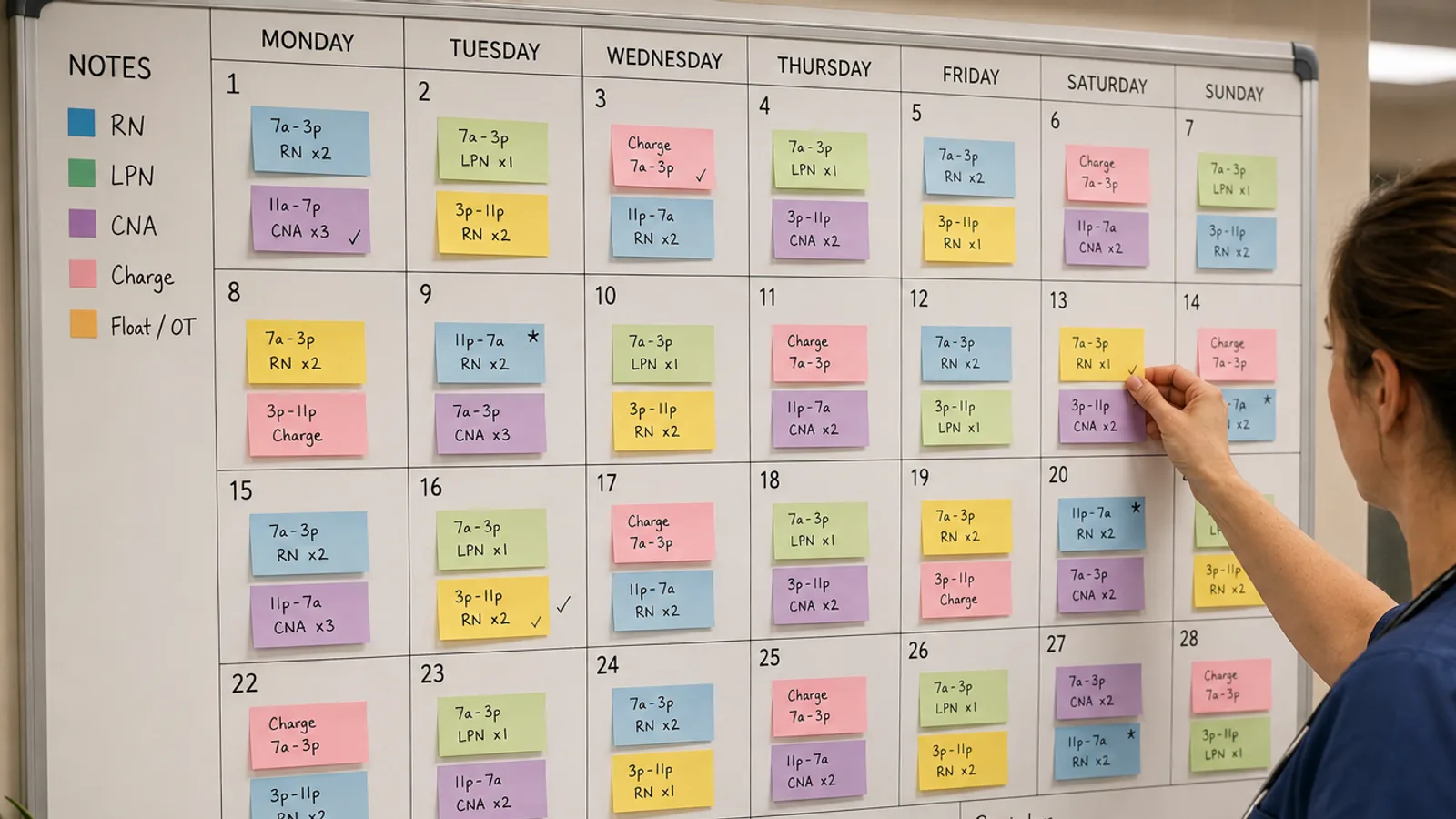
Self-scheduling sounds like it reduces manager workload. Nurses pick their own shifts, the schedule fills itself, the manager publishes. At a critical access hospital, this rarely happens. Instead, the manager inherits a partially-filled schedule, a coverage gap problem, and a fairness dispute, having lost the time to prevent all three.
Key Takeaways
- Self-scheduling at a CAH typically does not reduce manager workload. It restructures the workload: less time building the initial draft, more time managing coverage gaps, fairness disputes, and last-minute corrections after nurses have already claimed shifts.
- The coverage gap problem is structural: nurses choosing their own shifts tend to under-fill undesirable shifts (nights, weekends, holidays), and the less desirable the shift, the more it goes unclaimed.
- At a 20-nurse CAH, the manager who implements self-scheduling often becomes the person who fills whatever is left after nurses have claimed what they want. That gap-filling comes on top of the overhead of managing a failed self-scheduling round.
- Giving nurses scheduling control increases staff satisfaction only when the process produces fair and complete coverage. When it produces coverage gaps and fairness conflicts, it reduces satisfaction compared to a manager-built schedule with transparent fairness rules.
- The manager-review-and-approve model, where the manager builds or approves a draft that already meets coverage and fairness requirements, tends to produce better outcomes at CAH scale than open self-scheduling.
Table of Contents
- Why Does Self-Scheduling Increase Manager Workload at a Small Hospital?
- What Is the Coverage Gap Problem in Nurse Self-Scheduling?
- How Does Self-Scheduling Generate Fairness Disputes?
- What Is the Actual Time Cost of Managing a Failed Self-Scheduling Round?
- When Does Self-Scheduling Actually Work at a Small Hospital?
- How Does the Manager-Review-and-Approve Model Compare to Self-Scheduling?
- How Does SimpleScheduleAI Build the Schedule Instead of Self-Scheduling?
- What to Do This Week
- Frequently Asked Questions
There is an appealing logic to nurse self-scheduling. Nurses know their own availability. They have preferences about shift patterns. Giving them control over their schedules should reduce the manager’s workload and increase staff satisfaction simultaneously.
At large health systems with deep nursing staffs and scheduling software built specifically for self-scheduling, this logic can work: there are enough nurses to absorb the undesirable shifts and cover for each other. At a 20-nurse critical access hospital (CAH), it usually does not. The roster is too shallow to absorb the imbalance, and the nurse manager does not have the bandwidth to run a self-scheduling process and then fix the results.
The time ranges in this article are operational estimates drawn from CAH scheduling practice, not a formal time-motion study. Treat them as an illustrative pattern to check against your own cycle, not a guaranteed outcome.
Why Does Self-Scheduling Increase Manager Workload at a Small Hospital?
Self-scheduling increases manager workload at a small hospital because it converts a single scheduled task into a multi-phase process. Building the draft becomes opening the scheduling window, checking which shifts nurses have picked so far, following up on unfilled shifts, resolving conflicts, and negotiating coverage for undesirable shifts. All of that still has to happen within the same timeframe a direct build would have taken.
The time savings promised by self-scheduling assumes that nurses collectively fill the schedule correctly and completely during the open window. At a 20-nurse CAH, this assumption fails for three predictable reasons:
- There are not enough nurses to absorb undesirable shifts voluntarily.
- Nurses with seniority or faster reaction times claim desirable shifts before others can.
- The nurses who most need schedule flexibility (part-time, per-diem, new staff) are least able to participate in a competitive self-scheduling window.
When these three conditions combine, the nurse manager opens a self-scheduling window and waits two to three days. What comes back is a schedule that is mostly filled with day and evening shifts and has multiple open overnight and weekend slots. She then has to fill those slots through the same process she would have used in a direct build. The difference is that she is now starting from a fixed framework other nurses have already claimed, which constrains her options.
A direct build by hand for a 20-nurse roster runs an estimated 6 to 10 hours but produces a complete schedule the first time. A failed self-scheduling round adds an estimated 3 to 6 hours of cleanup on top of whatever partial schedule the nurses produced, plus the time spent managing the self-scheduling process itself.
What Is the Coverage Gap Problem in Nurse Self-Scheduling?
The coverage gap problem in nurse self-scheduling is structural: nurses choosing their own shifts will under-fill undesirable slots, and the less desirable a shift type is, the more it goes unclaimed. That is nurses acting sensibly on the choice in front of them, not a motivation problem.
At a CAH, the desirability hierarchy for shifts holds across most nursing staff. Day shifts are preferred over evening shifts, evening shifts are preferred over overnight shifts, and weekday shifts are preferred over weekend and holiday shifts. Every nurse in a self-scheduling window knows this hierarchy and acts on it.
When the self-scheduling window opens, the nurses who are fastest to respond (often senior staff with established patterns) claim the desirable shifts. The nurses who respond later find the desirable shifts claimed and have limited attractive options remaining. The overnight and weekend shifts fill last, fill slowly, and often do not fill at all within the self-scheduling window.
The nurse manager who tried self-scheduling to reduce her workload ends up with a calendar full of filled day shifts and empty overnight and weekend slots. She has to fill those slots through direct contact and negotiation. That negotiation is harder than in a direct build, because she is starting from a schedule that already has commitments from other nurses, which limits which nurses she can move to cover gaps.
How Does Self-Scheduling Generate Fairness Disputes?
Self-scheduling generates fairness disputes when the outcome of the scheduling window produces perceptibly unequal distributions of undesirable shifts across the nursing staff. The complaints take two forms. Nurses who ended up with more nights and weekends than their peers are concerned about unfair burden, and nurses who ended up with fewer shifts than they wanted are concerned about reduced hours.
The first complaint is common. A competitive self-scheduling window rewards faster-responding nurses with better shift distributions. The nurses who respond later, whether due to schedule constraints, technical friction, or simply not being as vigilant about the window opening, accumulate undesirable shifts disproportionately over time.
Unlike a manager-built schedule where the distribution decision is transparent and attributable, a self-scheduling outcome is produced by the collective choices of all nurses. Fairness disputes about the outcome are harder to resolve because there is no single decision to explain or revisit. The manager often ends up serving as an arbitrator for a process she set in motion but does not fully control.
The second complaint, insufficient hours, appears when self-scheduling windows close before per-diem or part-time nurses have claimed enough shifts. A per-diem nurse who needs 10 to 15 hours per week finds the most desirable shifts claimed before she can act. She takes what remains or reports to the manager with a shortage that requires manual intervention.
Both complaints land on the manager’s desk as exceptions to be resolved after the self-scheduling round has already produced a published result that other nurses are counting on. The same cross-cycle tracking gap shows up in holiday assignments, which is why a documented rotation rather than memory is what actually enforces fairness over time.
What Is the Actual Time Cost of Managing a Failed Self-Scheduling Round?
Call a round “failed” when it closes with 30% or more of required shifts still open, or when a fairness complaint needs the manager to step in directly. A round like that costs an estimated 3 to 6 hours more than if the manager had just built the schedule herself. The breakdown, illustrative and not a guarantee for any single facility:
| Cleanup Task | Estimated Time |
|---|---|
| Managing the self-scheduling window (reminders, monitoring progress) | 30 to 60 minutes |
| Identifying and filling unfilled shifts after the window closes | 2 to 3 hours |
| Resolving fairness disputes over the shift distribution | 30 to 90 minutes |
| Correcting overtime or coverage problems created by nurse choices | 30 to 60 minutes |
A direct build of the same schedule takes an estimated 6 to 10 hours and produces a complete schedule on the first pass. A failed self-scheduling round adds an estimated 3 to 6 hours of post-window cleanup on top of whatever the nurses claimed during the window. That cleanup time alone can run close to the cost of building the schedule directly.
Not every round fails outright. But at a 20-nurse CAH with a significant share of undesirable shifts to fill, failed rounds are common. Common enough that, on average, self-scheduling ends up costing the manager more time than a direct build, not less. That comes on top of whatever share of the 8 to 12 hours a week the manager already spends on scheduling overall.
When Does Self-Scheduling Actually Work at a Small Hospital?
Self-scheduling works at a small hospital when three structural conditions are in place:
- A simultaneous submission window, so the fastest nurse to respond cannot claim the best shifts before anyone else sees them.
- A hard minimum on undesirable shift assignments per nurse before desirable shifts can be claimed.
- A roster large enough to absorb the distribution without creating gaps.
Most small hospitals implement self-scheduling without these conditions. They open a window, let nurses claim shifts in real time, and then manage whatever results. This produces the coverage gap and fairness problems described above.
A simultaneous submission window means all nurses submit preferences at the same time, and the manager or system assigns shifts based on submissions plus fairness criteria. No nurse can claim the desirable shifts before others see them. This eliminates the first-mover problem and substantially reduces the fairness dispute rate.
A hard minimum on undesirable shifts means no nurse can be scheduled entirely for day and evening shifts if overnight and weekend coverage requirements are not met. This is a rule the nurse manager enforces as a prerequisite for the round, not a preference the system negotiates.
A large enough roster lets some undesirable shifts get filled voluntarily without creating a structural gap. A 40-nurse roster has more flexibility than a 20-nurse roster. Below a certain roster size, voluntary undesirable shift coverage becomes mathematically unreliable.
Most CAHs do not have a 40-nurse roster. For facilities under 25 nurses, manager-directed scheduling with staff input tends to produce more reliable coverage and fewer manager-hours per cycle than open self-scheduling. Open self-scheduling without the structural conditions above is not the right fit for a roster this small; it is a better match for larger facilities with deeper staffing benches.
How Does the Manager-Review-and-Approve Model Compare to Self-Scheduling?
The manager-review-and-approve model, where the manager or a scheduling service builds a complete draft and the manager reviews and approves before publication, captures the benefits of self-scheduling without the structural failure modes.
The key difference from pure self-scheduling is the starting point. Self-scheduling starts from nurse preferences and hopes coverage works out. The review-and-approve model starts from coverage requirements and fits preferences in around them, so the schedule the manager sees is already complete.
| Dimension | Open Self-Scheduling | Manager-Review-and-Approve |
|---|---|---|
| Starting point | Nurse preferences claimed first, coverage checked after | Coverage requirements first, preferences fit in around them |
| What the manager sees | A partially filled schedule with gaps to close herself | A complete schedule ready for review |
| Fairness distribution | Produced by the order nurses happened to claim shifts in | Built into the draft before anyone claims anything |
| Manager time, 20-nurse CAH | 6 to 10 hours build-equivalent, plus 3 to 6 hours of cleanup when a round fails | 6 to 10 hours if she builds the draft herself; less if a scheduling service builds it for her |
For nurse managers who tried self-scheduling to reduce their workload and found the opposite, review-and-approve is often the better fit at CAH scale. The manager’s role becomes judgment and oversight, not gap-filling and dispute resolution.
For more context on the specific structural fixes that make self-scheduling work better when it is the right choice for a facility, see Self-Scheduling Problems at a CAH: How to Fix Them.
How Does SimpleScheduleAI Build the Schedule Instead of Self-Scheduling?
SimpleScheduleAI is one way to run AI nurse scheduling on the review-and-approve model. It generates three schedule versions each cycle, Balanced, Fairness Optimized, and Cost Optimized, built from the roster, coverage rules, and fairness history before the manager ever opens the schedule. The manager reviews whichever version fits the cycle, overrides whatever needs changing by hand, and approves it. Watch the AI build a compliant week live, in under a minute, in the interactive demo.
Stating plainly how our own flow works: a nurse’s shift preferences and per-diem availability are entered by the manager during setup, not submitted by the nurse through a self-service claiming window. A nurse who wants a preference honored still tells her manager, who records it before the next cycle’s draft runs. That is a deliberate tradeoff, not an oversight. Because nothing is claimed by nurses directly, there is no open window for the coverage gap and fairness problems this article describes to form in the first place.
Run your own roster through the scheduling cost calculator to see what closing that gap would be worth at your hospital, or read how SimpleScheduleAI works for the full setup and review cycle.
Our Take
The self-scheduling workload trap comes down to sequencing: preferences get claimed before coverage is checked, instead of the other way around. Fixing that sequencing, whether by adding structural rules to self-scheduling or replacing it with a review-and-approve process, is what actually gets the manager's time back. Self-service alone was never the real goal. A complete, fair draft on the first pass was.
What to Do This Week
- Pull your last two self-scheduling cycles and count how many overnight and weekend shifts were still open when the window closed.
- Log the hours you personally spent filling gaps and resolving fairness complaints after each of those windows closed.
- Check whether your current process has a simultaneous submission window, or whether nurses claim shifts in the order they respond.
- If it is first-come, first-claimed, set a hard minimum on undesirable-shift assignments before any nurse can claim a desirable one.
- If your roster is under 25 nurses, pilot a manager-review-and-approve cycle against the next self-scheduling window and compare your own hours spent on each.
A complete draft that meets coverage requirements, before the manager reviews it.
SimpleScheduleAI builds three schedule versions per cycle: Balanced, Fairness Optimized, and Cost Optimized. Review, adjust, approve.
See how it works →Frequently Asked Questions
Q: Is self-scheduling ever the right choice for a small hospital?
Yes, but only with the structural conditions described above in place. Self-scheduling is not inherently wrong. Most small hospitals just implement it without a simultaneous submission window, a minimum on undesirable shifts, or a roster large enough to absorb the distribution. That combination is what produces the workload and coverage problems this article covers.
Q: How do I tell my nurses that I am moving away from self-scheduling?
Frame the change in terms of the outcomes, not the process. “Self-scheduling was creating unfair distributions and coverage gaps, and I was spending more time cleaning up the results than it was saving. We’re switching to a process where I build the schedule with your preferences in mind, and the distribution of nights and weekends is tracked across cycles so no one is consistently getting the harder shifts.” Nurses who were frustrated with the fairness outcomes of self-scheduling often prefer this framing. Nurses who liked the control of self-scheduling need to understand that their input is still incorporated, just upstream in the process rather than in a direct claiming window.
Q: What happens to preferences a manager-built schedule cannot honor?
Not every preference can be met in every cycle; coverage requirements come first. What matters for trust is that the unmet preferences are visible rather than silent. Note them in the published schedule or say so directly to the affected nurse, and carry them forward so the same nurse is not the one who loses out every cycle. A nurse who sees why a request was not honored, and sees it balanced out over time, reacts very differently than one who is simply told no with no explanation.
Pradeep Pandey is the co-founder of SimpleScheduleAI, an AI-native nurse scheduling service built for Critical Access Hospitals in Texas. He serves as Deputy General Manager of Operations at Apollo Hospitals and holds an MBA from IIM Trichy. LinkedIn →