By Pradeep Pandey · Co-Founder · 16 min read · Updated
Self-Scheduling Problems at a Critical Access Hospital: How to Fix Them
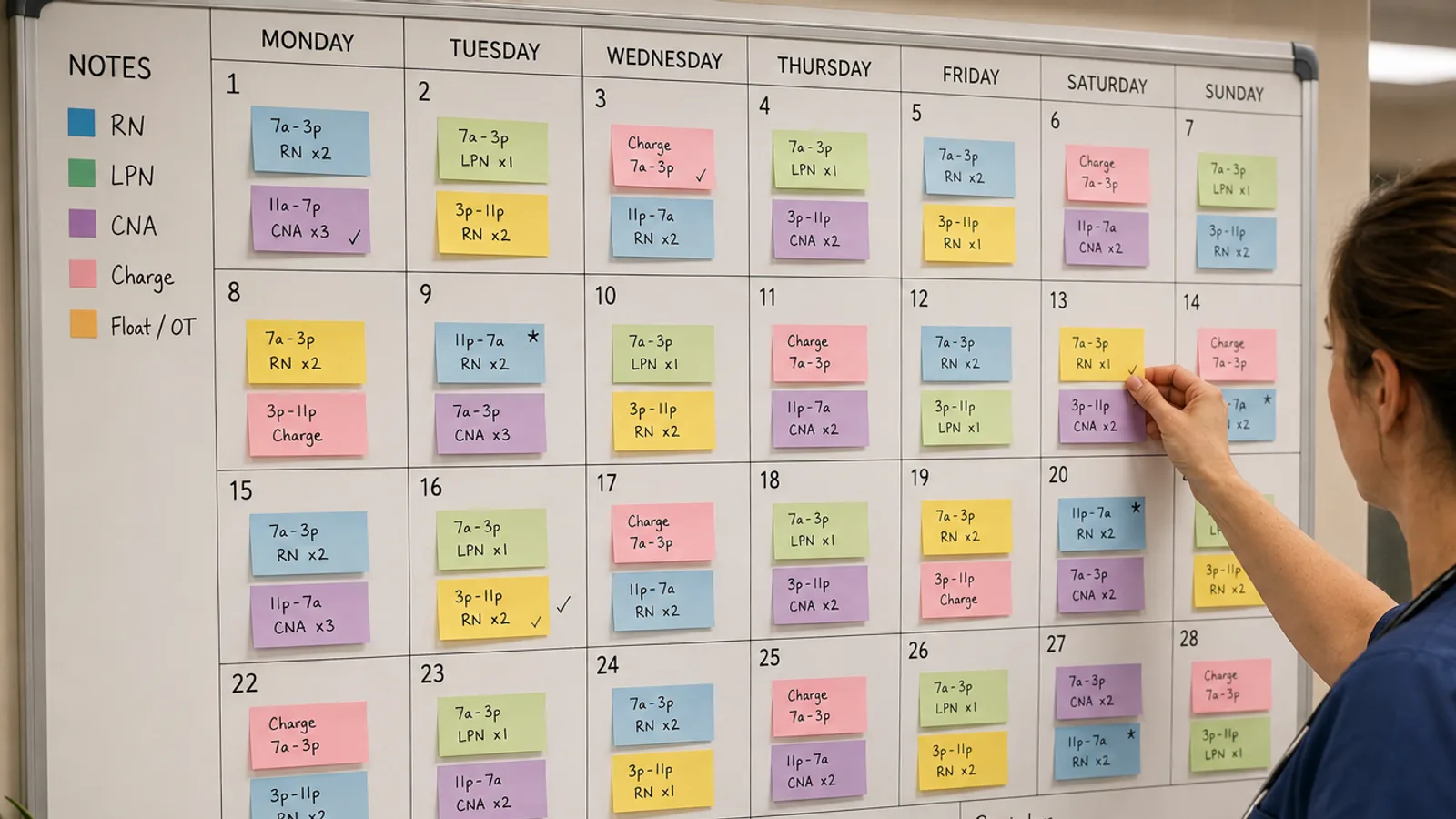
Self-scheduling sounds fair until day shifts fill in the first hour and no one has touched nights or weekends. At a 25-bed Critical Access Hospital, that imbalance compounds every cycle. This guide explains why self-scheduling breaks down at CAH scale and what structural fixes actually hold.

Key Takeaways
- Self-scheduling works when coverage rules are enforced before nurses can claim shifts. Without guardrails, senior or fast-moving nurses claim desirable shifts first.
- The most common breakdown pattern: day shifts fill within the first hour of the scheduling window opening; nights and weekends sit empty for days.
- Three structural fixes prevent selfish scheduling: a simultaneous submission window, a hard floor on undesirable shift load per nurse, and cross-cycle fairness tracking that carries equity metrics forward.
- A 25-bed CAH is too small to absorb sustained inequity. With 15-20 nurses on a unit, two or three consistently over-burdened nurses are a turnover event waiting to happen.
- Fairness-optimized scheduling distributes weekend and holiday load equitably before individual preferences are applied.
Table of Contents
- Why Does Self-Scheduling Break Down at a Critical Access Hospital?
- What Does Selfish Scheduling Actually Look Like?
- How Do You Enforce Fairness in a Self-Scheduling Model?
- What Is a Simultaneous Submission Window?
- How Do You Track Fairness Across Multiple Scheduling Cycles?
- How Does SimpleScheduleAI Address Self-Scheduling Inequity?
- What to Do This Week
- Frequently Asked Questions
Self-scheduling is appealing in theory. Give nurses autonomy over their hours and they will be more engaged, more satisfied, and less likely to leave. That logic has enough truth in it that the model has spread widely in hospital nursing. The problem is that self-scheduling requires structural guardrails that most small hospitals do not have the infrastructure to enforce.
At a large health system with a dedicated scheduling coordinator and a deep bench of staff, the damage from a flawed self-scheduling rollout is contained. At a 25-bed Critical Access Hospital with 15-20 nurses on a unit, the same failure pattern creates a coverage crisis within two cycles.
This guide is about the failure modes and how to fix them. If you are still deciding whether to run self-scheduling at all, the comparison of self-scheduling for nurses against a cyclical rotation works through which model fits a small hospital, and why most end up running a hybrid of the two.
Why Does Self-Scheduling Break Down at a Critical Access Hospital?
Self-scheduling breaks down at a CAH because the shift pool is too small to absorb the natural tendency of nurses to claim the same desirable shifts. When 15 nurses are all avoiding nights and weekends, the gap between what gets chosen and what needs to be covered is structural, not a matter of individual bad behavior. The coverage math does not work.
A 25-bed hospital running 24/7 nursing coverage needs a predictable distribution of day, evening, and night shifts across every week. If the scheduling window opens and 12 out of 15 nurses claim day shifts on weekdays, someone has to cover the rest. At a large hospital, there is a float pool and a coordinator who fills the gaps. At a CAH, the nurse manager fills them manually, often by calling the same nurses who already agreed to take the undesirable shifts last cycle.
Scheduling inequity is a primary driver of charge nurse and staff nurse burnout at small facilities. The mechanism is consistent: reliable nurses say yes more than others, and over time, yes becomes the expectation. Once that expectation is set, the nurses carrying the burden either get used to it or they leave. Whether that churn is best read as a national nurse shortage or a retention problem a small hospital can actually control is the question we take up in is it a nurse shortage or a retention crisis.
1. Window Opens
Fast movers claim all day shifts within the first hour
2. Coverage Gaps Appear
Nights, weekends, and holidays sit empty for days
3. Manager Patches
Calls the same reliable nurses who said yes last time
4. Burnout Builds
Burden concentrates on 2-3 nurses until they stop saying yes
What Does Selfish Scheduling Actually Look Like?
Selfish scheduling appears as three repeating patterns at a CAH: first-mover advantage where fast-acting nurses claim all desirable shifts before slower colleagues can respond, holiday stacking where the same nurses end up on Christmas and Thanksgiving every year because there is no cross-cycle record to enforce rotation, which is what a documented A/B/C holiday rotation exists to prevent, and night-and-weekend avoidance where some nurses claim only day shifts on weekdays cycle after cycle without any minimum floor enforced by policy.
In practice, selfish scheduling is not nurses behaving badly. It is the predictable outcome of a system with no guardrails on what any individual nurse can claim relative to the unit’s coverage needs. A nurse who logs in at 8 AM when the window opens and claims three consecutive day shifts on weekdays is following the rules as written. The problem is that those rules allow the coverage gap her choices create, and the manager absorbs that gap as extra hours, which is exactly the workload trap that makes self-scheduling cost more time than it saves at CAH scale.
Coverage gaps created by the rules appear in three forms:
First-mover advantage. The first nurses to submit preferences claim the best shifts. Late submitters get whatever remains. At a small unit, this consistently advantages senior nurses or nurses who are more attentive to scheduling deadlines, and consistently disadvantages newer staff who may not know the game yet.
Holiday stacking. Nurses remember which holidays they worked last year. With no cross-cycle tracking, there is no way to enforce “you worked Christmas last year so you have it off this year” without the manager reconstructing past schedules from memory. The nurses who advocate loudest for their preferences win. The nurses who say yes lose.
Night and weekend avoidance. With no minimum floor on undesirable shift load, a nurse can theoretically claim only day shifts on weekdays for an entire cycle. At a large hospital, the system rejects this because the shift pool refills from a float. At a 25-bed CAH, one nurse doing this shifts visible burden onto three others, and everyone on the unit knows it.
How Do You Enforce Fairness in a Self-Scheduling Model?
Enforcing fairness in self-scheduling requires three structural rules applied before individual preferences are honored: a simultaneous submission window, a hard minimum on undesirable shift load per nurse per cycle, and a cross-cycle tracking system that carries equity data forward. Without all three, enforcement is inconsistent and the manager absorbs the social cost of every exception.
None of these require software. All of them require consistent enforcement, which is where most manual systems break down. A simultaneous window can be enforced by policy. A minimum floor on night shifts can be written into a scheduling agreement. Cross-cycle tracking can be maintained in a spreadsheet. The question is whether a nurse manager who is also covering clinical shifts has the bandwidth to enforce all three without exception, cycle after cycle, without the system doing it for her.
What Is a Simultaneous Submission Window?
A simultaneous submission window means every nurse submits preferences at the same time, and no one can see what others have submitted until the window closes. The scheduler then assigns shifts based on preferences subject to coverage requirements, not based on who submitted first.
This eliminates first-mover advantage without eliminating nurse input. A nurse who wants every Saturday off submits that preference. If coverage requirements are met, she gets it. If they are not, the scheduler distributes the conflict equitably across all nurses who listed the same preference, rather than defaulting to whoever submitted last.
The practical challenge at a CAH is collection. Simultaneous submission requires a defined window, a consistent submission method, and a manager who can process all inputs at once rather than as they trickle in. With 15-20 nurses submitting via text, email, and paper forms at different times across a week, “simultaneous” becomes aspirational. A structured availability form with a hard deadline and a consistent format is the minimum viable version of this approach, even without any scheduling software.
A related challenge surfaces when hospitals try to use nurse-facing scheduling apps to collect preferences digitally. Multiple Capterra reviewers of NurseGrid Manager describe the loss of manager-side mobile functionality:
“It no longer has the manager app so I have to login to desktop.”
Chief Nursing Officer, Hospital & Health Care, posted June 13, 2024 on Capterra
“they took away the Manager App for your phone.”
Staffing Coordinator, Medical Practice, posted June 11, 2024 on Capterra
For a nurse manager moving between the floor and her office, this kind of mobile-vs-desktop split adds friction to the simultaneous-submission model. CAHs evaluating any nurse-facing app for preference collection should verify current manager-side mobile capabilities directly with the vendor before relying on it.
How Do You Track Fairness Across Multiple Scheduling Cycles?
Tracking fairness across cycles means maintaining a running record of each nurse’s weekend, holiday, and night shift count going back at least 12 months, and using that record to set floors and ceilings for the current cycle before preferences are applied.
Most CAH scheduling systems do not do this. The schedule is built for the current six weeks, approved, and posted. When the next cycle begins, the process restarts without reference to accumulated load. The nurse who worked Thanksgiving and Christmas last year has no documented claim to those days off this year unless the manager remembers, checks old spreadsheets, or the nurse reminds her.
Cross-cycle tracking is the most operationally significant missing piece in self-scheduling at small hospitals. Without it, fairness is negotiated every cycle rather than enforced systematically. The nurses who advocate for themselves get the best outcome. The nurses who absorb the burden get the worst, and eventually stop accepting it.
The data to build this system already exists in every hospital’s timesheets. The barrier is aggregation: pulling that data, organizing it by nurse, and applying it to the next scheduling cycle takes several hours that most scheduling managers do not have between cycles.
| Cycle | Nurse A (says yes) | Nurse B (advocates loudly) |
|---|---|---|
| Cycle 1 | 3 weekends, Thanksgiving | 1 weekend, no holidays |
| Cycle 2 | 3 weekends, Christmas | 1 weekend, no holidays |
| Cycle 3 | 4 weekends, New Year's | 1 weekend, no holidays |
| Outcome | Resignation letter by month 9 | No awareness of the imbalance |
How Does SimpleScheduleAI Address Self-Scheduling Inequity?
SimpleScheduleAI generates three schedule versions each cycle: balanced, overtime-minimized, and fair-rotation. The fair-rotation version distributes weekend and holiday load equitably across the unit based on each nurse’s accumulated load from prior cycles. The manager reviews a fairness score for each version and selects the one that fits the current cycle. The construction is done before any individual preference negotiation begins. See the AI build the three drafts and distribute weekend and holiday load live in the interactive simulator.
One honest limitation: nurses do not submit preferences directly into a self-service portal. The nurse manager collects preferences and inputs them during setup. If nurse self-service portal access is a hard requirement for your unit, a hybrid approach, using a communication tool for preference collection alongside managed scheduling for schedule generation, handles both without losing compliance coverage.
For critical access hospital scheduling at CAH scale, the managed service model addresses the enforcement problem that makes self-scheduling hard to sustain: the fairness rules are applied by the system before the manager reviews the schedule, not after she has already fielded three complaints from staff. For the broader treatment of how AI-built nurse schedules work, see AI nurse scheduling.
For a full look at what CAH-appropriate nurse scheduling software needs to handle beyond fairness, that guide covers the complete feature checklist. For more detail on the three-draft scoring model, see how SimpleScheduleAI works.
One honest limitation: constraint-aware fairness assignment is not the right fit for hospitals with stable senior rosters where weekend and holiday distribution has been worked out informally and is mutually agreed, or for facilities where self-scheduling already produces acceptable fairness without intervention.
Related operational guides: How Small Rural Hospitals Without an IT Department Manage Nurse Scheduling, Hospital Staff Scheduling Software for Critical Access Hospitals, and The $26,000 Scheduling Burden at Critical Access Hospitals.
Our Take
Self-scheduling at a CAH is a fairness problem. When the most reliable nurses are also the ones who fill the open holes voluntarily, self-scheduling quietly punishes them. The fix is not more self-service. The fix is constraint-aware assignment with override, so the system distributes the unwanted shifts evenly before anyone has the chance to avoid them. Selfish scheduling is what happens when the platform optimizes for nurse preference but not for unit fairness.
What to Do This Week
- Map the actual weekend and night-shift distribution from your last 8 weeks. Who is working weekends and how often? Who is consistently avoiding them? If the spread between most-loaded and least-loaded full-time nurse is wider than 2 to 1, self-scheduling is quietly punishing your most reliable staff.
- Set a hard cap on undesirable-shift volume per nurse per cycle. No more than 2 weekend shifts per 14-day period. No more than 4 night shifts per 28-day block. Cap first, then let self-scheduling fill the rest. Caps prevent selfishness; preferences fill the remainder.
- Move weekend and holiday assignment to manager-set rotation, not self-pick. Self-scheduling works for weekday day shifts where preferences vary. It fails for weekends and holidays where most nurses prefer the same outcome. Assign those before opening the rest.
- Audit the cost of self-scheduling silence. Track which nurses absorb voluntary overtime each cycle. They are the retention risk most CAHs lose to burnout, the concentration mechanism we detail in nurse burnout and the CAH schedule. Reliable nurses leaving is more expensive than fairness friction.
- See how SimpleScheduleAI works if you are a Texas Critical Access Hospital. The managed service applies constraint-aware fairness rules before nurses self-pick, so the system distributes the unwanted shifts evenly before anyone has the chance to avoid them. Start at how it works.
End selfish scheduling without losing self-service
SimpleScheduleAI distributes weekends and holidays before nurses self-pick, then opens the rest. Reliable nurses stop carrying the load. Built for Texas CAHs.
See how it works →Frequently Asked Questions
Q: Does self-scheduling work at a Critical Access Hospital?
Self-scheduling can work at a CAH if three structural rules are enforced: a simultaneous submission window, a hard minimum on undesirable shift load per nurse, and cross-cycle fairness tracking. Without all three, the model reliably produces coverage gaps and equity complaints within two or three cycles. Most CAHs lack the administrative bandwidth to enforce all three consistently without dedicated scheduling support.
Q: What is the most common self-scheduling complaint from CAH nurses?
The most common complaint is that the same nurses consistently end up with nights, weekends, and holidays while others claim desirable shifts cycle after cycle. This is not usually intentional rule-breaking. It is the predictable outcome of a system with no guardrails on what any individual nurse can claim relative to the unit’s coverage needs.
Q: How do you handle holiday scheduling fairly at a small hospital?
The most defensible approach is a cross-cycle rotation tracked in writing: who worked which holiday last year, and what the expectation is for the current year. Without that record, holiday fairness is negotiated rather than enforced, and the outcome depends on which nurses advocate hardest. A scheduling system that carries this data forward across cycles removes that negotiation from the manager’s plate.
Q: What is a fairness score in nurse scheduling?
A fairness score measures how equitably undesirable shifts, nights, weekends, and holidays, are distributed across a nursing team relative to each nurse’s FTE and prior cycle load. A schedule with a high fairness score distributes those shifts in proportion to contracted hours and accumulated burden. A low score means a subset of the team is absorbing a disproportionate share, which is a turnover risk at any unit size.
Q: Can you use self-scheduling and a managed service at the same time?
Yes. A hybrid model works: nurses submit preferences through whatever communication channel the unit already uses, and the scheduling service uses those preferences as inputs when generating the schedule. The difference is that preferences are applied subject to fair distribution rules and coverage requirements, not first-come-first-served. The nurse still has input. The manager still approves. The system enforces the rules that manual self-scheduling cannot consistently enforce.
Sources
[1] CMS Conditions of Participation §485.635 for Critical Access Hospitals. eCFR.
[2] FLSA healthcare overtime guidance. U.S. Department of Labor, Fact Sheet #54.
[3] HRSA rural workforce capacity data. data.hrsa.gov/topics/health-workforce/shortage-areas.
[4] Public reviewer quotes gathered from Capterra and AllNurses.com on 2026-04-30.
Methodology note: Vendor offerings, ratings, and product capabilities change over time; CAHs evaluating any specific platform should verify current capabilities directly with the vendor before deciding.
Pradeep Pandey is the co-founder of SimpleScheduleAI. He serves as Deputy General Manager of Operations at Apollo Hospitals and holds an MBA from IIM Trichy (Operations and Marketing). His work focuses on workforce optimization and scheduling operations for small and rural hospitals. LinkedIn →