By Pradeep Pandey · Co-Founder · 17 min read · Updated
The $26,000 Scheduling Burden at Critical Access Hospitals
CAH nurse managers spend 10 hours weekly on manual scheduling, a hidden $26,000 annual cost in misallocated leadership time. Five friction points drive this burden, and each one is measurably reducible.

Key Takeaways
- Manual scheduling costs Critical Access Hospitals approximately $26,000/year in misallocated leadership time (10 hrs/week x $50/hr)
- Last-minute callouts routed through agency staff carry 2-3x rate premiums plus an invisible orientation cost per shift
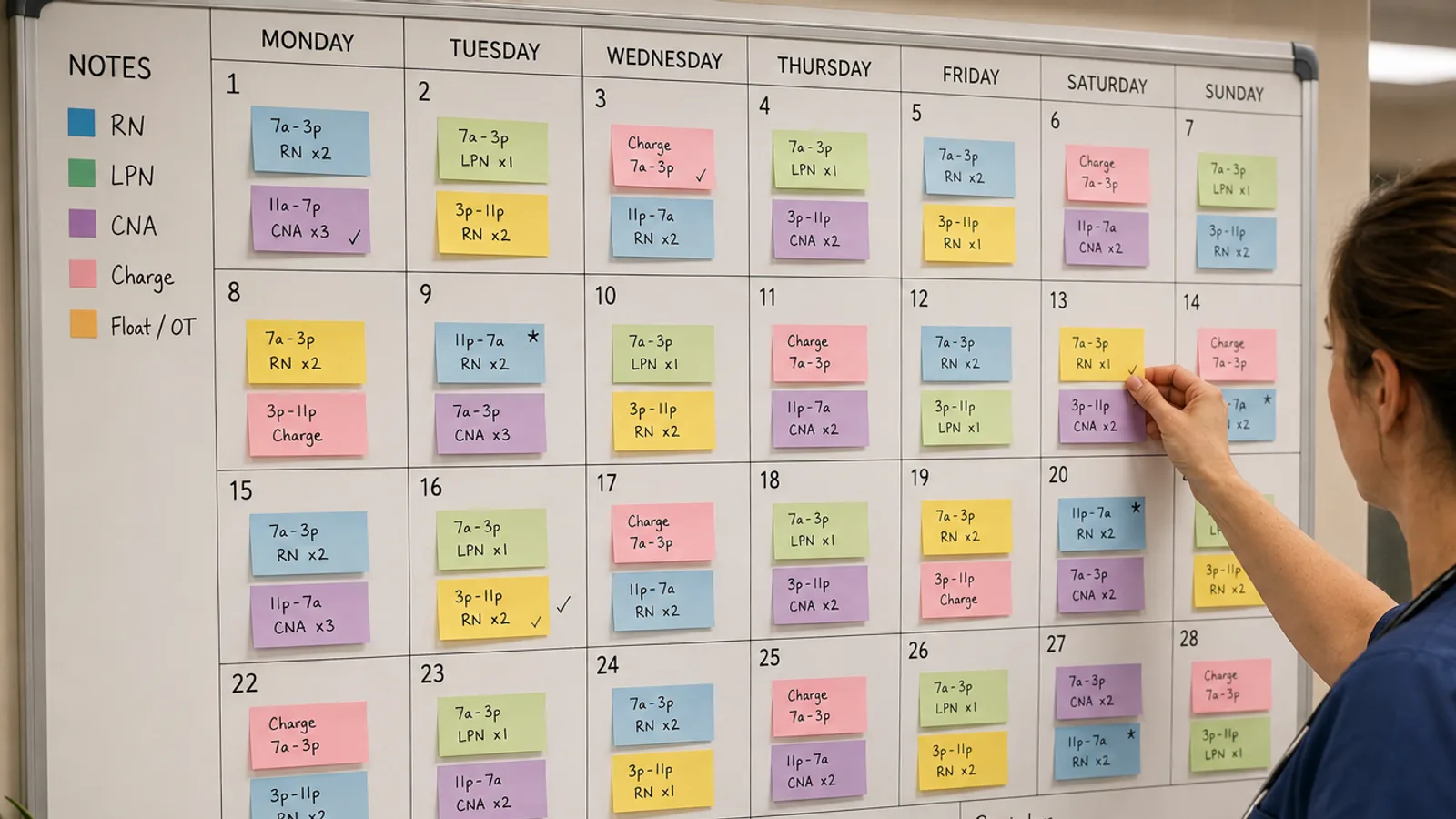
- Version drift across spreadsheets, whiteboards, and portal PDFs leaves a CAH unable to demonstrate that a licensed nurse was on duty as §485.631(a)(5) requires, a gap surveyors can flag
- Reliable nurses absorb disproportionate overtime under manual scheduling, driving turnover that costs $60,090 per RN departure (2026 NSI report)[1]
- PRN availability coordination adds 2+ hours per scheduling cycle, a hidden cost rarely tracked in scheduling budgets
- Fairness tracking and an automated replacement list are the two highest-impact interventions for CAH scheduling operations
Table of Contents
- What Is the Real Cost of Manual Scheduling at a Critical Access Hospital?
- Why Do Last-Minute Callouts Cost So Much More Than the Agency Invoice?
- How Does Spreadsheet-Based Scheduling Create Compliance Risk?
- Why Do Your Most Reliable Nurses Burn Out First?
- What Does PRN Coordination Actually Cost?
- Does Buying Scheduling Software Fix These Problems?
- How Does SimpleScheduleAI Address These Friction Points?
- What to Do This Week
- Frequently Asked Questions
What Is the Real Cost of Manual Scheduling at a Critical Access Hospital?
Manual nurse scheduling costs a Critical Access Hospital approximately $26,000 annually in misallocated leadership time. At a loaded rate of $50/hour for nurse managers and CNOs, 10 hours of weekly scheduling work totals $26,000 per year - time that cannot be redirected toward patient care quality, staff retention, or regulatory compliance.
This figure excludes downstream costs: agency premiums during last-minute callout gaps, overtime accumulated by reliable nurses absorbing excess shifts, and the $60,090 average cost per nurse turnover reported by the 2026 NSI National Health Care Retention Report.
After two months of interviews with 30 nurse managers and schedulers at small Texas healthcare facilities, we identified five recurring friction points that drive this burden. Our nurse manager scheduling time breakdown maps them activity by activity; here is where the 10 hours actually go each week:
- Data entry and version management (3-4 hrs): Copying shift assignments into Excel, updating the unit whiteboard, exporting PDFs for the staff portal.
- Callout coordination (2-3 hrs): Phone calls to find coverage, negotiating with nurses who are already at overtime risk, documenting who declined and why.
- PRN availability reconciliation (1-2 hrs): Collecting per-diem availability submissions by text, email, or paper and manually cross-referencing against open shifts.
- Conflict resolution and edits (1-2 hrs): Handling swap requests, leave approvals, last-minute preference changes, and correcting errors caught by staff.
None of this requires clinical expertise. All of it is being done by your most expensive operational resource.
For a deeper look at the specific compliance and coverage requirements driving these problems, see our guide to critical access hospital scheduling and what purpose-built nurse scheduling software for CAHs actually needs to handle. For the broader treatment of how AI-built nurse schedules work, see AI nurse scheduling.
The $26,000 Shadow Salary: Where the Hours Go
Total: ~10 hrs/week × $50/hr × 52 weeks = $26,000/year
License Cost vs Real Cost: What Buyers Anchor On Versus What They Pay
(per-nurse/month avg)
time on scheduling
(invisible to buyer)
The license-cost number most CAH buyers anchor on ($1,500/yr SaaS license at $2-8 per nurse per month) compared to the actual hidden cost of manual scheduling at a 25-bed CAH ($26,000/yr in nurse-manager time). The 17× gap is the buying decision the prose math hides.
“I spend more time fighting with spreadsheets than I do with my actual nursing team. It’s exhausting.”
Nurse Manager, 25-bed Critical Access Hospital, Texas (from our pre-build research interviews)
Why Do Last-Minute Callouts Cost So Much More Than the Agency Invoice?
Last-minute nurse callouts force a two-to-three hour coordination scramble that almost always ends at agency rates, commonly two to three times the standard hourly wage once premiums and fees are included. For a CAH on Medicare-dependent margins, this premium compounds quickly. But the invoice is only part of the cost: agency staff unfamiliar with your unit’s protocols, EMR workflows, and patient population carry an invisible orientation tax on every shift.
HRSA rural workforce capacity data identifies this orientation gap as a compounding factor in rural hospital quality metrics. The real cost of a callout is not just what you paid. It is the hours spent calling people, the rate premium, and the quality variance you cannot measure on a spreadsheet.
The coordination problem has a structural cause: most CAHs have no ranked shortlist of who to call when a nurse is out. The scheduler works from memory or a flat staff contact list, calling nurses in an ad-hoc order that prioritizes availability over overtime exposure or fairness. By the time someone says yes, the scheduler has already spent 90 minutes on the phone and the replacement nurse may be the worst possible choice from a labor cost standpoint.
How Does Spreadsheet-Based Scheduling Create Compliance Risk?
Version drift (when the unit whiteboard, the Excel master file, and the portal PDF each show a different version of the schedule) creates real survey exposure. The CMS Conditions of Participation for Critical Access Hospitals require a licensed nurse on duty whenever the CAH has inpatients (§485.631(a)(5)), and surveyors verify that against the facility’s actual staffing records. When three versions of the schedule disagree, the CAH cannot demonstrate who was actually on duty. For a full breakdown of what surveyors request, see staying CMS compliant with nurse scheduling.
Manual post-schedule edits also lack audit trails for overtime verification. Under federal FLSA overtime rules for healthcare, overtime applies to healthcare employers (Texas has no separate state overtime statute, so the federal FLSA governs). Documentation gaps leave facilities unable to reconstruct who worked what shift if an audit question arises - an exposure that grows with every undocumented change.
How it happens in practice: A nurse calls out. You update the unit whiteboard. You forget the Excel master. You post a PDF to the portal from an old file. Now you have three conflicting sources of truth and no clear record. For a side-by-side breakdown of where Excel breaks down for CAH scheduling specifically, see nurse scheduling software vs. Excel.
In a CMS survey, a surveyor may request staffing records for any 24-hour period within the prior 12 months. If your whiteboard showed one assignment and your timesheet shows a different nurse covered that shift, you have a documentation gap with no paper trail to explain it. The risk is not theoretical - it is a function of how many manual edits accumulate over a 6-week schedule cycle.
Version Drift: One Schedule, Three Conflicting Sources (Mon Apr 7)
Unit Whiteboard
Nurse A on Day shift
Excel Master File
Nurse B on Day shift
Staff Portal PDF
Nurse A (old version)
CMS Surveyor: Discrepancy Found
Cannot demonstrate §485.631 on-duty coverage
Why Do Your Most Reliable Nurses Burn Out First?
Fair workload distribution is nearly impossible to enforce manually. Managers default to calling the nurses they trust. Those nurses say yes, until they stop. When the same names absorb the callouts and the overtime week after week, the fairness gap widens quietly, and it usually surfaces as a resignation rather than a complaint.
When reliable nurses absorb disproportionate callout coverage and overtime, two things happen: their overtime pay drives up labor costs, and their tolerance erodes. The 2026 NSI report puts average RN turnover cost at $60,090 per departure. For a 25-bed CAH with 15-20 nurses, losing two or three to avoidable burnout is a six-figure operational event. That is the local half of the nurse shortage versus retention debate: the licenses exist nationally, but a rural roster still loses the nurses it already has.
A fairness flag system that tracks callout frequency and overtime distribution per nurse makes this invisible problem visible before it becomes a resignation letter, the same drift that turns nurse self-scheduling into a burden-concentration trap when the sign-up order goes unmanaged. The data to build this system already exists in your timesheets. The problem is that no one is looking at it in aggregate because aggregating it manually takes hours.
What Does PRN Coordination Actually Cost?
PRN coordination adds two or more hours per 6-week scheduling cycle at a typical Critical Access Hospital. At eight to nine cycles per year, that is 16-18 hours annually in untracked leadership time managing per-diem availability submissions by text, voicemail, and paper, then cross-referencing them against open shifts. At a $50 loaded rate, the hidden PRN overhead runs $800-$900 per year on top of the primary scheduling burden, and most scheduling budgets never capture it.
Per-diem nurses are essential to CAH flexibility, but their availability management adds a category of scheduling friction that rarely gets measured. In a typical 6-week scheduling cycle, a CAH scheduler will:
- Collect availability submissions from 3-8 PRN nurses via text, voicemail, or paper form
- Manually cross-reference those submissions against open shifts
- Follow up on gaps where no PRN has indicated availability
- Adjust the primary schedule to account for what PRN coverage is actually available
At two or more hours per cycle across 8-9 cycles per year, PRN coordination alone accounts for 16-18 additional hours of scheduling overhead annually. At a $50/hour loaded rate, that is $800-900 in untracked leadership cost - on top of the $26,000 shadow salary figure.
More importantly, manual PRN availability tracking creates a coverage blind spot. If a scheduler does not have a clear view of who is available on short notice, the default response to a callout is always the phone tree, always the agency call.
Does Buying Scheduling Software Fix These Problems?
Not always. Hospitals that have purchased scheduling software often find that the friction points described above do not disappear. They shift. Configuration burden, software reliability issues, and unresponsive support create a new category of administrative work that sits on top of the original scheduling burden.
Reviewers of major nurse scheduling platforms document the pattern clearly:
“automated scheduling and rules set up seem to have hiccups…I just stopped using the automation.”
Courtney D., Manager of Employee and Physician Relations, May 10, 2024, Capterra (QGenda review)
“It no longer has the manager app so I have to login to desktop.”
Chief Nursing Officer, Hospital & Health Care, June 13, 2024, Capterra (NurseGrid Manager review)
The $26,000 shadow salary does not disappear when you add software to the process. At facilities where the software requires ongoing configuration maintenance, or where the mobile app fails and managers have to work from a desktop while covering clinical shifts, the administrative burden can be comparable to what it was before the software was purchased. The problem is a mismatch between the tools available and the operational reality of a 25-bed rural hospital.
How Does SimpleScheduleAI Address These Friction Points?
SimpleScheduleAI is an AI-native, human-verified scheduling service built for Critical Access Hospitals. You keep your Excel roster; our AI handles the scheduling logic. The AI generates three draft schedule options (balanced, overtime-minimized, and fair-rotation), builds a replacement call list when a nurse is unavailable, and maintains a full audit trail for every schedule change - so you have documentation if a surveyor asks.
SimpleScheduleAI is not a self-serve software tool. A scheduling specialist checks every draft and handles setup and ongoing support, which means there is no learning curve for your team.
One honest limitation: if your facility has highly unusual union rules or a staffing mix we have not calibrated before, the initial setup period may take longer. We surface this during onboarding.
See how the scheduling process works →
Watch the AI build a schedule and generate a callout replacement shortlist in the interactive simulator.
Shadow Salary
$26K
per year in leadership time
Agency Callouts
2-3x
standard hourly rate premium
Version Drift
§485
CMS compliance deficiency risk
Nurse Burnout
$60K
avg cost per RN departure (2026 NSI)
PRN Overhead
16-18
extra hrs/year in availability mgmt
One honest limitation: a managed scheduling service is not the right fit for facilities over 50 beds, hospitals with dedicated scheduling administrators, or facilities where the nurse manager has protected administrative time for scheduling and prefers direct cell-by-cell control.
Sources
[1] NSI Nursing Solutions, 2026 National Health Care Retention & RN Staffing Report (CY2025 data). Per-RN turnover cost figure ($60,090). nsinursingsolutions.com.
[2] HRSA rural workforce capacity data and shortage area framework. data.hrsa.gov/topics/health-workforce/shortage-areas.
[3] CMS Conditions of Participation for Critical Access Hospitals, §485.631 (staff responsibilities, including the on-duty licensed nurse requirement at (a)(5)). cms.gov and eCFR.
[4] FLSA healthcare overtime guidance. U.S. Department of Labor, Fact Sheet #54.
[5] Pre-build CAH nurse-manager research interviews. Internal research conducted by SimpleScheduleAI; cited inline as “from our pre-build research interviews.”
[6] Reviewer quotes referenced in this guide gathered from Capterra and AllNurses.com on 2026-04-30.
Methodology note: Vendor offerings, ratings, and product capabilities change over time; CAHs evaluating any specific platform should verify current capabilities directly with the vendor before deciding.
Our Take
The $26,000 scheduling burden is a labor-allocation problem. CAH nurse managers spend roughly a fifth of their week on tasks that do not require clinical judgment - spreadsheet maintenance, phone-tree callouts, overtime reconciliation, paper documentation. The fix is not a better tool to do the same work faster. The fix is removing the work from the wrong person. Every hour returned to clinical leadership is an hour the hospital does not pay twice.
What to Do This Week
- Time-track every scheduling task for one week. Schedule building, callout phone tree, overtime checking, time-off processing, credential updates, version reconciliation across spreadsheets and whiteboards. Most CAH nurse managers underestimate the total because interruptions are not logged.
- Calculate your shadow administrative salary. Multiply your weekly scheduling hours by your loaded hourly rate, then by 50 weeks. For most CAHs this lands at $22,000 to $30,000 per year. Use the SimpleScheduleAI ROI calculator to model what reducing it returns in dollars and clinical hours.
- Audit which scheduling tasks actually need clinical judgment. Schedule construction, version control, overtime math, and callout documentation are work products. Clinical judgment is who covers a complex patient assignment or who is precepting this week. Most of this time is the former, not the latter.
- Identify your two highest-impact friction points. From the five we outlined (data entry, callout coordination, PRN reconciliation, conflict resolution, compliance documentation), pick the two that consume the most weekly time. Those are the highest-ROI targets for the next 90 days.
- Request a SimpleScheduleAI assessment if you are a Texas Critical Access Hospital. The service removes the friction points without adding software for your team to learn. Start at how it works.
Recover the $26,000 hidden in your schedule
SimpleScheduleAI removes the scheduling work from the wrong person, returning 8 to 10 hours per week to clinical leadership. Flat monthly pricing for Texas CAHs.
See how it works →Frequently Asked Questions
Q: How many hours per week do nurse managers typically spend on scheduling?
Based on interviews with 30+ nurse managers at Texas Critical Access Hospitals, the average is 8-12 hours per week on scheduling-related tasks - data entry, callout coordination, and version reconciliation. At a $50/hour loaded rate, this represents $20,800-$31,200 in annual leadership cost per facility before accounting for agency premiums or overtime.
Q: Does manual scheduling create compliance risk for Critical Access Hospitals?
Yes. CMS Conditions of Participation for CAHs require a licensed nurse on duty whenever inpatients are present (§485.631(a)(5)), and surveyors verify that against actual staffing records. Spreadsheet-based scheduling without an audit trail creates gaps that surveyors can flag, particularly when posted schedules do not match actual shifts worked. An automated system with a full change log addresses this directly.
Q: Why do reliable nurses burn out faster at facilities with manual scheduling?
Manual scheduling defaults to calling the most dependable nurses first. Over time, those nurses accumulate disproportionate overtime and callout coverage, driving voluntary turnover. The 2026 NSI report puts average RN replacement cost at $60,090. Tracking fairness (who is being called and how often) requires data that manual spreadsheets typically do not capture.
Q: What is the “shadow salary” in healthcare scheduling?
The shadow salary is the dollar value of leadership time consumed by scheduling tasks that do not require clinical expertise. A nurse manager spending 10 hours per week on data entry, at $50/hour, represents $26,000 annually - a cost that rarely appears in scheduling budget discussions but is very real.
Q: How does SimpleScheduleAI handle last-minute callouts?
When a nurse is unavailable, the system generates a replacement call list based on availability, overtime exposure, and fairness distribution. This replaces the 2-3 hour manual coordination process with a prioritized list you can act on in minutes.
Pradeep Pandey is the co-founder of SimpleScheduleAI. He serves as Deputy General Manager of Operations at Apollo Hospitals and holds an MBA from IIM Trichy (Operations and Marketing). His work focuses on workforce optimization and scheduling operations for small and rural hospitals. LinkedIn →