By Pradeep Pandey · Co-Founder · 22 min read · Updated
4 Best QGenda Alternatives for Critical Access Hospitals (2026)
The best QGenda alternatives for a 25-bed critical access hospital fit nurse scheduling without a physician-group platform or an IT team. QGenda is built for multi-specialty provider scheduling at health-system scale. This guide compares four options across cost, setup, and small-hospital fit, with honest limitations for each.

QGenda is the dominant physician scheduling platform that has expanded into nursing. For a 25-bed Critical Access Hospital that needs only nursing scheduling, the physician-scheduling overhead is paid complexity that delivers no operational return. SimpleScheduleAI is an AI-native, nursing-only alternative built for Texas Critical Access Hospitals where the nurse manager cannot absorb QGenda’s configuration burden alongside clinical duties.
One routing note before the comparison. QGenda made its name in physician scheduling, and many people searching for QGenda alternatives are replacing it on that side: physician shift and on-call coverage. That lane has its own vendors, led by Lightning Bolt from PerfectServe, Amion from Doximity, and TigerConnect, and its own rules (call fairness, privileges, ED response times), which our guide to physician and medical-staff scheduling at small hospitals lays out. This guide covers the other half of the search. If you are replacing QGenda for nurse scheduling at a small hospital, the four options below were chosen for exactly that job.
This guide compares four QGenda alternatives for a Critical Access Hospital, with the decision tree for when to stay and when the click-heavy configuration is no longer worth the value.
Key Takeaways
- QGenda holds 4.6/5 on G2 (164 reviews) and 4.2/5 on Capterra (68 reviews).[1] It is positioned primarily for physician scheduling at larger health systems and physician group practices.
- The trade-offs CAH demos should probe most carefully on QGenda: setup time, fit at small-hospital scale, and pricing for facilities that only need nursing scheduling.
- The main CAH-appropriate self-serve alternatives include TCP/Aladtec (self-serve, healthcare and EMS focus), ShiftWizard (self-serve, hospital nursing focus), and NurseGrid Manager (nurse-facing, communication layer). A managed service is a fourth option for facilities where the nurse manager cannot sustain platform administration alongside clinical duties.
- For a CAH that needs a self-serve platform built specifically for hospital nurse scheduling, ShiftWizard is the strongest fit. For lower cost with healthcare scheduling depth and faster setup, TCP/Aladtec is the common starting point. For a 25-bed facility where the issue is scheduling labor rather than platform cost or design, SimpleScheduleAI handles the scheduling work rather than providing better tools to do it yourself.
- If the goal is reducing nurse manager burden rather than just replacing the platform, a managed service addresses that more directly than a platform swap.
Table of Contents
- What QGenda Is Built For?
- Why Hospitals Switch Away from QGenda?
- What Does a Critical Access Hospital Actually Need in a QGenda Alternative?
- Quick Comparison: QGenda vs. The Alternatives
- What Are the 4 Best QGenda Alternatives for Hospital Scheduling?
- 1. SimpleScheduleAI
- 2. TCP Scheduling (Aladtec)
- 3. ShiftWizard
- 4. NurseGrid Manager
- When to Stay with QGenda?
- How SimpleScheduleAI Compares to QGenda?
- What to Do This Week
- Frequently Asked Questions
For a 25-bed critical access hospital, the best QGenda alternatives drop physician-group scale and fit nurse scheduling a single nurse manager can run. ShiftWizard is the strongest self-serve hospital-nursing fit, TCP/Aladtec is the lower-cost faster-setup starting point, and SimpleScheduleAI handles the scheduling work as a managed service when platform administration is the real constraint.
QGenda’s customer base skews toward physician group practices and larger health systems. For a 25-bed Critical Access Hospital evaluating it, often because a regional health system extended a contract, the question is whether QGenda’s scale and feature depth fit a facility with one nurse manager and no scheduling coordinator.
What QGenda Is Built For?
QGenda is built for physician scheduling and provider on-call management at larger health systems and multi-specialty group practices. Its core strength is complex scheduling logic across physician specialties, residency programs, and multi-facility on-call networks. The platform’s documented customer base and feature depth reflect enterprise-scale deployment. A 25-bed Critical Access Hospital evaluating QGenda is typically using a fraction of its features while carrying the full implementation complexity and cost.
QGenda’s product page covers provider scheduling, on-call management, credentialing, time tracking, and analytics for healthcare organizations. The platform’s strongest documented use case is multi-specialty physician scheduling and complex on-call management at larger health systems. Reviews from larger-scale customers and reviews from smaller-scale customers describe meaningfully different experiences, which is typical of platforms serving multiple market segments.
A representative positive review:
“Qgenda is easy to use and does a great job at automating.”
Ari W., Administrator (Hospital & Health Care), posted May 7, 2024 on Capterra
Why Hospitals Switch Away from QGenda?
Hospitals switch away from QGenda when the implementation complexity, configuration burden, and pricing exceed what a small facility can justify for nurse scheduling alone. Recurring complaints from smaller-organization reviewers cover initial setup time, friction with automated scheduling rule configuration, and changes in customer support quality after the sales process. For a CAH that primarily needs nurse scheduling rather than physician on-call management, the platform’s feature depth creates overhead without proportional operational value.
QGenda’s overall ratings are strong (4.6/5 on G2, 4.2/5 on Capterra). The minority of negative reviews from smaller-organization users cluster around a handful of themes worth probing during a CAH demo.
Online User Complaints
Setup-Time Complaints. Some reviewers describe initial configuration as time-consuming.
“Doing the initial set up of new providers is a little complicated.”
Brandi D., Scheduling Coordinator (Hospital & Health Care), posted December 13, 2023 on Capterra
“The initial setup was time-consuming…collating…digitize documents.”
Roger S., Practice Administrator, posted May 3, 2024 on Capterra
Automation Configuration Complaints. Some reviewers describe friction when configuring automated scheduling rules.
“automated scheduling and rules set up seem to have hiccups…I just stopped using the automation.”
Courtney D., Manager of Employee and Physician Relations, posted May 10, 2024 on Capterra
Customer Support Complaints. A subset of Capterra reviewers describe support as outsourced.
“They outsourced customer service…you have generic people who respond.”
David S., President (Hospital & Health Care), posted May 7, 2024 on Capterra
For a CAH evaluating QGenda, ask the vendor for the smallest hospital they have implemented in the past 12 months, a reference contact at that facility, and the full implementation cost including configuration services.
What Does a Critical Access Hospital Actually Need in a QGenda Alternative?
A CAH needs five things from a QGenda alternative: nurse-specific credential enforcement that blocks unqualified assignments automatically, proactive FLSA overtime tracking before the schedule publishes, CMS §485.635 compliant audit trail maintained automatically, callout coverage logic that ranks replacements by credential and overtime status, and an implementation timeline measured in days rather than weeks. Most alternatives serve some of these needs. The right choice depends on which gaps are the priority.
For a critical access hospital, scheduling requirements differ from what QGenda is optimized for:
Nurse-specific certification matching. CAH nurses cover multiple unit types with different credential requirements. The system must enforce this without the manager checking each assignment manually.
Proactive FLSA overtime tracking. The 40-hour threshold per workweek (or 80-hour threshold under the 8-and-80 rule) needs to be flagged before the schedule publishes, not after payroll.
CMS §485.635 compliant audit trail. Every schedule change, automatically logged with timestamps, not a feature to configure correctly, but a default.
Callout coverage logic. When a nurse calls out, a ranked replacement list that applies certification, overtime, and fair distribution rules.
Fast implementation. A CAH nurse manager cannot absorb a 4-8 week implementation project. Time to first operational schedule matters.
Quick Comparison: QGenda vs. The Alternatives
| Platform | Best For | Public Ratings | Setup Time |
|---|---|---|---|
| QGenda | Physician scheduling, larger health systems | G2: 4.6/5 (164 reviews) Capterra: 4.2/5 (68 reviews) | 6-12 weeks (typical) |
| TCP (Aladtec) | Public safety, EMS, fire, small healthcare | G2: 4.5/5 (94 reviews) Capterra: 4.6/5 (17 reviews) | 2-4 weeks |
| ShiftWizard | Hospital nursing | G2: 4.3/5 Capterra: 4.4/5 (723 reviews) | 2-4 weeks |
| NurseGrid Manager | Nurse-facing app; staff coordination | Capterra: 4.2/5 (13 reviews; small sample) | Days |
| SimpleScheduleAI | Critical Access Hospitals, Texas | New service; no public reviews yet | 3 to 5 business days |
What Are the 4 Best QGenda Alternatives for Hospital Scheduling?
The four strongest QGenda alternatives for a Critical Access Hospital are SimpleScheduleAI, TCP Scheduling (Aladtec), ShiftWizard, and NurseGrid Manager. SimpleScheduleAI and ShiftWizard address nurse scheduling specifically. Aladtec covers healthcare and public safety scheduling at a lower cost and faster setup than QGenda. NurseGrid serves nurse-facing communication but is not a full scheduling platform replacement. The right fit depends on whether you need better nurse scheduling software or need the scheduling work done for you.
1. SimpleScheduleAI
SimpleScheduleAI is a new service, without public G2 or Capterra reviews yet. It is a managed healthcare staff scheduling service built specifically for Critical Access Hospitals in Texas. Unlike a self-serve platform, SimpleScheduleAI requires no configuration work from the nurse manager: the AI builds draft schedules each cycle, while a specialist handles setup from an Excel roster upload (3 to 5 business days), checks each draft, and maintains the system as the roster changes.
Texas compliance is built in as the default: FLSA overtime thresholds and CMS CoP §485.635 documentation are part of the standard service rather than configuration the nurse manager has to maintain. See the AI build a schedule and the compliance checks run live in the interactive simulator.
Best for: CAHs where the nurse manager is already stretched and cannot absorb another implementation project, or where the core issue is scheduling labor rather than just platform cost.
Key advantages:
- Setup in 3 to 5 business days from Excel roster upload; no IT involvement or implementation project
- CMS §485.635 documentation is automatic, not a configured module the manager maintains
- Callout replacement list is ranked by overtime risk and filtered by unit competency before it reaches the manager
- FLSA overtime threshold tracking and CMS CAH requirements are defaults, not configuration options
- Service maintains scheduling rules as staff and policies change; no manager-side configuration burden
Key limitations:
- Managed service model means the nurse manager receives draft schedules rather than building them directly; less real-time control than QGenda’s self-serve model
- No staff-facing mobile app; if nurse self-service features are a priority, a hybrid approach with a separate communication tool is worth evaluating
- Not designed for physician on-call scheduling, resident scheduling, or the multi-specialty workflows QGenda specializes in
Verdict: The strongest alternative for a CAH where the nurse manager is the only person managing scheduling and cannot sustain a platform configuration burden alongside clinical duties. SimpleScheduleAI eliminates both the implementation and ongoing overhead that makes QGenda difficult to operate at small-hospital scale. See how it works.
Cost: Flat monthly price by roster size: $1,000/month for up to 20 nurses, $1,500/month for 21 to 40 nurses. No per-nurse or setup fees.
2. TCP Scheduling (Aladtec)
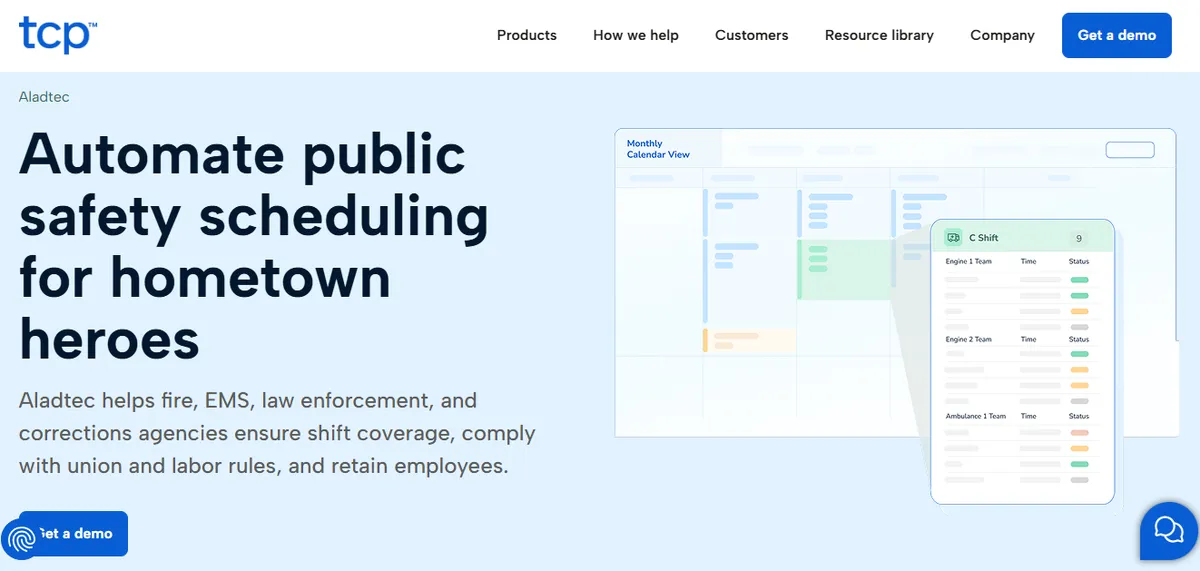
Aladtec by TCP holds 4.5/5 on G2 (94 reviews) and 4.6/5 on Capterra (17 reviews).[2] The platform’s documented customer base skews toward fire, EMS, law enforcement, and security users; its hospital-nursing deployment is a more recent expansion of the original use case (tcpsoftware.com).
For a CAH coming off QGenda, TCP/Aladtec’s pricing tier and faster setup may be a fit. Trade-offs CAH demos should probe:
“When editing the schedule there are a lot of clicks involved.”
Amanda F., Nurse Manager (Hospital & Health Care), posted October 13, 2020 on Capterra
“It was a bit complicated to figure out from the administrator side.”
Jeanne C., Administrative Coordinator, posted May 7, 2019 on Capterra
Ask the vendor for current named support contacts, response-time SLA, and a recent hospital-nursing reference customer at CAH scale.
Best for: CAHs with a scheduling coordinator or administrator who has time to configure and maintain a self-serve system and can absorb 4-6 hours of weekly scheduling administration.
Key advantages:
- Used in CAH and EMS settings; lower cost than QGenda with faster implementation at 2-4 weeks
- Minimal IT involvement for setup and ongoing operation
- Pre-built templates for common small-hospital shift patterns
Key limitations:
Configuration and ongoing maintenance fall to the nurse manager; credentials, overtime thresholds, and shift rules all require manual setup and upkeep
No automatic CMS §485.635 documentation; survey prep remains a manual process
Click-Heavy Workflow. Routine schedule edits require multiple steps.
“When editing the schedule there are a lot of clicks involved.”
Amanda F., Nurse Manager, Hospital & Health Care, October 13, 2020, Capterra
Setup Complexity. Initial configuration takes longer than expected for some administrators.
“It was a bit complicated to figure out from the administrator side.”
Jeanne C., Administrative Coordinator, May 7, 2019, Capterra
Since TCP acquired Aladtec in 2021, request current named support contacts and response-time SLA before committing
Documented customer base skews toward public safety; request a CAH-scale hospital reference before deciding
Verdict: A meaningful cost and complexity reduction from QGenda for CAHs that still want a self-serve platform and have bandwidth for ongoing configuration. Not a reduction in scheduling labor, only in platform cost and setup time.
Cost: Approximately $200-450 per month. Pricing requires a quote.
3. ShiftWizard
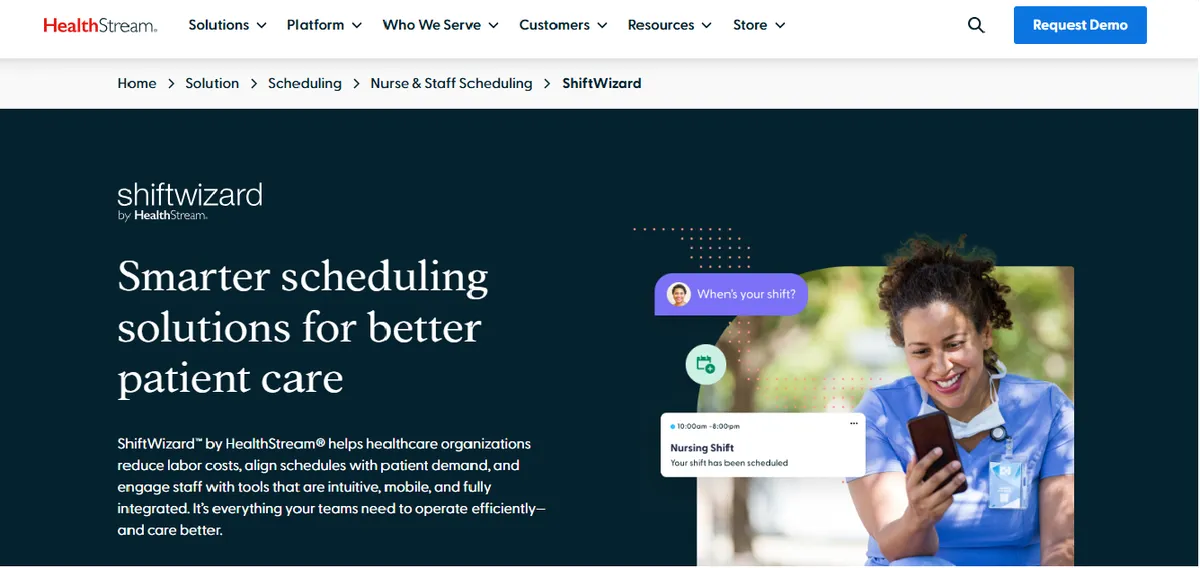
ShiftWizard holds 4.3/5 on G2 and 4.4/5 on Capterra (723 reviews) and was named a G2 Spring 2026 Leader.[3] It is a hospital scheduling platform owned by HealthStream, Inc. (acquired), designed specifically for hospital nursing scheduling and used by more than 500 hospital facilities (healthstream.com).
A representative positive review:
“ShiftWizard was designed by nurses which is why it is fantastic to use.”
Jennifer C., Director of Emergency Services, posted July 15, 2024 on Capterra
For a CAH coming off QGenda specifically because of physician-focus mismatch, ShiftWizard’s nursing-specific design may be a closer fit on workflow. A concern to probe in the demo:
“Can be slow and glitchy, making inputting schedule difficult and stressful.”
Erika A., Registered Nurse, posted July 9, 2024 on Capterra
Ask the demo to walk through mobile workflows from both manager and staff perspectives, and request a CAH-scale reference customer who completed onboarding in the past 12 months.
Best for: CAHs where the primary issue with QGenda is physician-focus mismatch and where a hospital-specific self-serve platform is still the preferred model.
Key advantages:
- Designed specifically for hospital nursing; more relevant out-of-the-box configuration than QGenda for nursing-only CAHs
- Strong reviewer ratings and named G2 Leader; faster implementation than QGenda at 2-4 weeks
Key limitations:
Self-serve model; ongoing configuration maintenance remains the nurse manager’s responsibility
Performance. Some reviewers note lag during active schedule periods.
“Can be slow and glitchy, making inputting schedule difficult and stressful.”
Erika A., Registered Nurse, July 9, 2024, Capterra
Verify with ShiftWizard whether the manager-facing mobile app covers your required department-level visibility; request a CAH-scale reference who uses the shift swap workflow before deciding
Verdict: The best self-serve alternative to QGenda for CAHs that specifically need a nursing-focused platform and prefer direct control. ShiftWizard’s hospital-nursing design is a closer operational fit than QGenda’s physician-scheduling heritage for a 25-bed CAH. See our deeper ShiftWizard alternatives guide for Critical Access Hospitals.
Cost: Pricing not publicly listed. Contact HealthStream for a quote.
4. NurseGrid Manager
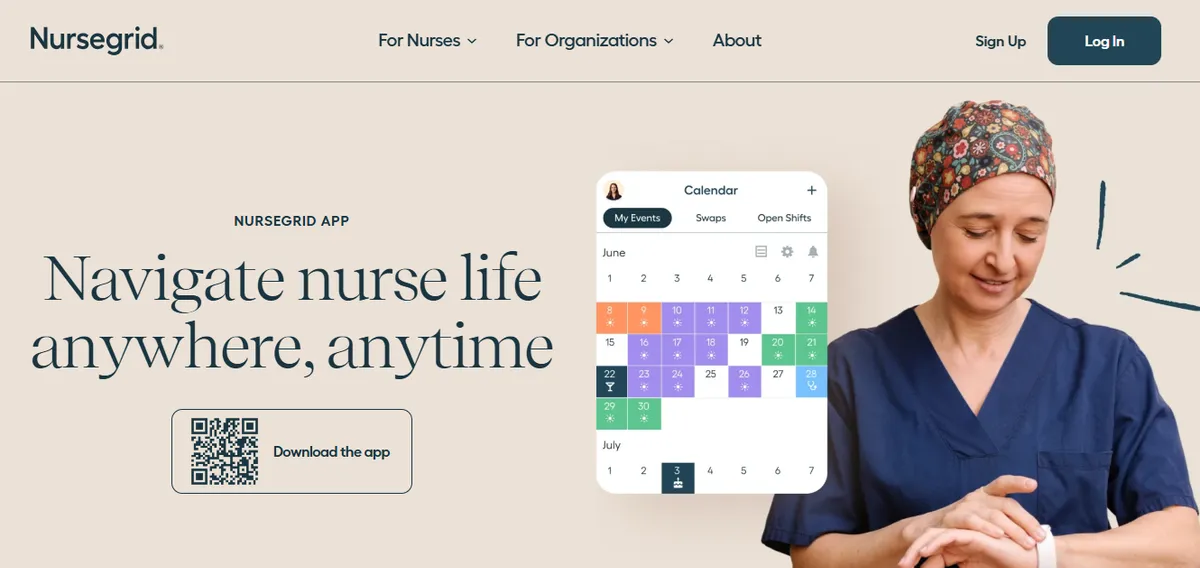
NurseGrid Manager holds 4.2/5 on Capterra (13 reviews; small sample).[4] NurseGrid is built primarily as a nurse-facing app for individual nurses to view schedules, pick up open shifts, and communicate availability (nursegrid.com). The Manager tier extends this with unit-level oversight.
Best for: CAHs discovering they primarily need nurse-facing schedule communication rather than a full scheduling platform, and evaluating QGenda because of physician-scheduling mismatch rather than feature depth.
Key advantages:
- Strong nurse-facing mobile experience; nurses view schedules, mark availability, and request shift trades
- Fast to deploy; most teams are operational within days
- Lower cost than QGenda, Aladtec, or ShiftWizard
Key limitations:
Not a primary scheduling system: NurseGrid does not build schedules, enforce credentials, track overtime, or generate CMS documentation
Manager App Removed. The manager-facing mobile app is no longer available, requiring desktop login for schedule edits (Capterra, June 2024).
“It no longer has the manager app so I have to login to desktop.”
Chief Nursing Officer, Hospital & Health Care, June 13, 2024, Capterra
“they took away the Manager App for your phone.”
Staffing Coordinator, Medical Practice, June 11, 2024, Capterra
For CAHs with active CMS obligations, NurseGrid cannot be the sole scheduling tool
Verdict: Appropriate as a staff communication layer, not as a QGenda replacement for hospitals with active compliance requirements. If the primary unmet need is nurse-facing schedule visibility, NurseGrid is worth evaluating alongside a separate managed service for the compliance layer. See our deeper NurseGrid alternatives guide for Critical Access Hospitals.
Cost: Approximately $150-300 per month. Pricing requires a quote.
When to Stay with QGenda?
Stay with QGenda when your facility has physician scheduling requirements that no nursing-only platform can handle, when the CAH operates under an enterprise health-system contract that covers QGenda at the system level, or when the implementation is fully configured and functioning for your specific workflows. The switching cost is real: new configuration, retraining, and a parallel-run period. If you have not decided yet and are weighing QGenda against ShiftWizard, our three-way comparison of what each one is built for sets them side by side before any switch. If QGenda is working, that cost rarely pays off unless the nurse manager’s scheduling burden is unsustainable.
QGenda is worth keeping in four situations. If any of these describes your hospital, the rest of this guide is not for you.
| If this describes your hospital | Why QGenda is still the right answer |
|---|---|
| You schedule physicians as well as nurses | QGenda’s physician on-call scheduling, resident scheduling and multi-specialty coordination are not matched by any alternative in this guide |
| Your CAH sits under an enterprise health-system QGenda contract | It is already paid for at the system level, so the transition cost may not be justified |
| The implementation is fully configured and working at your scale | The switching cost and retraining burden of a new platform are real, and may exceed the operational improvement |
| You have a dedicated scheduling coordinator | Someone operates the configuration without it landing on the nurse manager, which is the staffing model QGenda’s feature depth was designed for |
How SimpleScheduleAI Compares to QGenda?
| Feature | QGenda | SimpleScheduleAI |
|---|---|---|
| Target scheduling type | Physician + nurse, large systems | Nurse scheduling, CAH-specific |
| Implementation timeline | 6-12 weeks, needs IT | 3 to 5 business days, Excel upload |
| CMS §485.635 documentation | Yes, configured module | Yes, automatic default |
| Callout replacement ranking | Configurable | Built in, competency + OT-ranked |
| Ongoing configuration burden | High, requires dedicated admin | None, service manages |
| FLSA overtime thresholds (Texas) | Configurable | Built in as default |
| Physician scheduling | Yes, core feature | Not included |
| Best fit facility size | 100+ beds, large health systems | Up to 25 beds (CAHs) |
Our Take
QGenda is a strong physician-scheduling platform that has expanded into nursing. For a Critical Access Hospital that needs only nursing scheduling, the physician-scheduling overhead adds cost without proportional value, and the click-heavy configuration described by reviewers compounds at small administrative scale. The right alternative depends on whether the hospital actually needs physician scheduling. If it does, QGenda fits. If it does not, a nursing-focused tool removes the configuration burden the broader platform creates.
What to Do This Week
Know your contract terms. QGenda contracts are typically multi-year enterprise agreements. Understand your renewal date and required notice period before starting any evaluation; the contract clock matters more than the technology evaluation clock.
Export your roster. Get your current staff list, certifications, and scheduling rules in Excel format. This is the starting point for any alternative and a useful audit exercise regardless of whether you switch.
Define the problem you are solving. Is the issue QGenda’s pricing, physician-focus mismatch, implementation complexity, or the self-serve model itself? A platform swap solves pricing and design-fit issues. A managed service solves scheduling labor.
Request a demo of SimpleScheduleAI with your specific QGenda setup as context. Describe what you are using QGenda for at your CAH, what you are not using, and what the nurse manager’s weekly scheduling time looks like. Ask how SimpleScheduleAI would handle the same requirements. Contact via simplescheduleai.com.
If you want to stay on self-serve software, request a ShiftWizard demo and specifically ask for a CAH reference. ShiftWizard is the self-serve alternative with the strongest nursing-specific design. Ask for a current reference customer under 50 beds who completed onboarding within the past 12 months.
Done Paying Enterprise Prices for a System Built for a 500-Bed Hospital?
SimpleScheduleAI is built specifically for critical access hospitals. It onboards in 3 to 5 business days and delivers your first schedule inside two weeks with zero IT involvement. FLSA, Texas Labor Code, and CMS documentation are included by default. Schedule a free assessment to see how the transition works for your facility.
See pricing →For a full breakdown of nurse scheduling software options at the 25-bed CAH scale, and the specific compliance requirements that define critical access hospital scheduling, see our dedicated guides before finalizing your evaluation. For the broader treatment of how AI-built nurse schedules work, see AI nurse scheduling. Related comparison posts: best nurse scheduling software for 2026, Aladtec alternatives for hospitals, Schedule360 alternatives for Critical Access Hospitals, and the $26,000 hidden cost of manual scheduling.
Sources
[1] QGenda ratings: 4.6/5 on G2 (164 reviews), 4.2/5 on Capterra (68 reviews). Vendor page: qgenda.com. Verified 2026-04-30.
[2] TCP / Aladtec ratings: 4.5/5 on G2 (94 reviews), 4.6/5 on Capterra (17 reviews; small sample). Vendor page: tcpsoftware.com. Verified 2026-07-15.
[3] ShiftWizard ratings: 4.3/5 on G2, 4.4/5 on Capterra (723 reviews), G2 Spring 2026 Leader. Vendor: HealthStream. Verified 2026-04-30.
[4] NurseGrid Manager: 4.2/5 on Capterra (13 reviews; small sample). Vendor page: nursegrid.com. Verified 2026-04-30.
[5] QGenda reviewer quotes: Ari W. (Administrator, Hospital & Health Care, May 7, 2024); Brandi D. (Scheduling Coordinator, December 13, 2023); Roger S. (Practice Administrator, May 3, 2024); Courtney D. (Manager of Employee and Physician Relations, May 10, 2024); David S. (President, Hospital & Health Care, May 7, 2024). All Capterra, verified 2026-04-30.
[6] CMS Conditions of Participation §485.635 for Critical Access Hospitals. eCFR.
[7] FLSA healthcare overtime guidance. U.S. Department of Labor, Fact Sheet #54.
Methodology note: Reviewer quotes were cross-checked against AllNurses.com and the iOS App Store on the verification date. Documented product capabilities reference each vendor’s own product page. Vendor offerings, ratings, and product capabilities change over time; CAHs evaluating any specific platform should verify current capabilities directly with the vendor before deciding.
Frequently Asked Questions
What is the best alternative to QGenda?
It depends on which half of QGenda you are replacing. For physician shift and on-call scheduling, the established names are Lightning Bolt from PerfectServe, Amion from Doximity, and TigerConnect. For nurse scheduling at a small hospital, the four options in this guide fit better: SimpleScheduleAI for a service model built for critical access hospitals, TCP Scheduling or ShiftWizard for self-serve platforms, and NurseGrid Manager for a nurse-facing app.
Is QGenda appropriate for a critical access hospital?
QGenda is designed for enterprise health systems and physician scheduling. Its feature set and pricing are built for organizations with 100+ beds, dedicated scheduling administrators, and enterprise IT infrastructure. Most critical access hospitals get limited value from QGenda because they use a fraction of its features while carrying the full complexity and cost.
What complaint themes show up most often in QGenda reviews from smaller-organization users?
QGenda’s overall rating is high (4.6/5 on G2 across 164 reviews; 4.2/5 on Capterra across 68 reviews). Within the minority of negative reviews, recurring themes include initial setup time, friction configuring automated scheduling rules, and changes in customer support quality. See the Online User Complaints section above for verbatim attributed quotes.
How long does it take to switch from QGenda to a simpler scheduling tool?
Switching to another self-serve platform (TCP, ShiftWizard) takes 2-4 weeks for setup plus a transition period running parallel. Switching to a managed service takes 3 to 5 business days for the specialist to onboard from your roster file. Check your QGenda contract terms before initiating any transition.
Does SimpleScheduleAI handle physician scheduling like QGenda does?
No. SimpleScheduleAI is focused on nursing staff scheduling for critical access hospitals. It does not handle physician on-call scheduling, resident scheduling, or the academic scheduling workflows that QGenda specializes in. If you need physician scheduling alongside nurse scheduling, QGenda or a physician-specific platform may still be necessary for that function.
What does it actually cost to run QGenda at a 25-bed hospital vs. a simpler alternative?
QGenda does not publish pricing publicly, but enterprise contracts are typically structured for multi-facility health systems. The total cost of running QGenda at CAH scale includes the contract fee plus IT maintenance cost plus nurse manager time to operate a complex system. A CAH-appropriate alternative, either a simpler self-serve platform or a managed service, typically reduces all three cost components simultaneously.
Pradeep Pandey is the co-founder of SimpleScheduleAI, an AI-native nurse scheduling service for Critical Access Hospitals in Texas. He writes about scheduling operations, CAH compliance, and workforce management for small hospitals.