By Pradeep Pandey · Co-Founder · 20 min read · Updated
What Is ShiftWizard? Overtime, Certifications and Self-Service Reviewed (2026)
ShiftWizard and other hospital scheduling platforms are self-serve software: your team configures the system and your nurse manager operates it weekly. A managed service runs the scheduling function for you. For a Critical Access Hospital with no dedicated scheduling staff, the choice between these two operating models depends on weekly capacity, not feature lists. This guide explains the decision framework.

ShiftWizard demos show a scheduling platform with the features your hospital needs. Your nurse manager asks one question: “After I am trained on this, how many hours a week will I still spend on scheduling?” ShiftWizard answers that question with a self-serve software model. SimpleScheduleAI, an AI-native nurse scheduling service built for Texas Critical Access Hospitals, answers it differently: the AI builds the schedule, our scheduling team checks it, the nurse manager approves it.
This guide compares the two models on the operational dimensions that decide the answer for a 25-bed CAH: weekly time burden, configuration maintenance, callout coverage, FLSA overtime tracking, and CMS §485.635 documentation.
Key Takeaways
- ShiftWizard is a self-serve hospital scheduling platform owned by HealthStream. It holds 4.3/5 on G2 and 4.4/5 on Capterra (723 reviews), with over 88% of Capterra reviews rating 4 stars or higher.
- Self-serve platforms and managed services are not feature-equivalent products at different price points. They are different operating models. The right framing for a CAH evaluation is “what operating model fits my facility?” not “which product is better?”
- Self-serve platforms ask the nurse manager to configure and operate the scheduling system every week. Setup typically runs 2-4 weeks; weekly burden after go-live is typically 4-6 hours.
- Managed services handle configuration and weekly schedule generation through a specialist outside the hospital. The nurse manager reviews and approves. Setup typically runs 3 to 5 business days via Excel upload; weekly burden after go-live is typically 1-2 hours.
- The right choice depends on whether your nurse manager has 4-6 weekly hours of capacity to dedicate to scheduling administration. If she does, a self-serve platform fits. If she does not, the operating model is the actual constraint, not the platform.
Table of Contents
- What Is ShiftWizard?
- What Do ShiftWizard Reviewers Say About the App and Self-Service?
- What Is a Managed Scheduling Service?
- What Are the Five Questions to Ask in Any Hospital Scheduling Demo?
- What Does the Direct Comparison of the Two Operating Models Look Like?
- Where Self-Serve Platforms Fit?
- Where Does a Managed Service Fit?
- Which Model Fits Your Critical Access Hospital?
- How SimpleScheduleAI Fits If You Need the Managed Service Model?
- What to Do This Week
- Frequently Asked Questions
For a Critical Access Hospital nurse manager evaluating hospital scheduling options, the most consequential decision is not which scheduling product to buy. It is which operating model the hospital is signing up for. A self-serve platform like ShiftWizard puts the operational layer on your nurse manager’s calendar. A managed service moves that layer to a specialist outside the hospital. The feature-by-feature comparison matters less than this structural question. This guide covers what ShiftWizard is, how the self-serve model works in practice, and who it fits. If you have already ruled it out and want a shortlist of what else a small hospital can move to, our guide to ShiftWizard alternatives for Critical Access Hospitals does that job.
What Is ShiftWizard?
ShiftWizard is a self-serve hospital scheduling platform owned by HealthStream, designed specifically for nursing workflows. It holds 4.3/5 on G2 and 4.4/5 on Capterra across 723 reviews. The defining characteristic from an operating model perspective: the nurse manager or a designated scheduler configures the system, builds every schedule, and operates the platform week to week. ShiftWizard provides the tools; the hospital provides the labor to use them.
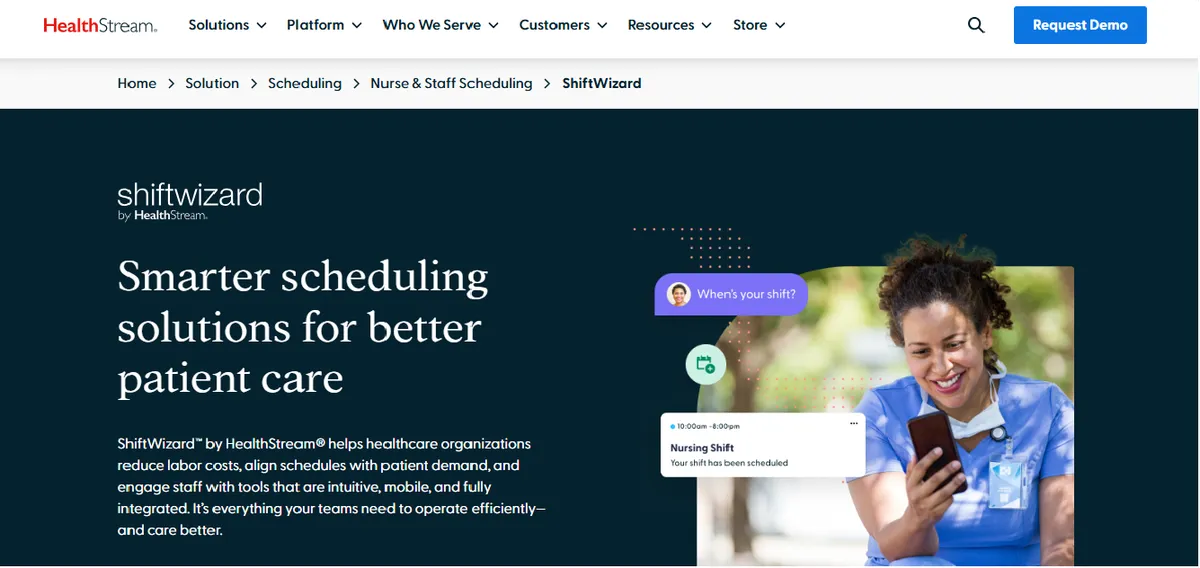
ShiftWizard is a self-serve hospital scheduling platform owned by HealthStream, Inc. It holds 4.3/5 on G2 and 4.4/5 on Capterra (723 reviews), with over 88% of Capterra reviews rating 4 stars or higher. G2’s overall summary describes ShiftWizard as a tool users praise for ease of use and intuitive scheduling, and ShiftWizard has been named a G2 Spring 2026 Leader.
ShiftWizard is built for hospital scheduling and covers shift assignment, self-scheduling, shift swaps, manager and staff mobile apps, credential management, overtime tracking, and onboarding support (healthstream.com).
The defining characteristic of the platform from an operating-model standpoint: it is self-serve. The vendor provides software, training, and onboarding support; your team configures the system, builds schedules, and operates the platform week to week. The schedule does not generate itself; the nurse manager (or a scheduling coordinator at facilities that have one) is the operator.
What Do ShiftWizard Reviewers Say About the App and Self-Service?
Capterra lists ShiftWizard at 4.4 out of 5 across 723 reviews, on a page last updated 20 August 2026 and checked on 5 September 2026. The quotes below are verbatim from that listing, with the reviewer name, role and date as Capterra shows them. Both the praise and the complaints are included.
The design itself gets credit, including the mobile app:
“ShiftWizard was designed by nurses which is why it is fantastic to use for Hospital/clinic use! The mobile app is fantastic, contacting employees with open shifts etc and communication is on point!”
Jennifer C., Director of Emergency Services, July 15, 2024, Capterra
The complaints in the same listing cluster on speed, login and the app:
“I wish the messaging was better, and that I have to input my info every time I log in.”
Melissa R., LVN, July 26, 2024, Capterra
“Can be slow and glitchy, making inputting schedule difficult and stressful”
Erika A., Registered Nurse, July 9, 2024, Capterra
“Everything is slow and difficult to use. The app does not work well. The website is slow and takes forever to click on any options. Everything about it is a negative experience.”
Jacob G., Registered Nurse, July 18, 2024, Capterra
A second cluster is configuration, which is the work the self-serve model leaves with the hospital:
“We do not like when we have to put in a new shift type that it comes across as a code VS the shift type.”
Amanda M., Quality Assurance Process improvement Manager, July 15, 2024, Capterra
“Not being able to sign up for 4 hour increment shifts.”
Michalina W., RN, August 13, 2024, Capterra
On time to get running, G2 lists ShiftWizard’s average time to implement as 3 months, averaged from its own reviewers. That figure times a hospital buying the software, configuring it and then running it. It also runs longer than the two to four week range this guide uses for self-serve platforms in general, so for ShiftWizard specifically the reviewer-reported figure is the one to plan around. A service that configures the schedule for a hospital which runs nothing afterwards delivers a first schedule inside two weeks. The gap is the delivery model rather than the same job done faster.
What Is a Managed Scheduling Service?
A managed scheduling service builds schedules for the hospital rather than giving the hospital tools to build them. The vendor’s specialist team handles configuration, weekly schedule generation, and ongoing system maintenance. The nurse manager reviews delivered drafts and approves them. Her role shifts from builder to reviewer, and the weekly scheduling time drops from 4-6 hours to 1-2 hours for approval decisions only.
A managed scheduling service is a different category of product. Instead of providing a platform your team operates, the service provides outcomes: a delivered schedule, on a cadence, configured to your facility’s rules.
The structural difference: with a platform, your team uses tools to do the scheduling work. With a managed service, an external specialist team does the scheduling work and your nurse manager reviews their output. The platform-vs-service distinction is not about pricing tier or feature depth; it is about which side of the hospital boundary the operational work happens on.
The nurse manager retains final authority over every scheduling decision in either model. The difference is whether she is building or reviewing.
What Are the Five Questions to Ask in Any Hospital Scheduling Demo?
Five questions reveal operational fit in any hospital scheduling demo faster than feature walkthroughs: typical setup time for a 25-bed hospital without IT support, weekly nurse manager hours after go-live, how the CMS §485.635 audit trail export looks, what the manager can and cannot do from the mobile app, and the exact callout workflow step by step at 5am. The answers expose operating model constraints that vendor feature pages do not mention.
These questions surface operational fit faster than feature checklists do. Use them in any demo, whether the vendor is selling a self-serve platform or a managed service.
"What is your typical setup timeline for a 25-bed hospital with limited IT? Show me a sample onboarding schedule."
"How many hours per week does the nurse manager spend on this platform after go-live? Reference customer at our scale, please."
"Show me the audit-trail export for CMS §485.635. Show me the [FLSA](https://www.dol.gov/agencies/whd/fact-sheets/54-healthcare-overtime) 8-and-80 overtime rule configuration."
"Walk me through what a nurse manager can and cannot do from the mobile app, with both manager and staff perspectives shown."
"A nurse calls out at 5am Sunday. Show me the exact workflow the nurse manager uses to find a qualified, non-overtime replacement."
The answers to these five questions, not the feature pages, determine operational fit at CAH scale.
What Does the Direct Comparison of the Two Operating Models Look Like?
The two operating models differ on who configures the system, who builds each schedule, who handles callouts, setup timeline, weekly nurse manager burden, whether a staff-facing mobile app exists, and how much direct control the nurse manager retains. Self-serve platforms deliver full control with 4-6 weekly hours of construction work. Managed services deliver 1-2 hours of review time per week and delegate construction to a specialist outside the hospital.
| Dimension | Self-Serve Platform (e.g. ShiftWizard) | Managed Service |
|---|---|---|
| Who configures the system | Hospital team, with vendor onboarding support | Service specialist, from Excel roster upload |
| Who builds each schedule | Nurse manager, in the platform | Service specialist, delivered for review |
| Who handles a callout | Nurse manager, using platform tools | Service delivers ranked shortlist; nurse manager calls |
| Typical setup time | 2-4 weeks | 3 to 5 business days |
| Weekly nurse manager burden | ~4-6 hours | ~1-2 hours |
| Staff-facing mobile app | Yes (varies by platform) | Varies by service; SimpleScheduleAI does not have one |
| Direct platform control | Full | Approval authority retained; configuration delegated |
These are typical numbers across the two operating models. Specific products vary. The decision is which row matters most for your facility.
Where Self-Serve Platforms Fit?
Self-serve platforms fit when the hospital has a designated scheduling coordinator whose primary role includes scheduling administration, when direct real-time control over individual assignments matters operationally, when staff-facing mobile features for shift trading and availability submission are a hard requirement, and when the hospital prefers operational self-sufficiency over a service dependency. If all four conditions apply, a platform like ShiftWizard, Aladtec, or QGenda is the right evaluation category, and our QGenda and ShiftWizard comparison covers how those two differ from each other.
Self-serve platforms are the right model when:
- Your facility has a designated scheduling coordinator. Someone whose job description includes scheduling administration as a primary responsibility, not the nurse manager fitting it in between clinical shifts.
- Direct platform control matters operationally. If your facility’s scheduling logic involves enough variability that a specialist building from a stable rule set would not capture it, hands-on configuration matters.
- Staff-facing mobile features are a hard requirement. Most self-serve platforms include a staff-facing mobile app for nurses to view schedules and request swaps. Most managed services do not.
- You prefer operational self-sufficiency over service dependency. With a platform, you own the operational process. With a managed service, you depend on the service relationship for ongoing delivery.
When these conditions hold, a self-serve platform like ShiftWizard, TCP/Aladtec, or QGenda is worth comparing on operational fit using the five demo questions above.
Where Does a Managed Service Fit?
A managed scheduling service fits when the nurse manager is also a clinical provider and cannot protect 4-6 weekly hours for scheduling construction, when the hospital has limited IT capacity for implementation or maintenance, when time to first operational schedule matters more than staff self-service features, and when CMS compliance documentation is currently assembled manually before each survey. If any of these apply, the operating model is the actual constraint, not the platform.
A managed service is the right model when:
- Your nurse manager is also a charge nurse, department head, or other clinical role. Time on the floor cannot be substituted with platform time; the scheduling work needs to come off her calendar entirely, not be made faster.
- Your facility has no dedicated IT capacity. Implementation that assumes IT support, for integrations, configuration, or troubleshooting, fails at facilities where the IT person is one part-time role.
- Time-to-operational matters more than mobile self-service. When a current scheduling situation is unsustainable, a 3-5 day setup timeline matters more than a staff app that the previous platform also had.
- Compliance documentation is a survey-relevant concern. Managed services typically deliver auto-logged audit trails for CMS §485.635 as part of the service, rather than requiring the nurse manager to maintain documentation through configuration.
Which Model Fits Your Critical Access Hospital?
The model that fits depends on two variables: whether the nurse manager has 4-6 protected weekly hours for scheduling administration, and whether staff-facing mobile self-service is a hard requirement. If she has the time and mobile features matter, a self-serve platform fits. If she does not have the time, the operating model is the binding constraint and a managed service is the better fit regardless of feature comparison.
The decision tree:
- Does your nurse manager have 4-6 weekly hours of dedicated time for scheduling administration after go-live? If yes, evaluate self-serve platforms. If no, the operating model is the actual constraint.
- Is staff-facing mobile self-service (shift trades, schedule viewing on phones) a hard requirement for your facility’s culture? If yes, a self-serve platform is the cleaner fit.
- Is implementation timeline urgent (current situation unsustainable in next 4 weeks)? If yes, a managed service is the faster path.
- Does your facility have any IT capacity for implementation? If no, a managed service avoids the dependency.
The honest answer for many CAHs is “items 1, 3, and 4 favor a managed service; item 2 favors a platform.” When this is the breakdown, a hybrid architecture (managed service for scheduling plus a separate communication tool for staff-facing features) can work.
How SimpleScheduleAI Fits If You Need the Managed Service Model?
SimpleScheduleAI is an AI-native nurse scheduling service built for Critical Access Hospitals in Texas where the nurse manager takes clinical shifts and cannot sustain weekly scheduling construction. Setup takes 3 to 5 business days from an Excel roster upload. CMS §485.635 documentation is automatic. Callout replacement lists are pre-ranked by skill match and overtime status. The AI builds the schedule and our scheduling team checks it, so the nurse manager approves rather than builds. There is no staff-facing mobile app. See the AI build a schedule and rank callout replacements in the live simulator.
SimpleScheduleAI is an AI-native nurse scheduling service for Critical Access Hospitals in Texas. We are not a self-serve scheduling platform; we are not positioned as a head-to-head replacement for ShiftWizard.
SimpleScheduleAI is a new service, without public G2 or Capterra reviews yet. What we offer instead:
- Evaluation on real delivered schedules, not demos. We build a real schedule against your roster so you judge the output, not a sales pitch.
- Founder-led service. Pradeep Pandey, founder, has direct operations experience at Apollo Hospitals (Deputy GM, Operations) and an MBA from IIM Trichy. Service decisions go through him, not through a tier-3 support queue.
- CAH-specific design. Excel roster onboarding, no IT integration required, 3-5 day go-live, FLSA overtime compliance built in, CMS §485.635 audit trail logged automatically.
SimpleScheduleAI is the right choice for a CAH where the nurse manager has concluded that the self-serve scheduling model takes more weekly time than her role can absorb, and where seeing a real schedule built on her own roster matters more than aggregate vendor reviews.
It is not the right choice if staff-facing self-service mobile features are a hard requirement; we currently focus on the manager-facing scheduling workflow and do not have a staff-facing app. For more on the operating model, see how SimpleScheduleAI works, our nurse scheduling software hub, and the compliance requirements that shape critical access hospital scheduling. For the broader treatment of how AI-built nurse schedules work, see AI nurse scheduling.
Sources
[1] ShiftWizard ratings and reviewer quotes: 4.4/5 on Capterra across 723 reviews, page last updated 20 August 2026, quotes re-verified verbatim 2026-09-05. capterra.com. G2: 4.3/5 across 405 reviews and a 3-month average time to implement, founder page-verified 2026-08-14. Vendor: HealthStream, Inc..
[2] CMS Conditions of Participation §485.635 for Critical Access Hospitals. eCFR, Title 42, Part 485, Subpart F.
[3] FLSA healthcare overtime guidance. U.S. Department of Labor, Wage and Hour Division, Fact Sheet #54.
Methodology note: ShiftWizard reviewer quotes referenced in this comparison were cross-checked on G2, Capterra, AllNurses.com, Reddit (r/nursing), the iOS App Store, Google Play, GetApp, and SoftwareAdvice on the original verification date, 2026-04-30, and re-verified on Capterra on 2026-09-05. Documented product capabilities reference each vendor’s own product page on that date. Vendor offerings, ratings, and product capabilities change over time; CAHs evaluating any specific platform should verify current capabilities directly with the vendor before deciding.
Our Take
ShiftWizard and a managed scheduling service answer different questions. ShiftWizard answers "how does the hospital build better schedules with a hospital-nursing tool?" - a real question for hospitals that can sustain a scheduling administrator. A managed service answers "how does the nurse manager stop being the scheduling administrator?" For a 25-bed Critical Access Hospital where the manager also covers clinical shifts, the second question is usually the one that decides the purchase.
What to Do This Week
- Time-track your nurse manager’s ShiftWizard hours for one cycle. Schedule build, configuration edits, credential updates, callout coverage, and FLSA threshold checks. Compare the total to the 1 to 2 hours per week a managed service requires. The gap is the recovered-time number for an ROI calculation.
- Audit which ShiftWizard configurations have drifted. Credential expiration dates current for all staff? Minimum staffing rules reflect current per-diem and float policies? Overtime thresholds match your FLSA model? Configuration drift is the silent failure mode of any self-serve hospital scheduling platform.
- Calculate total cost of ownership, not just license fee. Subscription plus implementation labor plus ongoing maintenance labor plus the nurse manager’s weekly scheduling hours at her loaded rate. Use the SimpleScheduleAI ROI calculator to compare the two models on dollar value.
- Identify whether your nurse manager would rather operate a tool or approve a finished schedule. ShiftWizard is the right answer for managers who want direct control of every cell. A managed service is the right answer for managers who want the construction work removed. Neither is universally better; the fit depends on the manager’s preference and available time.
- See how SimpleScheduleAI works if you are a Texas Critical Access Hospital. The managed service delivers the scheduling outputs ShiftWizard was purchased to enable, without the configuration maintenance burden. Start at how it works.
ShiftWizard configuration without ShiftWizard configuration
SimpleScheduleAI provides ShiftWizard-grade compliance and fairness logic without requiring the nurse manager to maintain the system.
See how it works →Frequently Asked Questions
Does ShiftWizard work for a 25-bed Critical Access Hospital?
ShiftWizard’s healthcare-specific design makes it more appropriate for hospitals than generic workforce-management tools. The fit at CAH scale is an operational question rather than a product question: ask the vendor for reference customers at 25-bed scale who completed onboarding in the past 12 months, and use the five demo questions above to evaluate whether the operating model fits your facility’s capacity.
What happens when a nurse calls out at 5am with each model?
With a self-serve platform, the nurse manager opens the platform, checks current hours and availability, verifies certifications, and makes calls. With a managed service like SimpleScheduleAI, you log the callout with us and the system generates the top 3 replacement candidates with reasons, ranked by skill match, competency for the unit, charge coverage, and overtime risk, checked by our scheduling team. You pick, we update the schedule and send the corrected copy. Ask both vendors to demo this exact workflow.
Is SimpleScheduleAI cheaper than ShiftWizard?
ShiftWizard is quote-based and does not publish list pricing. SimpleScheduleAI publishes its price: a flat monthly price by roster size, $1,000/month for up to 20 nurses and $1,500/month for 21 to 40 nurses, with no per-nurse fees and no setup fees. The relevant comparison is still total cost of ownership, meaning software cost plus the nurse manager’s operating time. A service bundles both into one fee; a platform separates them.
Can I use both ShiftWizard for staff communication and SimpleScheduleAI for scheduling?
This hybrid is technically possible but creates two systems of record for schedule data, which adds coordination overhead. A simpler architecture for facilities that want both staff-facing mobile features and managed scheduling is to use a separate communication tool (group messaging, internal portal) alongside the managed service, rather than running two scheduling systems in parallel.
What is the biggest risk with the self-serve model at a small hospital?
Setup configuration that drifts out of date. Self-serve platforms work as well as the rules configured in them; if a regulatory rule changes or a unit-specific scheduling pattern shifts, the configuration needs maintenance. At facilities with no dedicated scheduling administrator, that maintenance work tends to slip, and the platform produces increasingly inaccurate output until someone catches it.
See how the managed service model works in practice →
Pradeep Pandey is the co-founder of SimpleScheduleAI. He serves as Deputy General Manager of Operations at Apollo Hospitals and holds an MBA from IIM Trichy (Operations and Marketing). His work focuses on workforce optimization and scheduling operations for Critical Access Hospitals and other small rural facilities. LinkedIn →