By Pradeep Pandey · Co-Founder · 15 min read · Updated
How to Handle Nurse Callouts at a Critical Access Hospital
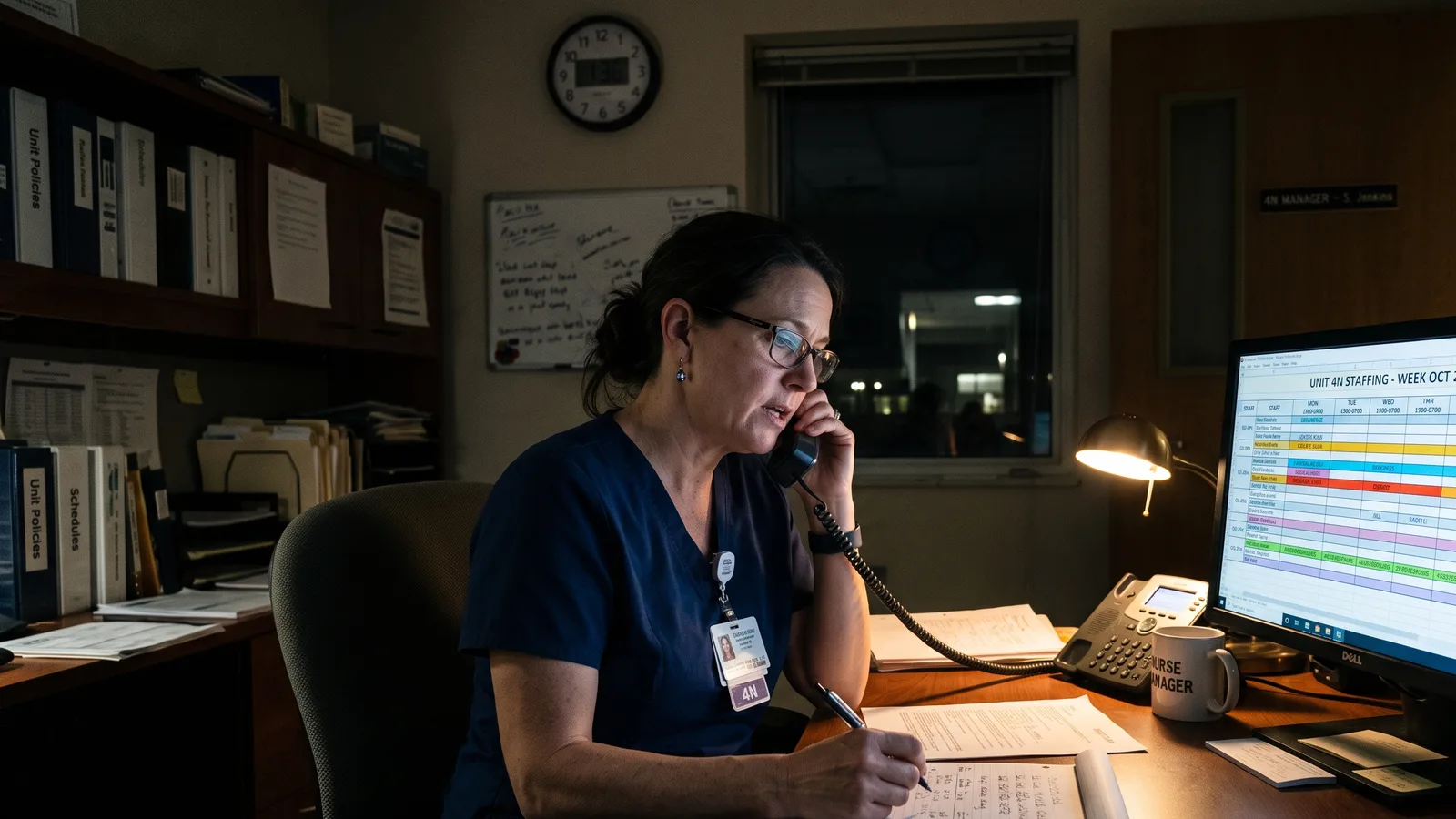
A callout at a small rural hospital lands on a bench of four to six people and a manager who may be taking the call at 2 AM. This guide gives you the policy, the ranked call list, and the documentation habit, plus the Texas overtime statute most callout guides miss.
Key Takeaways
- Callout handling at a small hospital is a process problem before it is a staffing problem. The same thin roster feels like a crisis or a checklist depending on whether the call order was decided before the phone rang
- The most expensive callout mistake is calling the wrong nurse first: someone already near the applicable FLSA overtime threshold, or someone without the credentials the shift requires. A ranked call list prevents both
- In Texas, mandatory overtime is not a lawful fallback. Texas Health and Safety Code Chapter 258 prohibits requiring a nurse to work beyond scheduled hours, with four narrow emergency exceptions
- Every callout event needs a written trail: who called out, when, who was contacted in what order, and who covered. That record is what stands up in a CMS survey or a wage dispute
- A ranked callout list is a one-page tool any unit can build in Excel this week. Some scheduling systems maintain it automatically; the ranking logic is the same either way
Table of Contents
- Why Is Nurse Callout Coverage a Process Problem?
- What Should a Nurse Callout Policy Put in Writing?
- How Do You Build a Ranked Callout List?
- What Does the Callout Coverage Workflow Look Like?
- How Do You Document a Callout Event?
- What Should You Do When You Cannot Fill the Shift?
- How Do You Reduce Callout Frequency Over Time?
- How Does SimpleScheduleAI Help With Callouts?
- What to Do This Week
- Frequently Asked Questions
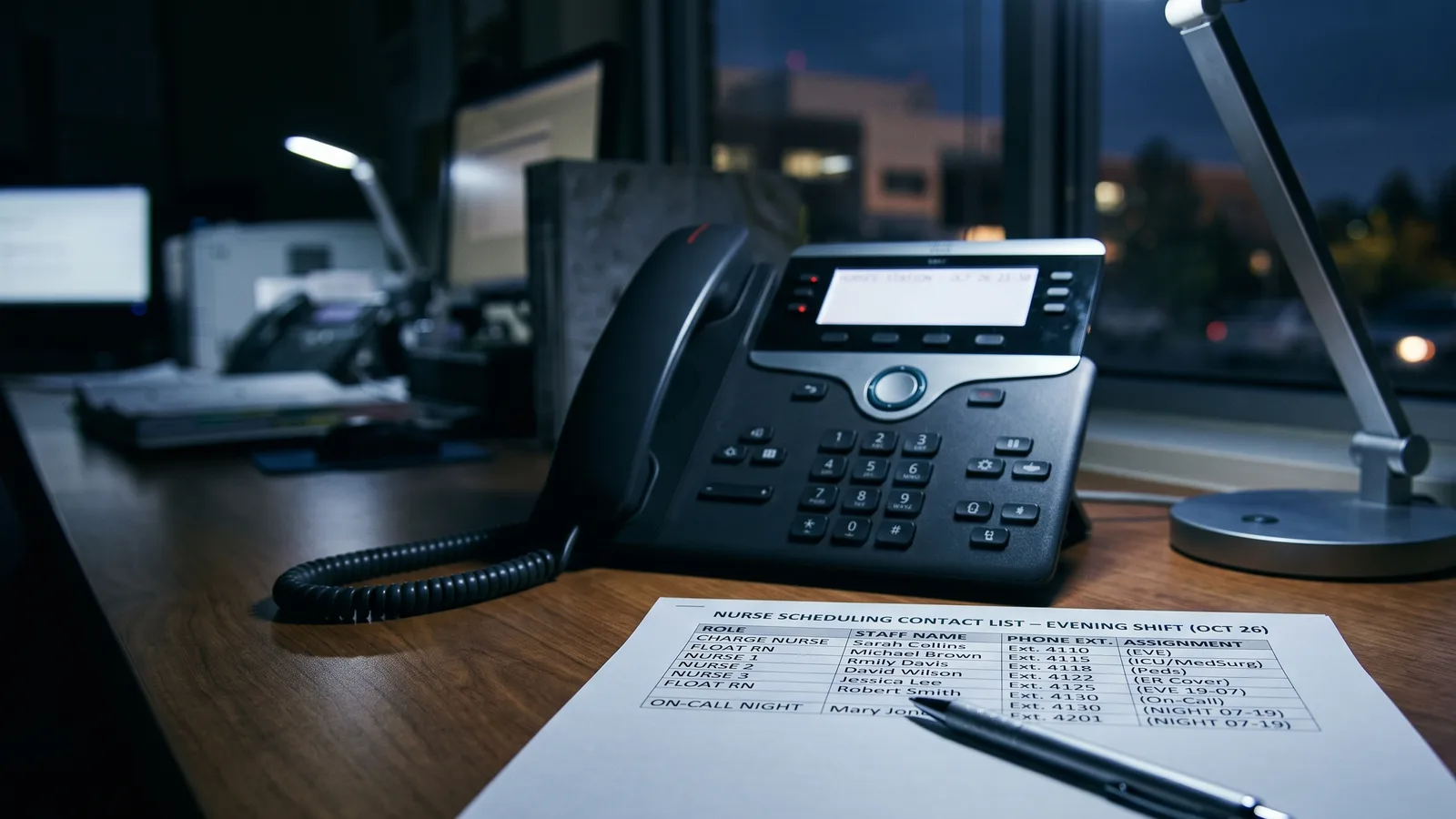
A nurse calls out at 10 PM for a 7 AM shift. At a large hospital, that triggers a float pool request, and someone from the pool fills the gap. At a 25-bed critical access hospital with no float pool, it triggers a phone tree of four to six people, each of whom may or may not be available, qualified, and safely below an overtime threshold.
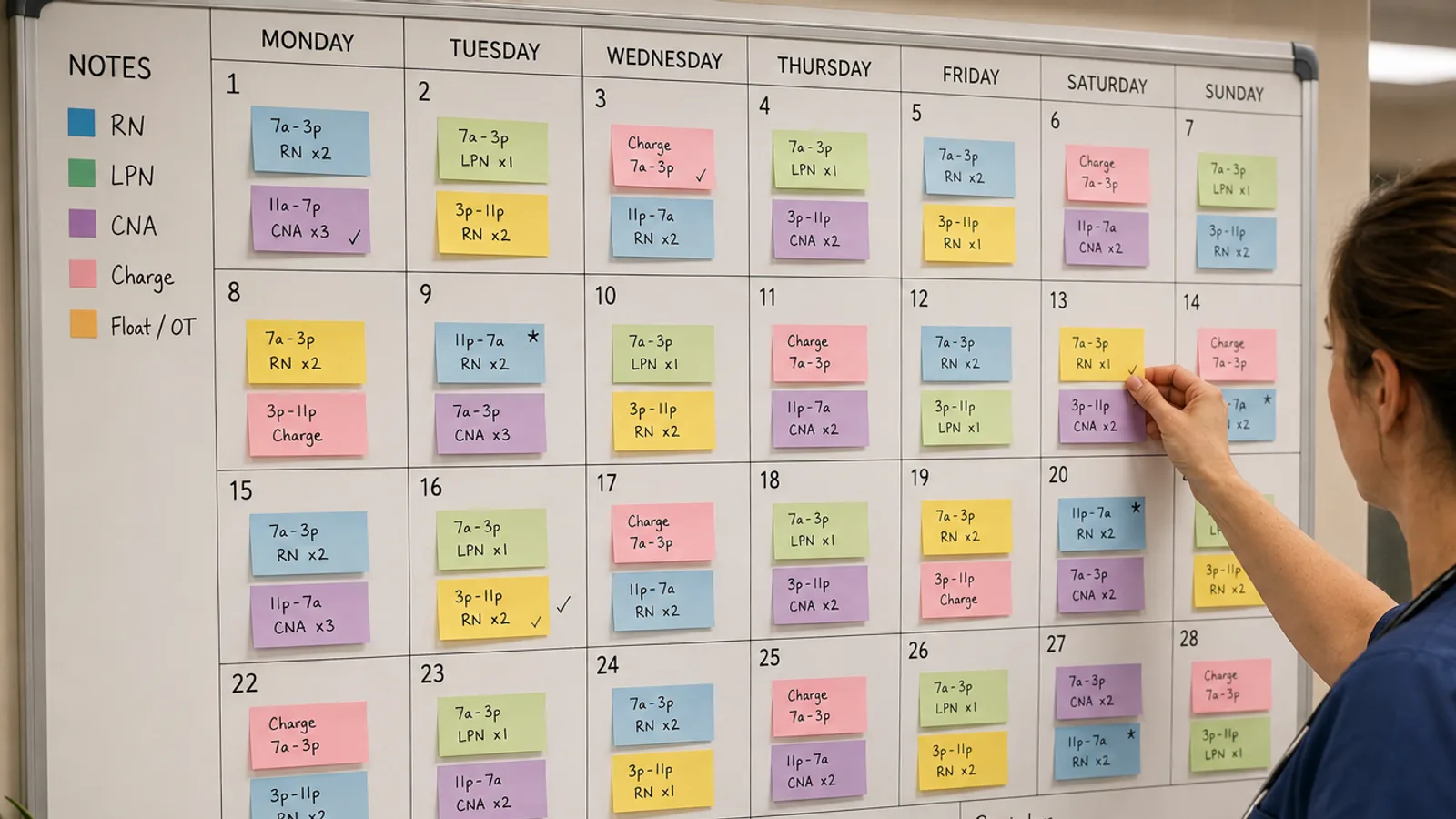
How that phone tree runs decides everything downstream: covered care or uncovered care, appropriate overtime or avoidable overtime, a documented decision or an undocumented one. This guide covers the four pieces that turn a 2 AM scramble into a process: the written policy, the ranked call list, the coverage workflow, and the documentation habit.
Why Is Nurse Callout Coverage a Process Problem?
Three failure modes account for most of the damage a callout does, and none of them is caused by the callout itself.
Wrong nurse called first
The nurse accepts, but she is already deep into her hours for the period. The shift gets covered and an avoidable overtime premium gets owed.
Fix: rank by overtime risk before calling anyone
No credential check
The shift needs a charge-qualified nurse or a specific certification. The nurse who says yes does not have it, and the gap is discovered at handoff.
Fix: filter the call list by shift credentials first
No documentation
A CMS survey or a wage question arrives months later, and there is no record of who was contacted, who covered, or why.
Fix: log every callout event when it happens
All three failures share a cause: the decision was improvised at the moment of the callout instead of decided in advance. The rest of this guide is the advance work.
What Should a Nurse Callout Policy Put in Writing?
A callout policy sets the rules before the emergency. Nurses who know the rules in advance are less likely to dispute how a specific coverage decision was handled. The policy should cover four things.
Notification requirements. How much notice a nurse must give before a shift, who to notify (charge nurse on duty, manager, or a specific number), and how the notification is recorded. Set a specific window, for example at least two to four hours before shift start, and enforce it consistently.
Coverage expectations. Whether nurses are expected to seek their own swap before notifying management, how the replacement search will run, and the order of escalation: unit roster first, then PRN pool, then agency if the hospital holds agency agreements.
Consequences for policy violations. What happens when a nurse calls out without meeting the notification requirement, how callout frequency is tracked, and what threshold triggers a conversation.
Documentation. A statement that every callout event is logged with its time, circumstances, and coverage outcome. That line matters for both employee relations and survey readiness.
How Do You Build a Ranked Callout List?
The ranked callout list is the operational tool that makes the policy work. It is consulted before any call is made, and it is only useful if it is current.
| Column | Purpose |
|---|---|
| Nurse name | Identification |
| Employment type | Full time, part time, or PRN, which sets availability expectations |
| Credentials | Certifications, charge designation, unit-specific qualifications |
| Hours this period | Running total against the overtime threshold your hospital uses |
| Days scheduled this week | Prevents double-scheduling |
| Contact preference | Cell number, best time to call |
| Response history | Notes on who consistently declines, so expectations stay realistic |
One clarification on the hours column, because it is where callout lists go wrong. Under the FLSA, hospitals owe overtime past 40 hours in a workweek by default. A hospital that has formally adopted the optional 8-and-80 system instead owes overtime past 8 hours in a day or 80 hours in a 14-day period, per DOL Fact Sheet 54. Track hours against whichever threshold your hospital actually uses, not against a number remembered from a previous employer. The wider program this column belongs to is in how to reduce nurse overtime.
Ranking logic, in order:
- 1
Identify what the open shift requires: credentials, charge coverage, unit, and time.
- 2
Filter to credential-eligible nurses only.
- 3
Remove anyone already scheduled that day or already near the overtime threshold.
- 4
Sort the remainder by hours this period, fewest first. Call from the top and document each attempt.
The list must be updated after every shift worked and after every callout event. A list that is a week stale is worse than no list, because it lends false confidence to a wrong ranking.
For hospitals on spreadsheets, the practical fix is naming one owner: the manager or the charge nurse on duty updates the list at the end of every shift. Generic nurse scheduling software varies widely on whether it maintains these fields automatically, which is worth checking during any evaluation.
What Does the Callout Coverage Workflow Look Like?
When the callout comes in:
- Log the callout immediately. Time of notification, the nurse’s name, and the shift affected. This starts the documentation chain.
- Identify what the open shift requires. A charge shift callout is a different search than a general staff callout.
- Pull the ranked list and apply the filters. Right credentials, not already working that day, below the threshold.
- Call from the top, in order. Do not skip names because you predict a no. Log each attempt: time, and whether it was answered, declined, or unanswered.
- On an acceptance, confirm shift details, log it, and update the hours tracker immediately.
- On a decline or no answer, move down the list. Do not circle back to a decliner unless the list is exhausted.
If nobody on the unit list accepts, escalate in the order the policy sets: PRN nurses outside the primary list, then agency staff if agreements exist, then leadership coverage options. In Texas, what this escalation may not casually include is mandatory assignment, covered in the next section. Document every escalation step with times and responses. For the night-specific version of this problem, the per-diem bench design and the after-hours cost math, see after-hours callout coverage.
How Do You Document a Callout Event?
CMS surveyors can ask for staffing records, and surveys can be unannounced. A critical access hospital also has a specific floor to evidence: under 42 CFR 485.631, a licensed nurse must be on duty whenever there is an inpatient, so the record for a callout shift must show who actually covered and with what qualifications.
No regulation prescribes a log format; these five fields are the minimum that makes the record defensible. For each event, the log should hold:
- Date and time of the callout notification
- Name of the nurse who called out and the shift affected
- Every nurse contacted, in order, with time and outcome
- The replacement nurse and a confirmation of their credentials
- The coverage outcome if no replacement was found, and who made that call
A spreadsheet works. A shared document works. Verbal-only handling that leaves no record is the only wrong answer.
What Should You Do When You Cannot Fill the Shift?
Some shifts will not fill from the available pool. What happens next is where Texas hospitals get into legal trouble, because the intuitive fallback is the unlawful one.
Mandatory overtime is prohibited in Texas, with narrow exceptions. Texas Health and Safety Code Chapter 258 says a hospital may not require a nurse to work hours beyond her scheduled shifts, and a nurse may refuse mandatory overtime. The exceptions are narrow: a health care disaster in the county or a neighboring county, a declared federal, state, or county emergency, an unforeseeable emergency the hospital could not have anticipated, or a procedure in progress the nurse cannot safely leave. Even inside the unforeseeable-emergency exception, the statute requires the hospital to first attempt voluntary overtime, agency nurses, and off-duty volunteers. The chapter also prohibits retaliating against a nurse who refuses. Texas is one of several states that protect that refusal, and our guide to mandatory nurse overtime by state covers what the exceptions allow elsewhere.
So the unfillable-shift playbook looks like this:
Reassess the need. If census is low and minimum staffing holds with the nurses on shift, a voluntary two-to-four-hour extension by willing staff may close the gap without anyone working a full extra shift. Document the assessment.
Exhaust the voluntary routes. Voluntary overtime from qualified staff, PRN and agency options, and leadership coverage where qualifications allow. Keep the times and responses in the log.
Reserve mandatory assignment for a true Chapter 258 exception. If the situation genuinely fits one of the four exceptions, document which one, show the voluntary attempts that preceded it, and assign it to a qualified nurse with the lowest hours in the period.
Review the event afterward. An unfillable shift is data. If the same shift slots keep failing, the roster or the PRN pool needs a structural fix, not a better phone tree.
How Do You Reduce Callout Frequency Over Time?
Handling callouts well is reactive. Reducing them is schedule design.
Predictability. A schedule posted well in advance, on a stable rotation, gives nurses fewer collisions between work and life, which is where many callouts start. Late postings and frequent changes push nurses to protect their plans with a callout. The same logic drives holiday nurse staffing from Thanksgiving to New Year, where posting the holiday schedules in October comes first.
Equitable distribution. A nurse who can see that weekends, nights, and holidays fall evenly has less reason to defend herself against the schedule. Track the distribution per nurse and correct visible imbalances before they harden into resentment.
Pattern reading. A nurse whose callouts spike is usually signaling burnout or a life change, not an attendance attitude. A workload conversation beats a warning letter, and our rural retention strategies guide covers what actually keeps small-roster nurses.
How Does SimpleScheduleAI Help With Callouts?
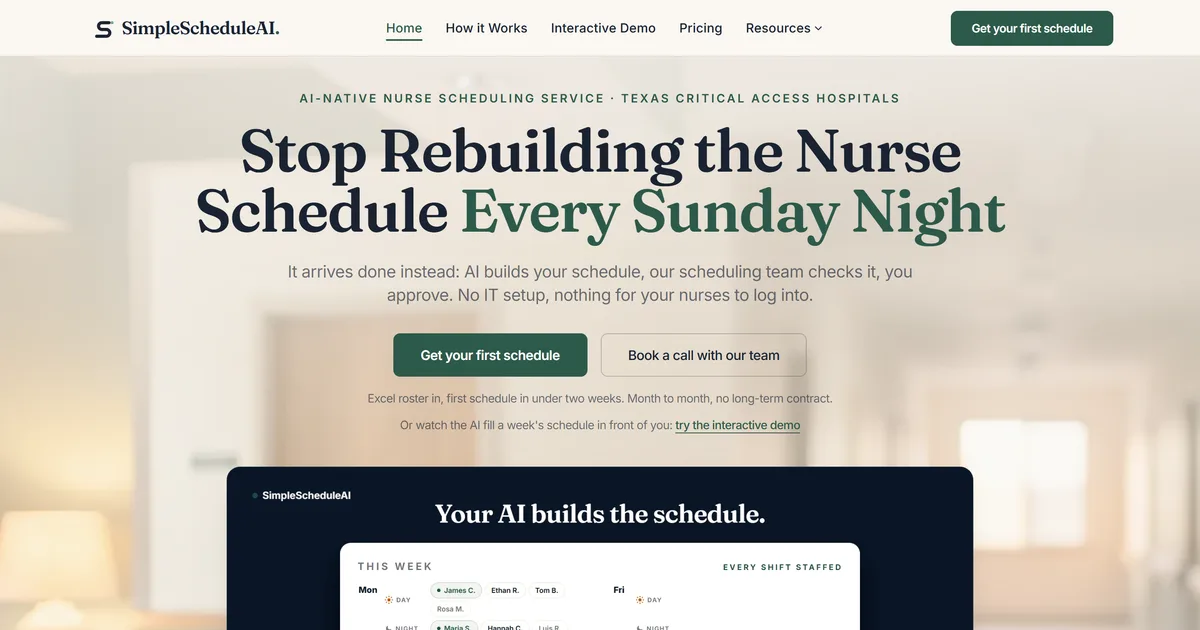
SimpleScheduleAI is an AI-native nurse scheduling service for Texas Critical Access Hospitals, and callouts are the sharpest version of the problem it exists for. When a callout is reported, the service returns a ranked shortlist of qualified replacement candidates with the reasons visible: skills, role, charge coverage, and overtime risk. The manager calls from that list and decides; nothing is assigned without their approval. Underneath the shortlist sit the same fundamentals this guide describes, maintained continuously instead of at the end of each shift: compliance and fairness rules configured at onboarding, a running per-nurse count of weekends and holidays, and a timestamped log of every schedule change, so the final coverage decision is captured the moment it is approved. You can walk the full cycle on how the scheduling process works.
One honest boundary: everything in this guide works in Excel, and a disciplined manager with a current one-page list gets most of the benefit. What the service removes is the 2 AM spreadsheet math and the competency cross-check, at the moment the manager has the least capacity for either. The call-by-call record of who was contacted and who declined stays yours to keep; the shortlist’s job is to make that list short.
Our Take
Most callout chaos is scheduled weeks earlier, when the roster was built without asking who could absorb a surprise. The phone tree is just where the bill arrives. Decide the call order before the phone rings, write down what happens when it does, and treat Chapter 258 as a design constraint, not a footnote. A hospital that does those three things has solved most of the callout problem before the first callout.
What to Do This Week
- Review your last 10 callout events. For each: who was called first, and what were their hours at that moment? If the answer was “the nurse most likely to say yes,” your defaults are buying coverage with overtime.
- Create or update the callout log. If the past 30 days are undocumented, rebuild the record from schedules and time data. Surveys do not schedule themselves around your paperwork.
- Write or update the one-page callout policy. Notification window, escalation order, documentation statement. Distribute it; a policy staff have not seen cannot be enforced fairly.
- Build the ranked list in Excel. Names, credentials, hours this period, availability flag. Sort by hours ascending and use it on the next callout.
- Check your mandatory overtime practice against Chapter 258. If mandatory assignment has been a routine fallback, align the policy with the statute’s exceptions before it becomes a complaint.
Stop guessing who to call at 2 AM
SimpleScheduleAI ranks every qualified replacement by skill match and overtime risk, with the manager making the final call. Every approved change lands in a timestamped log automatically.
See how it works →Frequently Asked Questions
Q: How much notice does a nurse have to give before calling out in Texas?
No Texas statute sets a callout notice period. The requirement comes from your policy, so set one, communicate it, and enforce it consistently. A written window of at least two to four hours before shift start is a reasonable, defensible standard, with notification to a named role rather than to whoever answers.
Q: Can a Texas hospital mandate a nurse to cover a callout shift?
Generally no. Texas Health and Safety Code Chapter 258 prohibits mandatory overtime for nurses and protects a nurse who refuses it from retaliation. The exceptions are a health care disaster, a declared emergency, an unforeseeable emergency the hospital could not have anticipated, or a procedure in progress. Even in an unforeseeable emergency, the hospital must first attempt voluntary overtime, agency staff, and off-duty volunteers. A routine callout does not qualify.
Q: Should the charge nurse or the nurse manager run callout coverage?
Whoever holds the current ranked list and the hours data, which is usually the manager. If the manager is unreachable, the charge nurse on duty runs the initial response from the same list and escalates. The failure mode to design against is the charge nurse calling from memory, which is where the overtime and credential mistakes happen.
Q: What happens when the charge nurse is the one calling out?
Filter the list to charge-qualified nurses first, which usually shrinks the pool to a handful. Work that short list in ranked order. If no charge-qualified nurse can take the shift, the remaining options are voluntary overtime from a charge-qualified nurse or reassessing coverage under your minimum staffing rules, documented either way. Our guide to what a charge nurse is and who covers the shift explains why that pool is so small.
Q: Does SimpleScheduleAI handle callouts outside business hours?
Callouts do not keep business hours, and the service does not either. A callout can be reported at any hour and the ranked replacement shortlist reflects the current schedule and hours data at that moment. For anything coverage-blocking, the escalation path published on how it works applies: a response within one business hour, or within three hours outside business hours.
Sources
- U.S. Department of Labor, Fact Sheet #54: The Health Care Industry and Calculating Overtime Pay. DOL
- Texas Health and Safety Code, Chapter 258: Mandatory Overtime for Nurses Prohibited. Justia
- 42 CFR 485.631, Conditions of Participation: Staffing and staff responsibilities. eCFR
Pradeep Pandey is the co-founder of SimpleScheduleAI, an AI-native nurse scheduling service built for Critical Access Hospitals in Texas. He serves as Deputy General Manager of Operations at Apollo Hospitals and holds an MBA from IIM Trichy. LinkedIn →