By Pradeep Pandey · Co-Founder · 17 min read · Updated
After-Hours Callout Coverage for Critical Access Hospitals
After-hours callout coverage at a small or Critical Access Hospital works best with a pre-ranked call list, a written escalation order, a standing per-diem bench, and CMS-ready documentation. This guide shows the exact process that replaces the 2 AM phone tree.

Key Takeaways
- A nurse calling out at 2 to 5 AM is one of the most disruptive scheduling events at a Critical Access Hospital, because there is no float pool and no staffing office awake to absorb it.
- A workable callout process has four written parts: a pre-ranked call list, a fixed escalation order, a standing per-diem bench, and a documentation step that satisfies CMS §485.635.
- Ranking the call list by overtime exposure, credential match, and rotation fairness before the night shift starts converts a 40-minute phone tree into a 3-call sequence.
- A per-diem bench of 4 to 6 cross-credentialed nurses, contacted on a fixed weekly cadence, is the difference between covering a 2 AM hole internally and paying agency premium rates.
- A managed scheduling service removes the after-hours phone tree by maintaining the ranked list and the bench so the on-call charge nurse makes calls instead of building the list at 2 AM.
Table of Contents
- Why Is an After-Hours Nurse Callout the Hardest Coverage Problem at a Critical Access Hospital?
- What Does an After-Hours Callout Actually Cost a Critical Access Hospital?
- What Does a Workable After-Hours Callout Process Look Like?
- How Do You Build a Ranked Callout Call List Before the Night Shift?
- What Documentation Does CMS §485.635 Require After a Callout?
- How Do You Prepare a Per-Diem Bench So You Are Not Calling an Agency?
- How Does SimpleScheduleAI Help with After-Hours Callouts?
- What to Do This Week
- Frequently Asked Questions
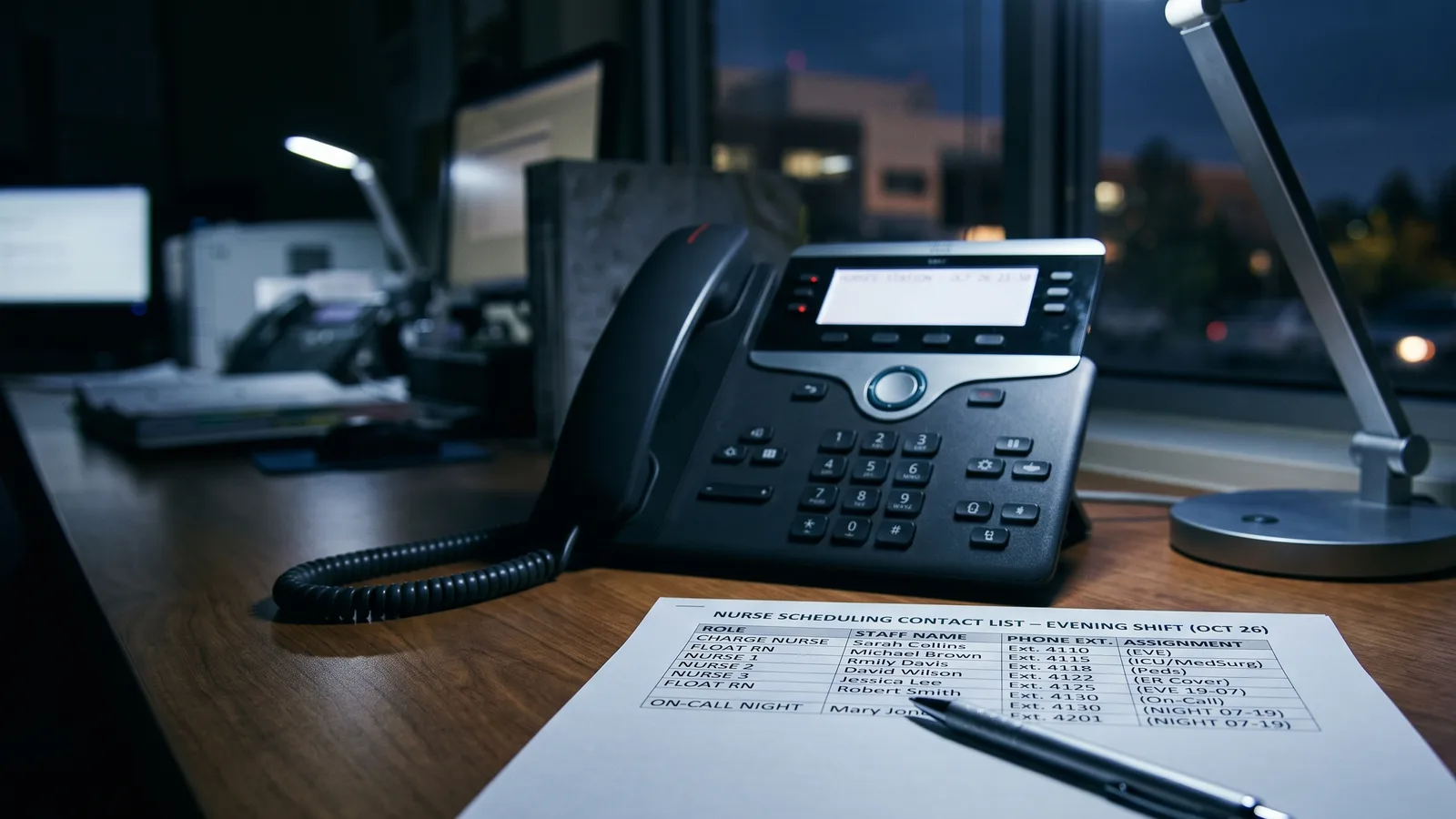
A nurse calls in sick at 2:40 AM for a shift that starts at 6:45 AM. There is no float pool, no staffing coordinator on duty, and no agency desk that answers before business hours. The person solving this is usually the on-call charge nurse or the nurse manager, working a phone list from memory while the unit runs short. This post is the operational playbook for that exact moment, written for Critical Access Hospitals.
Why Is an After-Hours Nurse Callout the Hardest Coverage Problem at a Critical Access Hospital?
An after-hours callout is the hardest coverage problem at a small hospital because every buffer that a large facility relies on is absent. There is no float pool to pull from, no night staffing office, no internal agency desk, and often only one or two qualified replacements in the whole county, which is why a small hospital leans on coverage models built for its size rather than a float pool. The callout has to be solved by one tired person making phone calls.
At a 200-bed hospital, a night callout routes to a staffing office that reassigns a float nurse in minutes. A Critical Access Hospital has none of that infrastructure. The Flex Monitoring Team documents that CAHs operate with thin staffing margins by design, because they serve low-volume rural areas where a full float pool is not financially viable. When the one night nurse on a unit calls out, the replacement pool is a list of individual people who are asleep at home.
The problem compounds at night specifically. Daytime callouts have a deep bench of available staff and a manager at her desk. A 2 AM callout has the smallest possible candidate pool, the highest chance of pushing someone into overtime, and the least decision support. This is why after-hours callout coverage, not schedule building, is the operational pain that CAH nurse managers report first.
What Does an After-Hours Callout Actually Cost a Critical Access Hospital?
A single uncovered or poorly covered after-hours callout costs a Critical Access Hospital in four ways: overtime premium, agency premium, manager time, and patient-safety risk. The cash cost of one agency-covered shift can exceed the nurse’s own daily wage by a wide margin, and the manager time spent solving it is clinical capacity that disappears.
The true cost is rarely captured because many CAHs track only the agency invoice. The full picture has four components:
| Cost Component | What Drives It | Why It Is Often Missed |
|---|---|---|
| Overtime premium | Replacement nurse crosses the FLSA 40-hour or 8-and-80 threshold | Buried in the next payroll cycle, not tied back to the callout |
| Agency premium | No internal nurse available, agency called at last-minute rate | Only this line is tracked, so it looks like the whole cost |
| Manager time | 30 to 60 minutes of calling, often during a clinical shift | Never invoiced, so it is treated as free |
| Patient-safety risk | Unit runs short until coverage arrives, or runs short all shift | No dollar figure, so it stays off the operations report |
The American Nurses Association links inadequate staffing directly to patient outcomes and nurse retention in its staffing advocacy work, which means an uncovered hole is not only a cost line, it is a safety and turnover driver. A recurring callout problem accelerates the departures we cost out in the real cost of losing one nurse at a rural hospital. For a CAH operating on thin rural margins documented by HRSA’s rural health workforce research, a recurring callout problem that quietly converts staff hours into overtime and agency hours can move the labor budget by several points over a year. The compounding manager-time portion of this cost is the same shadow burden we break down in the healthcare scheduling crisis.
What Does a Workable After-Hours Callout Process Look Like?
A workable after-hours callout process has four written, pre-built parts: a pre-ranked call list, a fixed escalation order, a standing per-diem bench, and a documentation step. The defining feature is that all four exist before the phone rings. The 2 AM task becomes “call down the list” instead of “figure out who to call.” The scheduling tools that build and rank that per diem call list are compared in our per diem nurse scheduling software guide.
The failure mode at most small hospitals is that the process lives in the nurse manager’s head. When she is off, asleep, or on a clinical shift, the institutional knowledge is unavailable and the on-call charge nurse improvises. A workable process is written down and survives the manager being unreachable.
1. Ranked Call List
Built before the shift, sorted by overtime exposure, credential match, and rotation fairness.
2. Escalation Order
Fixed sequence: internal volunteers, then bench, then holdover, then administrator-on-call.
3. Per-Diem Bench
4 to 6 cross-credentialed per-diem nurses on a known weekly availability cadence.
4. Documentation
Who called out, who was contacted, who covered, logged for CMS §485.635 review.
The escalation order matters as much as the call list. Without a written order, the on-call charge nurse defaults to whoever is easiest to reach or hardest to say no to, which burns out the same two reliable nurses and erodes fairness, the exact churn behind the nurse shortage versus retention crisis debate as it lands on a small rural roster. A fixed order, agreed in daylight and posted at the nursing station, removes that judgment call from a 2 AM decision.
How Do You Build a Ranked Callout Call List Before the Night Shift?
You build a ranked callout call list by sorting every available nurse for the upcoming shift on three factors before the shift begins: overtime exposure first, then credential and unit match, then rotation fairness. The list is printed or accessible at the nursing station so the on-call charge nurse calls top-down instead of guessing.
The three ranking factors are not interchangeable, and the order matters:
Overtime exposure first. A nurse who is already at 36 hours this FLSA week is one shift from time-and-a-half. A nurse at 12 hours is not. Ranking by remaining hours before the overtime threshold protects the budget on every callout. For hospitals on the FLSA 8-and-80 healthcare overtime rule, the threshold logic is per day and per 14-day period, which is harder to track in your head at 2 AM and is exactly why it must be pre-computed.
Credential and unit match second. A nurse who cannot legally cover the open shift does not belong on the list, no matter how available she is. The list should already be filtered to nurses credentialed for that unit, so the on-call charge nurse never has to verify competency at 2 AM.
Rotation fairness third. Among nurses who are credentialed and not near overtime, the one who has been called least often this rotation goes to the top. This is the factor most likely to be skipped under pressure, and skipping it is what drives the “you always call me” resentment that erodes the bench over time. Building fairness into the list before the shift removes it as an in-the-moment judgment, the same fairness drift that lets self-scheduling quietly concentrate nights on a few willing nurses when no one tracks it across cycles. For more on balancing fairness with cost, see how a managed scheduling service handles the same tradeoff at review time.
What Documentation Does CMS §485.635 Require After a Callout?
CMS §485.635 requires a Critical Access Hospital to provide nursing services that meet the needs of its patients and to have policies governing those services. In practice, that means a callout must leave a record showing the unit remained adequately staffed and the substitution followed hospital policy. The record, not the verbal handoff, is what survives a survey.
The Conditions of Participation for CAHs require nursing services to be furnished in accordance with written policies and under the direction of a qualified nurse, as set out in the CMS State Operations Manual, Appendix W. A surveyor reviewing a flagged shift will ask how the open position was covered and whether the covering nurse was qualified for the assignment. If the answer lives only in someone’s memory, that is a documentation gap.
The practical documentation set for one callout is short but must be consistent. Captured at the time, this is a 5-minute log. Reconstructed weeks later before a survey, it is hours of guesswork and a compliance exposure. The goal is a callout process that produces this record as a byproduct, not as a separate chore.
CMS §485.635 Callout Documentation: 5-Item Log
- Name and role of the nurse who called out
- Time the callout was received
- Every person contacted and their response
- Name and credentials of the nurse who covered
- Resulting unit staffing for the shift
Logged in real time, this satisfies §485.635 review without separate survey prep.
How Do You Prepare a Per-Diem Bench So You Are Not Calling an Agency?
You prepare a per-diem bench by maintaining a standing roster of 4 to 6 cross-credentialed per-diem nurses, confirming their rolling availability on a fixed weekly cadence, and contacting them on the bench before any agency call. If you are still defining the staffing model, our explainer on what per diem nursing is covers how these as-needed nurses are paid and scheduled. The bench exists to absorb the callout internally at internal rates, before the conversation ever turns to premium agency coverage.
A per-diem bench only works if it is actively maintained, not assembled in a crisis. Three rules keep it functional:
Cross-credential the bench. A per-diem nurse who can only work medical-surgical helps half the time. A bench whose members are each credentialed for two or more units covers far more callouts without expanding headcount. HRSA rural workforce data shows the rural nurse supply is structurally limited, so the gain is not more people, it is more flexibility per person.
Refresh availability on a cadence. A bench is only as good as its current availability. A standing weekly text or short call that asks each per-diem nurse for their available nights that week turns the bench from a stale list into a live one. The on-call charge nurse then calls people known to be available, not people who might be.
Treat bench order as fairness, not convenience. The same fairness logic that governs the staff call list governs the bench. Rotating who gets the first bench call keeps per-diem nurses engaged and prevents the two most agreeable ones from quietly burning out and leaving. Once the internal staff list and the bench are exhausted, agency coverage is the documented fallback, not the reflex.
How Does SimpleScheduleAI Help with After-Hours Callouts?
SimpleScheduleAI is an AI-native, human-verified nurse scheduling service for Critical Access Hospitals in Texas. It removes the 2 AM phone tree because your roster is set up with us at onboarding, per diem availability is tracked as it comes in, and the AI ranks against both. When a nurse calls out, the on-call charge nurse receives a replacement shortlist the AI has already sorted by overtime exposure, skill match, and rotation fairness, and makes calls instead of building the list. The callout record is captured in the same step for CMS §485.635 review. The pre-ranked shortlist pattern is the same one we cover in our broader piece on AI nurse scheduling vs. traditional methods.
Honest limitation: the service prepares and ranks the list, but a human at the hospital still places the calls and confirms the replacement. SimpleScheduleAI does not auto-dial nurses or fill the shift without a person deciding. For a small hospital, that human confirmation step is intentional, because the on-call charge nurse knows context the data does not. What changes is that the thinking, ranking, and compliance logging are done before the phone rings, not at 2 AM.
To see the underlying scheduling model, compare nurse scheduling software options against the managed approach, review how AI nurse scheduling produces the ranked shortlist, read the operational requirements behind critical access hospital scheduling, and see how the managed service works end to end. Watch the AI build a schedule and generate a callout replacement shortlist in the interactive simulator.
Our Take
After-hours callout coverage at a Critical Access Hospital is an infrastructure problem, solved at 2 AM by the one tired person who happened to be awake. The hospitals that have this under control are the ones that pre-ranked the call list during business hours and built a standing per-diem bench. The work happens upstream, not in the middle of the night.
One honest limitation: a managed callout shortlist is not the right fit for hospitals with a dedicated full-time staffing office, on-site after-hours coordinators, or facilities where callout volume is low enough that the manual phone tree is operationally sustainable.
What to Do This Week
- Build your ranked call list before the next night shift starts. Pull your nursing roster, sort by overtime status this pay period, certification match, and rotation fairness. Print or share it with the on-call charge nurse before 7 PM. The 40-minute phone tree becomes a 3-call sequence when the ranking is done in advance.
- Document your callout-coverage escalation order in writing. Charge nurse → per-diem bench → cross-credentialed daytime staff → agency. Put it on one page, post it in the break room and in the charge nurse handoff binder. Verbal escalation orders fail at 3 AM.
- Recruit and brief your per-diem bench this month. Aim for 4 to 6 cross-credentialed nurses on a fixed weekly availability cadence. Confirm their certifications match your acute-coverage needs. A standing bench is the difference between paying agency premium and covering internally.
- Audit your CMS §485.635 callout-documentation gaps. Pull the last six months of callouts. For how many do you have a complete record of who was called, who declined or accepted, what time, and the credential match? Documentation gaps surface during CMS surveys, not when the callout happens.
- See how SimpleScheduleAI works if you are a Texas CAH. The service produces the ranked call list and the timestamped record of every change, so the on-call charge nurse makes calls instead of building the list at 2 AM. Start at how it works.
Stop building the call list at 2 AM
SimpleScheduleAI produces the ranked callout shortlist and the timestamped record, so coverage gets handled without the charge nurse building a phone list at 2 AM.
See how it works →Frequently Asked Questions
How do small hospitals handle nurse callouts without a float pool or agency desk?
Small hospitals handle callouts with a pre-built process: a ranked internal call list sorted by overtime and credentials, a written escalation order, and a standing per-diem bench contacted before any agency call. The work is done before the shift so the after-hours decision is “call down the list,” not “figure out who to call.”
What is the right order to call nurses for an after-hours callout?
Call in this order: internal staff who are credentialed, not near the overtime threshold, and lowest on the fairness rotation, then the per-diem bench in rotating order, then a voluntary holdover or extension of the on-duty nurse, then the administrator-on-call to authorize agency coverage. The order should be written and posted, not improvised at 2 AM.
Does a callout need to be documented for CMS at a Critical Access Hospital?
Yes. Under CMS §485.635, a CAH must furnish nursing services under written policies and keep records showing patients were adequately staffed. A callout record should capture who called out, who was contacted, who covered, their credentials, and the resulting staffing, captured at the time rather than reconstructed before a survey.
How many nurses should a Critical Access Hospital keep on its per-diem bench?
Many CAHs are well served by 4 to 6 cross-credentialed per-diem nurses with rolling weekly availability. The number matters less than two things: each bench member being credentialed for more than one unit, and availability being refreshed on a fixed cadence so the bench is live rather than a stale list when a 2 AM callout happens.
Can a managed scheduling service handle after-hours callouts for a small hospital?
A managed service does not place the calls, but it removes the hardest part of the after-hours callout: building and ranking the list under pressure. The service ranks the list from your roster and current availability, and captures the compliance record, so the on-call charge nurse spends the 2 AM window calling and confirming, not deciding who is eligible.
Related: 8-hour vs 12-hour nursing shifts shows how shift length changes callout exposure.
Pradeep Pandey is the co-founder of SimpleScheduleAI. He serves as Deputy General Manager of Operations at Apollo Hospitals and holds an MBA from IIM Trichy (Operations and Marketing). His work focuses on workforce optimization and scheduling operations for small and rural hospitals. LinkedIn →