By Pradeep Pandey · Co-Founder · 9 min read · Updated
What Is a Charge Nurse? Role, Duties, and Who Covers the Shift
Someone has to be in charge on every shift, including nights and weekends. At a 25-bed hospital only a few of your nurses are cleared to do it. That makes charge a scheduling problem, not a hiring one.

Key Takeaways
- A charge nurse is a registered nurse who runs the shift. The American Nurses Association describes charge nurses as overseeing unit operations “during a set period while working alongside the team.”
- Charge is usually an assignment rather than a rank. RegisteredNursing.org puts it plainly: “The position is an assignment, not a separate license or title.”
- A charge nurse runs the shift. A nurse manager runs the unit, and handles longer-term work like hiring, budgets and building the schedule.
- At a small hospital the charge nurse usually looks after patients as well, so the extra work is added on top of a normal assignment.
- Charge coverage is the part that breaks. Only some of your nurses are cleared for it, and the job depends on knowing your unit, which agency staff do not.
Table of Contents
- What Does a Charge Nurse Do on a Shift?
- Is Charge Nurse a Job Title or a Shift Assignment?
- How Is a Charge Nurse Different From a Nurse Manager?
- Who Covers Charge When the Charge Nurse Calls Out?
- How Does SimpleScheduleAI Handle Charge Coverage?
- What to Do This Week
- Frequently Asked Questions
A charge nurse is the registered nurse who runs a nursing unit for one shift. They take report, make the assignments, and decide what happens when the unit gets busier than planned.
Most writing about the role is aimed at nurses who want the job. This guide is for the person on the other side of it, who has to make sure someone qualified is in charge on every shift, every day of the week.
What Does a Charge Nurse Do on a Shift?
The American Nurses Association describes charge nurses as overseeing “the operations of their specific nursing unit during a set period while working alongside the team.” That last phrase matters. The charge nurse is on the floor.
In a small hospital the list is short and heavy. The charge nurse hands out patient assignments at the start of the shift. They redo those assignments when a new patient arrives. They decide whether the unit can safely take another transfer. And they are the first call when a nurse is struggling.
Is Charge Nurse a Job Title or a Shift Assignment?
Usually an assignment. RegisteredNursing.org states it directly: “The position is an assignment, not a separate license or title.” There is no national charge nurse certification.
Practice varies by hospital. RegisteredNursing.org describes two patterns. One is “a rotating assignment given to experienced staff nurses on a per-shift basis.” The other is “a permanent, posted position with its own job description and pay grade.” Either way, no separate license comes with it.
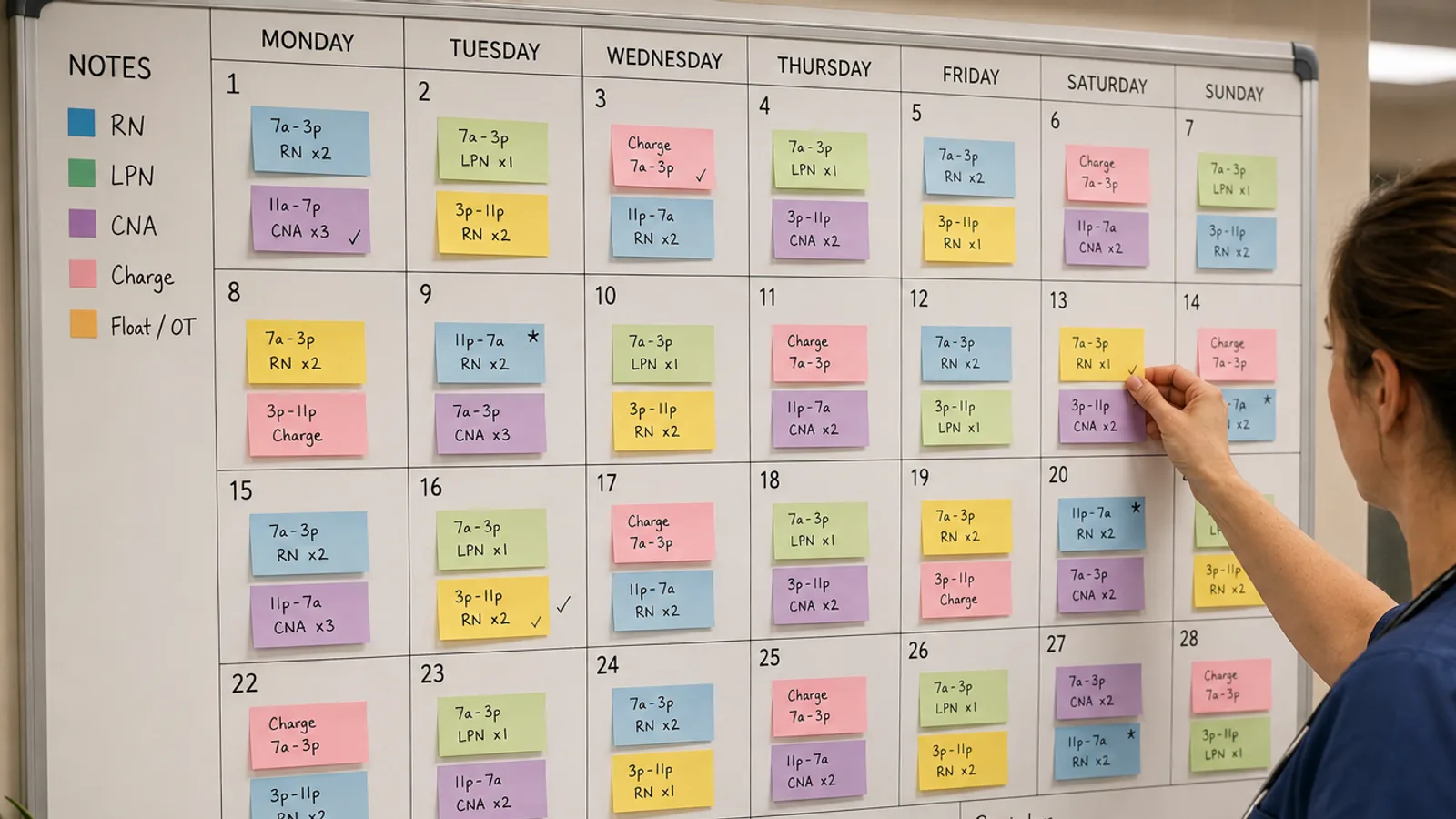
Every shift needs one qualified nurse in charge. That need is there whether or not anyone planned for it when the schedule was built. So charge is a scheduling question, not a hiring one.
A dedicated charge nurse with no patients is a luxury most small units keep for their heaviest days, a threshold acuity-based staffing at a small hospital shows how to write down.
Charge is also a role people grow into rather than train for. The American Nurse Journal reports that “many organizations lack role-specific competency-based orientation, leaving nurses to learn on the job.”
How Is a Charge Nurse Different From a Nurse Manager?
The charge nurse runs the shift. The nurse manager runs the unit.
| Charge nurse | Nurse manager | |
|---|---|---|
| Focus | Today's shift | Next month's roster, hiring and budget |
| Where | On the floor, "working alongside the team" | Often "in an office environment versus a clinical setting," though less so at a small hospital |
| Typical duties | Assignments, admissions, escalation | Hiring, discipline, budgets, unit strategy |
Quoted phrases are ANA’s. If nobody can say who is in charge tonight, that is a planning problem, and it lands on the shift.
At a Critical Access Hospital the two roles blur, because the director of nursing often takes clinical shifts and sometimes charge herself. That is what a thin roster produces. For the full comparison, including whether a charge nurse counts as a supervisor and who owns which schedule, see nurse manager vs charge nurse.
Who Covers Charge When the Charge Nurse Calls Out?
This is the part that keeps managers awake, and most guides skip it.
An ordinary callout is a coverage problem. You need someone with the right license. A charge callout is a qualification problem. You need one of the few people your hospital has cleared for it. On a 25-bed unit that is often four or five nurses, and some are already working or on required rest.
Two things make it harder than it looks. Charge depends on knowing your unit, your policies and who to call when something goes wrong. That is why hospitals are usually reluctant to give it to agency or travel staff, so the option you would normally fall back on is closed. And the nurses who are cleared for charge tend to be your most experienced, which means they are already picking up extra shifts. Leaning on them again burns out the people you can least afford to lose, a pattern we trace in nurse burnout and the schedule.
A better phone tree will not fix this. What fixes it is building the schedule so no shift ever has just one nurse who can take charge. That shift is one callout away from a real problem. Handling the callout itself is covered in how to handle nurse callouts.
How Does SimpleScheduleAI Handle Charge Coverage?
SimpleScheduleAI is an AI-native nurse scheduling service for Texas Critical Access Hospitals. We build the schedule, our scheduling team checks it, and your nurse manager approves it.
Charge coverage is one of the compliance rules every draft is checked against. A shift with no charge-qualified nurse does not pass, so you see it while the schedule is still a draft.
Two things matter here. Weekend charge shifts get filled first. They fall at the end of the schedule period, and filling in date order leaves your charge nurses with too many hours by the time it reaches them. Second, when a nurse calls out, the replacement ranking knows whether that nurse was in charge. If nobody free is cleared for charge, you are told that straight away, rather than handed a name who cannot take the shift. Agency is never offered for charge.
One thing decides whether this fits you. We are not right for a hospital that wants a vendor to judge who should hold charge. We do not assess competency, track charge nurse training, or certify anyone. Your roster tells us who is cleared, so an out-of-date list produces a confidently wrong schedule.
If you are comparing tools rather than services, our guide to charge nurse scheduling software reviews eight platforms on what each one documents about charge coverage.
Watch the AI build a week with charge coverage in the interactive simulator, or see how AI nurse scheduling works and nurse scheduling software.
Our Take
Hospitals think of charge as a person, then schedule it as an afterthought. It is a job on every shift, and at a small hospital the list of people who can do it fits on one hand. If you have never written that list down, start there. A lot of the trouble people blame on scheduling software is really a four-name list nobody ever wrote down.
What to Do This Week
- Write down who on your roster is charge-qualified. Not who has done it in a pinch, but who your hospital has cleared.
- Count the shifts this month with exactly one charge-qualified nurse on them. Each was a single callout away from a 5am problem.
- Check whether your charge nurses are also your overtime leaders. If the same names top both lists, those nurses are carrying charge and overtime at once, and they are your biggest flight risk.
- Decide when charge is dedicated and when it is working charge. Put the patient-count threshold in your staffing plan so it is not relitigated every shift.
- See how charge coverage is enforced when a schedule is built. Start at how it works, or read the wider picture in critical access hospital scheduling.
Never publish a schedule missing charge coverage
SimpleScheduleAI checks every draft for charge coverage, and tells you when a callout leaves nobody qualified to take it. Built for Texas Critical Access Hospitals.
See how it works →Frequently Asked Questions
Q: Do you need a certification to be a charge nurse?
No. RegisteredNursing.org states that “no nationally recognized charge-nurse-specific certification exists,” and that the position “is an assignment, not a separate license or title.” Hospitals set their own criteria, usually based on clinical experience and unit familiarity.
Q: Can a travel nurse or agency nurse be the charge nurse?
Usually not. The role depends on knowing the unit’s policies, people and escalation paths, which is knowledge a temporary assignment does not build. Check your own hospital’s policy, since this is set locally rather than by any national rule.
Q: Does the charge nurse also take patients?
Often. RegisteredNursing.org reports that “most charge nurses still take a patient assignment on top of their leadership duties.” Whether charge is dedicated or working usually depends on how busy the unit is.
Sources
[1] American Nurses Association, Charge Nurse vs. Nurse Manager. nursingworld.org.
[2] RegisteredNursing.org, Charge Nurse role overview. registerednursing.org.
[3] Bilyeu et al., “Magnet and the charge nurse role,” American Nurse Journal (2023). myamericannurse.com.
Pradeep Pandey is the co-founder of SimpleScheduleAI. He serves as Deputy General Manager of Operations at Apollo Hospitals and holds an MBA from IIM Trichy (Operations and Marketing). His work focuses on workforce optimization and scheduling operations for Critical Access Hospitals and other small rural facilities. LinkedIn →