By Pradeep Pandey · Co-Founder · 19 min read · Updated
Mandatory Nurse Overtime: Which States Let a Nurse Refuse?
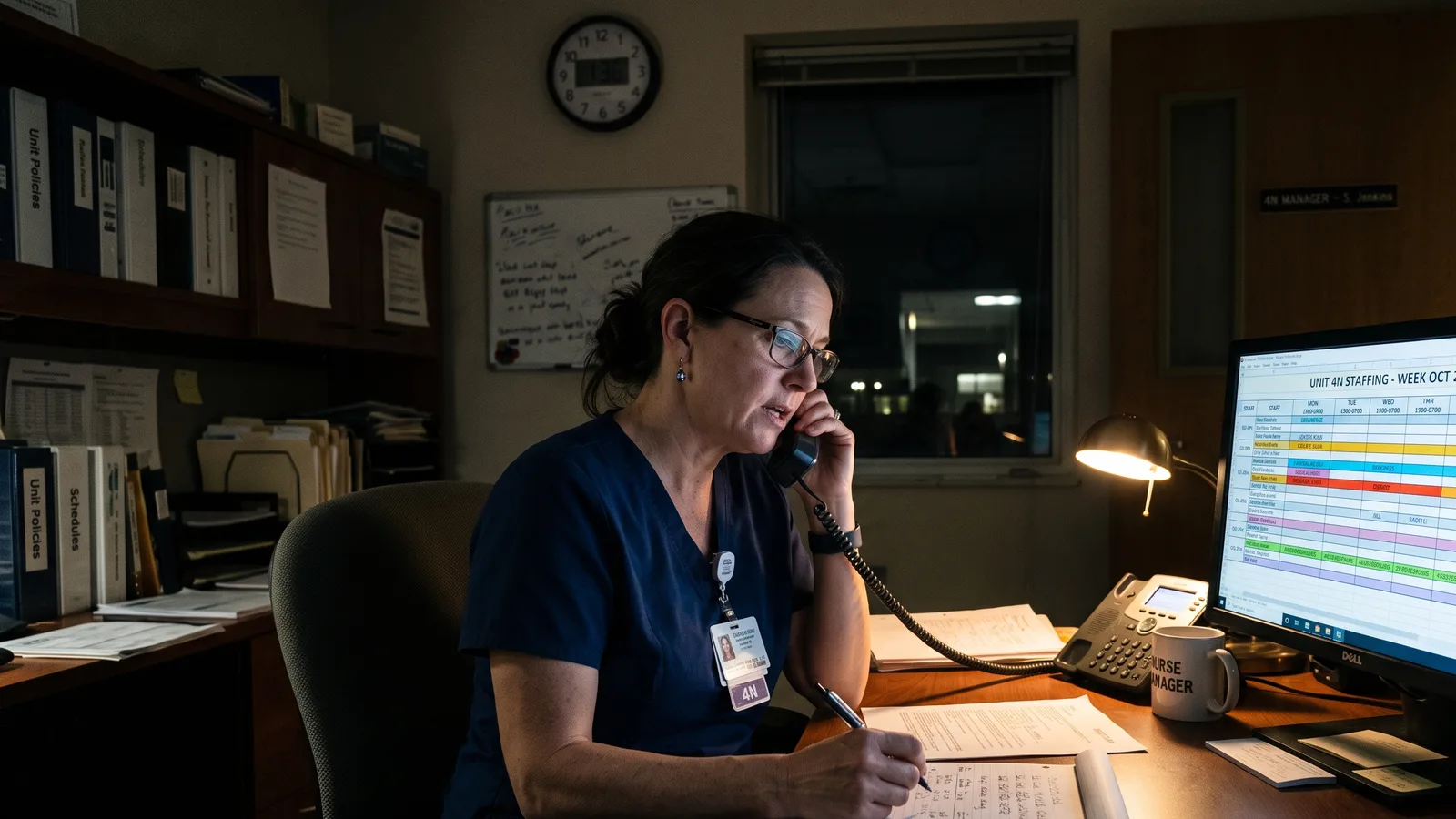
A nurse says no to staying past her shift, and the charge nurse has to decide in the moment whether that refusal is protected. In Texas it is, and the hospital has to try voluntary coverage before it asks anyone to stay.

Key Takeaways
- Mandatory nurse overtime means making a nurse keep working after her shift ends. It is limited by state law, not federal law. We read the statute or rule in seven states, and all seven stop a hospital from doing it.
- Texas is one of them. A nurse at the end of her shift can say no and go home. Texas Health and Safety Code Chapter 258 prohibits a hospital from requiring a nurse to work hours beyond her scheduled shifts, and a nurse may refuse mandatory overtime.
- Saying no is protected in Texas, Pennsylvania and Washington. A hospital in those states cannot punish her for it. New York bans the overtime but does not protect the nurse who turns it down, so the two do not always come together.
- The exceptions are narrower than they sound. One of the four Texas exceptions is an emergency the hospital could not have seen coming, and a hospital may only use it after trying voluntary overtime, agency nurses and off-duty nurses. California and Massachusetts carry their own version of that voluntary-first condition.
- Neither a single unplanned callout nor chronic short staffing is an emergency, which together covers most of the nights a nurse gets asked to stay. Massachusetts writes the second half into the statute: mandatory overtime “shall not be used as a practice for providing appropriate staffing for the level of patient care required.”
- Nobody agrees how many states these are. The American Federation of Teachers says 16. Other lists say 18. Almost none name a statute you can check, so go to your own state’s text instead of a count.
Table of Contents
- Can a Nurse Refuse Mandatory Overtime?
- What Counts as Mandatory Overtime?
- Which States Restrict Mandatory Nurse Overtime?
- What Do the Emergency Exceptions Actually Allow?
- Does an Unplanned Callout Count as an Emergency Exception?
- Can a Texas Hospital Require a Nurse to Stay Late?
- What Does a Refusal Right Mean for the Schedule?
- How Does SimpleScheduleAI Handle Overtime Limits?
- What to Do This Week
- Frequently Asked Questions
Can a Nurse Refuse Mandatory Overtime?
In some states, yes, and Texas is one of them. In those states a hospital may not require a nurse to work past the shift she agreed to, outside a narrow set of emergencies. Texas, and some but not all of the others, also bar the hospital from punishing her for saying no. That second protection does not come automatically with the first. Everywhere else there is no state rule, and refusal is a matter between the nurse and her employer.
The right has limits. It applies to hours beyond the schedule, not to the schedule itself. A hospital can still build a nurse a 12-hour shift, still ask her to pick up an extra one, and still run prescheduled on-call. What it cannot do is order her to stay when the shift ends because nobody came in to relieve her.
What Counts as Mandatory Overtime?
It is overtime a nurse is required to work, past the hours she was scheduled for. The trigger is the requirement, not the hour count. On an 8-hour shift, a 9th hour she is ordered to work counts. On a 12-hour shift, a 13th hour she volunteers for does not.
The phrase the statutes use is “hours she agreed to work,” and that wording confuses people who have never signed anything with a nurse. It means the shift you posted and she accepted by working it. A posted schedule is the agreement. Self-scheduling does not change that, because she still picked shifts and you still published them.
Two things get mistaken for mandatory overtime. Prescheduled on-call time is excluded in Texas and New York, so a call-in from an on-call rotation does not count. Brief handoff at the end of a shift is also excluded. The New York Department of Labor treats shift report as regularly scheduled hours, and bars an employer from using on-call time as a substitute.
Keep all of this separate from overtime pay. These laws govern assignment, meaning whether you can make somebody stay. Pay is a separate question, governed by the federal Fair Labor Standards Act, and it is answered the same way in every state. Our guide to nursing overtime rules in Texas covers the pay side, and our explainer on what nursing overtime is covers how the federal rule counts hours.
Which States Restrict Mandatory Nurse Overtime?
Published lists name 16 or 18 states depending on who is counting, and almost none of them cite a statute. Rather than repeat a list we cannot check, here are the seven whose statute or regulation we read, with what each one prohibits. If you staff in Texas, the first row is the one that binds you and the rest are context.
| State | What a hospital may not require | Statute or rule |
|---|---|---|
| Texas | Any hours beyond a nurse's scheduled shifts. Retaliation against a nurse who refuses is separately prohibited. | Health and Safety Code ch. 258 |
| California | More than 12 hours in 24 for a nurse on a 12-hour shift, unless the chief nursing officer declares a health care emergency. Nobody may be required past 16 hours in 24. | Wage Order 5, 8 CCR 11050 |
| Massachusetts | Hours beyond the agreed schedule, and that schedule itself may not exceed 12 hours in any 24-hour period. Every instance of mandatory overtime must be reported to the state health department. | General Laws ch. 111 sec. 226 |
| New York | Work beyond regularly scheduled hours for registered nurses and licensed practical nurses. Penalties run to $3,000 for a repeat violation inside 12 months. | Labor Law sec. 167 |
| Oregon | Work beyond the prearranged shift, past 48 hours in a hospital work week, or past 12 hours in 24. Certified nursing assistants are covered alongside nurses. | 2023 Oregon Laws ch. 507 |
| Pennsylvania | Work past the agreed, predetermined, regularly scheduled shift. A nurse who does work past 12 consecutive hours is owed 10 consecutive hours off. | Act 102 of 2008, 43 P.S. sec. 932.3 |
| Washington | Any required overtime for an employee of a health care facility. The statute covers the whole facility rather than nurses alone. | RCW 49.28.140 |
Three of the seven go further and protect the nurse who says no. Texas, Pennsylvania and Washington bar an employer from disciplining, penalizing or otherwise acting against her for refusing. Washington is the most explicit about how small that action can be, naming a threat of discipline alongside dismissal.
Do not assume the protection travels with the prohibition. New York restricts the overtime and fines the employer for requiring it, and its statute gives the nurse no separate anti-retaliation right. A state can bar the practice without arming the person it protects.
Eleven more states appear on the published lists: Alaska, Connecticut, Illinois, Maine, Maryland, Minnesota, Missouri, New Hampshire, New Jersey, Rhode Island and West Virginia. They are named here so you can tell whether yours is in play at all, and no further, because we have not read those statutes and will not summarize a law we have not opened. If you operate in one of them, ask your state hospital association for the citation before relying on a blog table, this one included.
How many patients a nurse may be assigned is a separate state map with a different set of states on it, covered in nurse-to-patient ratios by state. That map has its own count of 16, from a different organization and covering staffing laws generally. The two numbers are not measuring the same thing, so do not carry one across to the other.
Nothing federal applies today. A bill that would extend limits to Medicare-participating facilities nationwide is backed by the American Nurses Association and sitting in committee as of September 2026, so it changes nothing for now.
What Do the Emergency Exceptions Actually Allow?
Less than most people assume. Every law we read carves out genuine emergencies, and every one of them puts a condition on the carve-out. The condition is the part that gets skipped.
Texas allows four, and only four:
- A health care disaster in your county or a neighboring one.
- A declared federal, state or county emergency.
- An emergency the hospital could not reasonably have seen coming.
- A procedure already in progress that the nurse cannot safely leave.
Number three is the one hospitals reach for, and it carries a condition. Before using it, the hospital has to try voluntary overtime, agency nurses and off-duty nurses first.
California puts the same idea in a different form. A chief nursing officer or authorized executive has to declare the emergency, and the employer has to show that reasonable steps were taken to provide the required staffing and that continued overtime is still necessary. Massachusetts asks for a good faith effort at voluntary coverage first, and then adds the sentence that decides most real cases:
“Mandatory overtime shall not be used as a practice for providing appropriate staffing for the level of patient care required.”
Read together, these say something a nurse manager already knows. A snowstorm and a bus rollover are emergencies. A unit that runs short every third Tuesday because the roster was never built to cover it is a staffing plan, and no exception covers a staffing plan.
Does an Unplanned Callout Count as an Emergency Exception?
Generally no, and this is the case that matters, because it is most of them. A nurse calling in sick is not a disaster and not a declared emergency. It is also not unforeseeable in the sense the statutes mean, because callouts are a known feature of running a unit. Our callout handling guide takes the same position.
So the honest version of Tuesday night is uncomfortable. Voluntary coverage genuinely failed, it is not an emergency, and in Texas you cannot order her to stay. The statute closes that door and does not open another one, which means the remaining moves are operational rather than legal:
- Work the voluntary list further out. Off-duty nurses who were not called, the PRN pool, agency if you hold agreements.
- Put a qualified licensed body on the floor from somewhere else, including the DON or the nurse manager.
- Change what the unit is carrying. Hold admissions, divert, or move a patient.
The first two are yours. The third is a nursing leadership and administrator call, and it is the one worth having decided in advance rather than at 7 p.m. A hospital that has never discussed which of these it would choose will reach for the order it is not allowed to give.
Can a Texas Hospital Require a Nurse to Stay Late?
Only inside those four exceptions, and only after trying to fill the hours another way. Two details decide who this covers. Chapter 258 protects registered nurses and licensed vocational nurses, and Texas issues the LVN license that most other states call an LPN, so those are one job under two names. Aides and techs are not covered at all.
Retaliation is handled separately. A hospital may not take action against a nurse for refusing hours the statute protects. That protection matters more than the prohibition itself, because the pressure at 7 p.m. is rarely a formal order. It is a question asked in a tone that makes refusing feel expensive.
Who would ever come asking? The chapter carries its own enforcement and complaint-resolution section, and the anti-retaliation protection covers a nurse who reports a violation as well as one who refuses to stay. The likeliest route is a complaint from the nurse you asked. On whether Texas makes the hospital report its own use of an exception the way Massachusetts does, the sections we read do not create that duty. Treat that as an absence rather than an exemption, and ask your counsel.
One clarification is worth making inside your own building. Texas sets no state overtime pay rule. People hear that and conclude “Texas does not regulate nurse overtime.” On assignment, Texas is one of the stricter states, so that conclusion is wrong in the direction that gets a hospital in trouble.
What Does a Refusal Right Mean for the Schedule?
Your records become the argument. A hospital that required a nurse to stay has to be able to show what it tried before that, and the only thing that shows it is what you wrote down at the time. If the call order lives in the memory of whoever was on the phone, you have nothing to hand the nurse, the state, or your own counsel six weeks later.
The refusal right lands on a 25-bed hospital in three places.
A callout is where this gets tested. Call in this order: unit roster, then the PRN pool, then agency if you hold agreements, then a conversation about what the unit can carry. Write the call order down and follow it every time. An order you improvise is an order you cannot show later. Handling nurse callouts has the full version, and after-hours callout coverage covers the 2 a.m. case.
Write four things per call, while you are making it. Who you called, the time, what they said, and what you did next. That is the whole record, and it fits on the back of the assignment sheet. Do this by hand, because no scheduling system listens to your phone calls. A nurse schedule audit trail sits alongside it and covers a different thing, which is who changed the schedule and when.
The real fix is upstream. A roster that depends on somebody staying over is one callout away from a compliance problem. Reducing that dependency is a schedule design question rather than a legal one, and reducing nurse overtime covers the patterns that create it.
How Does SimpleScheduleAI Handle Overtime Limits?
SimpleScheduleAI is an AI-native nurse scheduling service for Texas Critical Access Hospitals of 25 beds or fewer. We build the software and we run it. The AI builds the schedule, our scheduling team checks every draft, and your nurse manager approves it. You can watch a week get built in the interactive simulator, and AI nurse scheduling explains how the drafts are produced.
The honest boundary matters on a legal topic. We do not decide whether a Chapter 258 exception applies, and we do not certify a hospital as compliant with any state overtime law. Those are calls for your nursing leadership and your counsel. We are also not right for a hospital that wants to configure and run its own platform.
What the service does is narrower. When a nurse calls out you get a ranked replacement shortlist, ordered by who is qualified for that shift and available, with the reason shown next to each name. You still make the calls. The system records which escalation steps were taken, whether each was attempted, the outcome and the time.
Be clear about where that stops. It does not record the individual calls you made or what was said on them. Who you called, the time, what they said and what you did next are still yours to write down. No scheduling system captures a phone conversation for you. What you get from us is the step-level trail around those calls, plus a log of every schedule change with the person who made it. Separately, each nurse’s running hours are tracked against the 40-hour weekly overtime threshold, so a draft that would push somebody into overtime is visible before it is published. See how it works and critical access hospital scheduling for the wider picture.
Our Take
The state count is the least useful thing in this topic, and it is what every article leads with. Sixteen or eighteen, nobody cites a statute, and the number tells a nurse manager in Alpine nothing about Tuesday night. Two smaller questions do. Does your state protect a refusal? In Texas, yes. Can you show what you tried before you asked somebody to stay? For most hospitals, not yet. Only the second question is inside your control, and it is the one nobody writes about.
What to Do This Week
- Count how many shifts last month ended with somebody staying past their shift. Timecards will tell you in twenty minutes. That count is the size of your exposure, and most managers guess it low.
- Pick one of those shifts and try to reconstruct who was asked and when. If the answer lives only in somebody’s memory, that is the gap to close first. It is also the cheapest one to close.
- Write the call order down on one page. Unit roster, PRN pool, agency, then the conversation about what the unit can carry. Distribute it, because a sequence only you know is a sequence nobody else follows at 2 a.m.
- Decide the hard case before it happens. Agree with your administrator now what you do when voluntary coverage fails and no exception applies. Deciding it at 7 p.m. is how hospitals end up giving an order they are not allowed to give.
Build the schedule so nobody has to be asked
We build and check the schedule your nurse manager approves, with running hours tracked against the FLSA threshold and every change logged. Onboarding takes 3 to 5 business days and your first schedule lands inside two weeks.
See how it works →Frequently Asked Questions
Can a nurse be fired for refusing mandatory overtime?
Not in a state that protects the refusal. Texas, Pennsylvania and Washington all prohibit retaliation against a nurse who declines. New York restricts the overtime itself without adding that protection, which is a reminder to check the two things separately. In a state with no such law, refusal is governed by the employment relationship and any union contract.
Is mandatory overtime illegal in Texas?
Yes, outside four narrow emergency exceptions, and a nurse who refuses is protected from retaliation. The practical reading for a nurse manager is that ordering someone to stay is not an available tool on an ordinary short night, however the conversation is worded.
Are nursing assistants and techs covered?
It depends on the state, and in Texas they are not. Chapter 258 covers registered nurses and licensed vocational nurses only. Oregon covers certified nursing assistants alongside nurses, and Washington covers every employee of a health care facility. Check the definition section of your own state’s law rather than assuming it matches the nursing scope.
Does a refusal right apply to on-call shifts?
Not to prescheduled on-call time. Texas and New York both exclude it, so being called in from an on-call rotation is not mandatory overtime. New York separately bars an employer from using on-call time as a way around the limit.
How many states restrict mandatory nurse overtime?
Published counts say 16 or 18, and they disagree about which states belong. We read the statute or rule in seven states as of September 2026. Confirm your own state with its hospital association or your counsel before relying on any count.
Sources
[1] Texas prohibition, the four exceptions, and the anti-retaliation provision. Health and Safety Code ch. 258, sections 258.002 to 258.005. Justia. Verified 2026-08-05.
[2] New York restriction covering registered nurses and licensed practical nurses, and its four exceptions. Also the treatment of on-call time and shift report, and the penalty schedule. Section 167 contains no anti-retaliation clause, which we confirmed by reading all seven subdivisions. Labor Law sec. 167, amended effective June 28, 2023. New York State Department of Labor. Verified 2026-09-02.
[3] Pennsylvania Prohibition of Excessive Overtime in Health Care Act, Act 102 of 2008, effective July 1, 2009. The 10 hours off owed after 12 consecutive hours worked and the retaliation bar are both in the statute at 43 P.S. sec. 932.3, subsections (b) and (d), rather than on the agency summary page at the Pennsylvania Department of Labor and Industry. Verified 2026-09-02.
[4] Washington prohibition on required overtime for health care facility employees, its exceptions, and the bar on discrimination, dismissal, discharge, threatened discipline or other penalty for refusing. All of it sits in RCW 49.28.140, the retaliation bar at subsection (2). RCW 49.28.150 is the separate provision directing the Department of Labor and Industries to investigate complaints. Verified 2026-09-02.
[5] California hour limits on 12-hour shifts, the chief nursing officer emergency declaration, the three showings required, and the 16-hour ceiling. Wage Order 5, 8 CCR 11050. Cornell Legal Information Institute. Verified 2026-09-02.
[6] Massachusetts definition, the no-reasonable-alternative test, the good faith voluntary effort requirement, the bar on using it as a staffing practice, and the reporting duty. General Laws ch. 111 sec. 226. Massachusetts Legislature. Verified 2026-09-02.
[7] Oregon limits on the prearranged shift, 48 hours in a work week, and 12 hours in 24. House Bill 2697, 2023 Oregon Laws ch. 507, effective September 1, 2023. Oregon Legislature. Verified 2026-09-02.
[8] The 16-state count. American Federation of Teachers. Verified 2026-09-02; the page carries no date and no citations, which is why this post adopts neither count.
[9] Nurse Overtime and Patient Safety Act, S.5319 and H.R.10056, endorsed August 12, 2026. American Nurses Association. Verified 2026-09-02.
Scope note: This post covers state limits on requiring a nurse to work overtime. It does not cover overtime pay, which is a federal wage question answered the same way in every state. State law changes; confirm anything decision-critical with your state hospital association or your counsel before relying on it.
Pradeep Pandey is the co-founder of SimpleScheduleAI, an AI-native nurse scheduling service for Critical Access Hospitals in Texas. He serves as Deputy General Manager of Operations at Apollo Hospitals and holds an MBA from IIM Trichy (Operations and Marketing). LinkedIn →