By Pradeep Pandey · Co-Founder · 14 min read · Updated
Why Do Nurse Managers Stop Using Scheduling Automation?
A hospital can pay for scheduling automation for a year after the nurse manager went back to building the schedule by hand. Nobody cancels a subscription that stopped earning its keep. Here is how to spot that gap before the next renewal.
Key Takeaways
- Nurse scheduling automation is usually abandoned quietly. The license stays paid, the tool stays installed, and the schedule moves back into a spreadsheet.
- One QGenda reviewer described the whole failure in a sentence: “automated scheduling and rules set up seem to have hiccups…I just stopped using the automation.”
- The common cause is rule configuration that was never finished. Every rule the software does not know becomes a manual override the manager applies by hand.
- Small hospitals abandon faster because nobody owns the configuration. With no scheduling office and no super-user, the person who set the rules up is the person running the unit.
- Two measures tell you whether it already happened: how often the generated schedule gets overridden, and whether a parallel spreadsheet exists.
Table of Contents
- What Does Abandoned Scheduling Automation Look Like at a Small Hospital?
- Why Do the Scheduling Rules Stop Matching the Unit After Go-Live?
- Why Does One Bad Schedule End a Manager’s Trust in Automation?
- Who Owns the Scheduling Rules After the Vendor Implementation Team Leaves?
- How Do You Tell Whether Your Automation Is Being Used or Worked Around?
- How Does SimpleScheduleAI Keep the Automation From Being Abandoned?
- What to Do This Week
- Frequently Asked Questions
Nurse scheduling automation rarely fails loudly. There is no cancellation, no escalation, and no line item vanishing from the budget. The schedule simply starts appearing in a spreadsheet again, built the way it was built before the purchase. This post is about the gap between go-live and that quiet reversal.
What Does Abandoned Scheduling Automation Look Like at a Small Hospital?
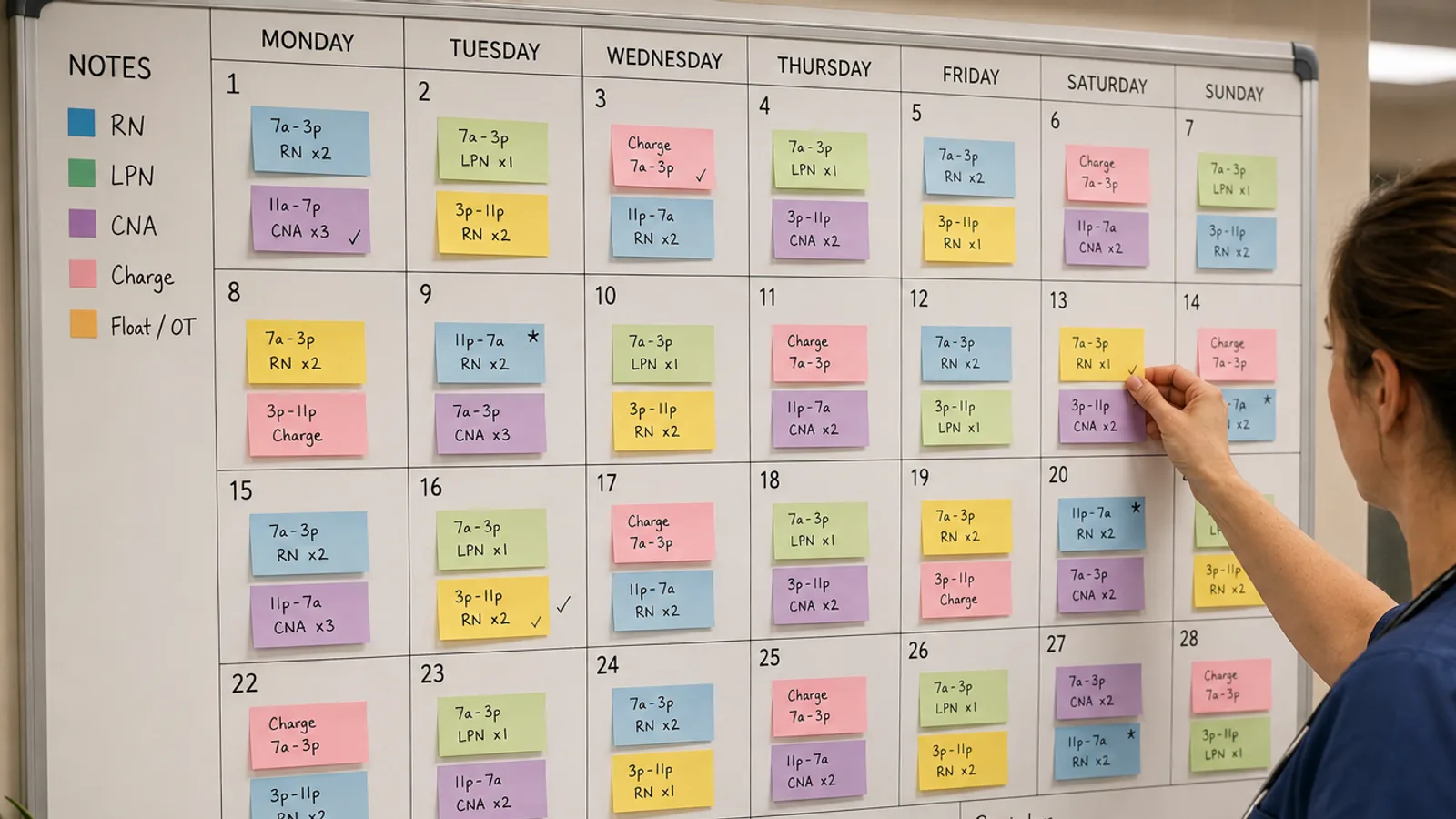
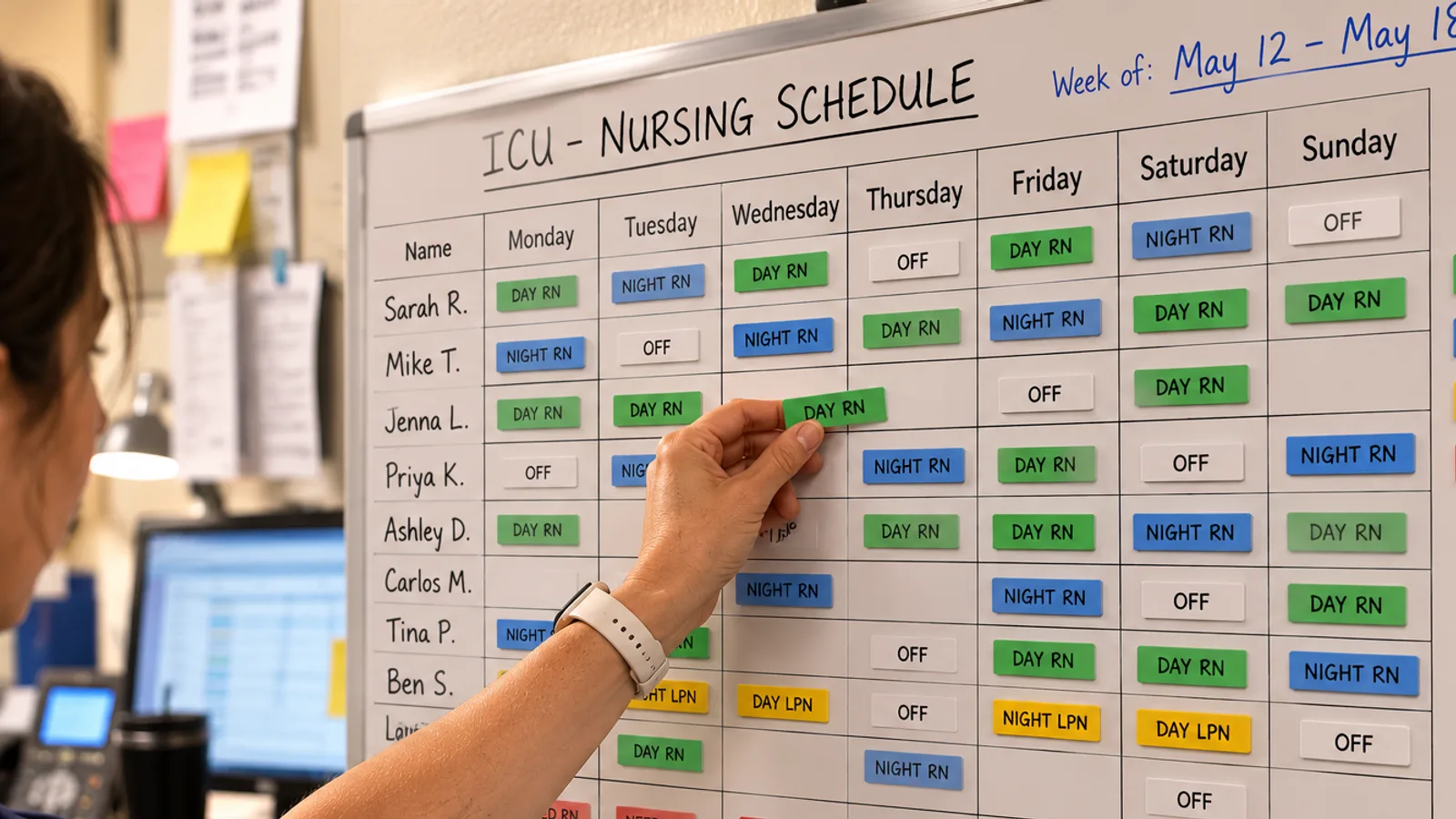
Abandoned scheduling automation looks like a live license with a dead workflow. The tool still holds the roster and still appears in the budget, but the schedule is assembled somewhere else and pasted back in afterwards. Nobody decides to stop using it. Overrides accumulate until the software is a record of the schedule rather than the source of it.
The clearest published description of this comes from a reviewer of QGenda, a physician and staff scheduling platform. Writing on Capterra, Courtney D., a Manager of Employee and Physician Relations, put it plainly:
“automated scheduling and rules set up seem to have hiccups…I just stopped using the automation.”
Courtney D., Manager of Employee and Physician Relations, May 10, 2024, Capterra
That is not a review of a bad product. Another reviewer of the same platform wrote the opposite:
“Qgenda is easy to use and does a great job at automating.”
Ari W., Administrator, Hospital & Health Care, May 7, 2024, Capterra
Both describe the same software in the same month. What separates them is whether the rules were ever finished, and whether anyone owned them afterwards.
The pattern shows up in three stages, and the first two look like success.
1. Go-live
The tool generates a draft. The manager corrects a few assignments by hand and posts it.
2. Override drift
Corrections grow each cycle as real constraints surface that the rules never captured.
3. Quiet reversal
Building from scratch becomes faster than correcting the draft. The spreadsheet returns.
Stage three is where the money is lost, and nobody reports it. A cancelled contract triggers a conversation. An unused one does not.
Why Do the Scheduling Rules Stop Matching the Unit After Go-Live?
Scheduling rules stop matching the unit because a unit’s real constraints surface over months, while the configuration window lasts days. Implementation captures the rules someone can state out loud in a meeting. It misses the ones living in the manager’s judgment, and every missed rule becomes a correction made by hand after the draft is generated.
Consider what a nurse manager knows that a configuration form rarely asks. Two specific nurses cannot share a shift. One nurse is finishing a degree and cannot take Tuesdays this term. A per-diem nurse is reliable on weekends and unreachable on weekdays. None of that is exotic, and all of it is invisible to a rules engine configured before anyone knew to ask.
The same reviewer base describes the front end:
“The initial setup was time-consuming…collating…digitize documents.”
Roger S., Practice Administrator, May 3, 2024, Capterra
Setup effort is finite, so it gets spent on the rules known on day one. Rules discovered in month four have no budget and no owner.
The unit itself also changes. A nurse resigns, a competency level moves, the census band shifts for the season. Each change invalidates part of the configuration. Software that is never reconfigured keeps producing schedules against rules that stopped being true, which is worse than producing nothing, because the manager now has to find the errors before posting.
Why Does One Bad Schedule End a Manager’s Trust in Automation?
One bad schedule ends trust because a scheduling error at a small hospital lands on a person rather than on a report. A schedule that puts an unqualified nurse in a charge slot, or leaves a night uncovered, is discovered by whoever is on the unit at the time. After that, the manager checks every future draft line by line, which takes about as long as building from scratch.
That is the mechanism that turns one defect into permanent abandonment. Automation only saves time if its output can be trusted without full re-verification. Once a manager audits every assignment, the math reverses and the tool becomes a slower route to the same schedule.
The stakes are higher at a small hospital because the margin for absorbing an error is thinner. Under CMS §485.635, a Critical Access Hospital must furnish nursing services under written policies, and the schedule is part of the evidence that patients were adequately staffed. There is no float pool to quietly cover a miss, the same thinness behind after-hours callout coverage being so hard to solve at this size.
What makes trust recoverable is a visible reason. A draft that says which rule produced an assignment, and which shifts it could not fill and why, can be checked in minutes. A finished grid with no explanation has to be checked in full or believed in full, and after one bad cycle no manager will believe it.
Who Owns the Scheduling Rules After the Vendor Implementation Team Leaves?
At most small hospitals, nobody does. Enterprise scheduling platforms assume a super-user: a staffing coordinator or workforce analyst who keeps the configuration current. A hospital with 25 beds or fewer rarely has that role, so ownership defaults to the nurse manager, who already has a unit to run.
That is why abandonment runs faster at small hospitals. The Flex Monitoring Team’s historical data counts 1,388 certified Critical Access Hospitals in the United States as of July 2026. Staffing at that scale is thin by design, because low-volume rural service areas cannot support the overhead a large system carries.
| Ownership task | Who does it at a large system | Who does it at a 25-bed hospital |
|---|---|---|
| Updating rules when a nurse's competency or role changes | Workforce analyst or staffing office | The nurse manager, between clinical duties |
| Re-training after a vendor interface change | Internal super-user runs a session | Nobody, until something breaks |
| Diagnosing why a draft looks wrong | Super-user, then vendor support | The manager overrides it and moves on |
| Deciding the tool is no longer worth it | A renewal review with usage data | Nobody decides; use just stops |
The last row is the one worth sitting with. Where no usage review happens, abandonment never becomes a decision anyone made, so it never becomes a problem anyone fixes.
How Do You Tell Whether Your Automation Is Being Used or Worked Around?
You measure overrides, not logins. A manager can open the software daily and still build the real schedule somewhere else. Five questions separate a working tool from one being politely worked around, and all five can be answered from your last three published schedules.
- How many assignments changed between the generated draft and the posted schedule? A handful is normal. A third of the grid means the rules do not match the unit.
- Does the schedule pass through a spreadsheet? A parallel spreadsheet is the clearest sign the software has become a filing cabinet.
- Can anyone name the last rule change made in the tool? If the answer is the implementation, the configuration is as old as the contract.
- When a draft looks wrong, can the manager find out why? If the only remedy is an override, every defect turns into a manual habit.
- Would the schedule still get built if the software went down on a Tuesday? If yes, and nobody would notice for a week, the automation has already been abandoned.
Write down two of them every cycle. Override count and the presence of a parallel spreadsheet predict abandonment before it happens, and neither appears on a vendor dashboard. It is the same measurement gap that lets self-scheduling quietly shift work back onto the manager while the schedule still looks fine from outside.
How Does SimpleScheduleAI Keep the Automation From Being Abandoned?
SimpleScheduleAI is an AI-native nurse scheduling service for Texas Critical Access Hospitals. Our AI builds your schedule. Our scheduling team checks every draft. Your manager approves. That middle step is the direct answer to abandonment, because checking the draft and keeping the rules current is done by us rather than added to the nurse manager’s week.
Three parts of the model target the failure this post describes.
We configure the rules before your first cycle, and we keep configuring them. Charge nurse requirements, skill mix ratios, on-call limits: all mapped to your unit. Changes take effect the next cycle, and rule changes are included in the monthly price rather than billed as a change request. Rules drift out of date at most hospitals because updating them costs someone time they do not have. Here it costs an email.
Every cycle produces three schedule options, not one. SimpleScheduleAI generates a balanced draft, a fairness-optimized draft, and a cost-optimized draft. The manager chooses between real alternatives instead of accepting or overriding a single answer. Each draft also names the shifts it could not fill and why, so a review takes minutes rather than a line-by-line audit.
Your staff never touch software. You get a post-ready PDF and Excel file each cycle, so adoption cannot fail on the nurse side. Onboarding takes 3 to 5 business days. First schedule inside two weeks.
Honest limitations, because they matter more than the pitch here. We do not track credential or license expiry dates, so renewals remain the hospital’s process. Night shifts are filled first because they are the hardest to cover, but we do not keep a running per-nurse night count. Weekend and holiday distribution is what we count, and we can send you that record on request. If your hospital already has a staffing coordinator who owns the configuration and keeps it current, the software route is a reasonable fit.
To see the mechanics, compare nurse scheduling software against the service approach and read how AI nurse scheduling produces the draft. The operational requirements behind critical access hospital scheduling are covered separately, and how it works walks the cycle end to end.
Our Take
Automation gets abandoned at small hospitals for an unglamorous reason. Rules go stale and nobody owns them. Platforms built for 300-bed systems assume a super-user role a 25-bed hospital does not staff, so ownership lands on a nurse manager who already has a unit to run. Whoever keeps the rules current is the whole product. If that person is missing from your org chart, the software gets abandoned and the license renews anyway.
What to Do This Week
- Count the overrides on your last posted schedule. Compare the generated draft with what got posted. Under five changed assignments is healthy. Over twenty means the configuration no longer describes your unit.
- Find the parallel spreadsheet. Ask whether the schedule passes through a spreadsheet before it is posted. If it does, the software is storing schedules rather than building them.
- Name the owner of your scheduling rules. Write down who updates rules when a nurse’s competency, role, or availability changes. A blank name is the gap to close first, whichever tool you use.
- Log the last rule change and its date. If the most recent change dates from implementation, book an hour to review the rules against your current roster.
- See how the service model handles this if you are a Texas Critical Access Hospital. The rules are configured with you and updated for you, so nobody at the hospital has to own the configuration. Start at how it works.
Stop babysitting the scheduling software
Our AI builds your schedule, our scheduling team checks every draft, and your manager approves. Rule changes are included, so the configuration stays current.
See how it works →Frequently Asked Questions
Why do hospitals stop using scheduling software they already paid for?
Because the rules inside it stop matching the unit and nobody owns updating them. Each unmatched rule becomes a manual override, overrides accumulate every cycle, and building from scratch eventually beats correcting the draft. The license keeps renewing because nobody formally decides to stop.
Is scheduling automation worth it for a hospital with 25 beds or fewer?
It is worth it when someone owns the configuration. Automation at this scale fails on ownership rather than capability, because a small hospital rarely staffs the super-user role enterprise platforms assume. Assign that owner internally, or buy the ownership as part of a service.
How do I know if our nurse scheduling automation is actually being used?
Count changed assignments between the generated draft and the posted schedule, and check whether a spreadsheet sits between the two. Login counts prove nothing, because a manager can open the tool daily and build the real schedule elsewhere.
Can automation handle rules that were never written down?
Only once they are written down. Constraints that live in the manager’s judgment, such as two nurses who should not share a shift, are invisible to any rules engine until someone records them. Capturing new constraints as they surface is the recurring work that has no owner at a small hospital.
What happens to the schedule if the vendor changes the interface or support declines?
At a hospital with no super-user, usually nothing good. Retraining has no owner, so the workaround becomes permanent. Before buying, ask who will absorb a version change, and treat the answer as part of the cost. Our comparison of a managed service against scheduling software covers where that cost lands in each model.
Pradeep Pandey is the co-founder of SimpleScheduleAI. He serves as Deputy General Manager of Operations at Apollo Hospitals and holds an MBA from IIM Trichy (Operations and Marketing). His work focuses on workforce optimization and scheduling operations for small and rural hospitals. LinkedIn →