By Pradeep Pandey · Co-Founder · 12 min read · Updated
What Is Clinical Scheduling? How It Differs From Nurse Scheduling
Clinical scheduling covers every licensed and allied health role a hospital has to staff, not just nursing. A small rural hospital runs five of these staffing streams at once, under two federal rules that never pause, with no float pool to absorb a gap in any of them.

Key Takeaways
- Clinical scheduling is the whole job: assigning qualified clinical staff, nurses, providers, and allied health, to the shifts and on-call rotations that keep a hospital covered. Nurse scheduling is one part of it
- The distinction is operational, not academic. Each staff category carries its own coverage rules, credential requirements, and on-call structure, so a tool built for one does not transfer to the others
- A small rural hospital runs five scheduling streams at once with overlapping owners and no float pool, so a gap in one stream lands on someone already covering another
- Two federal requirements sit underneath the whole thing: a licensed nurse on duty whenever there is an inpatient, and emergency services available 24 hours a day
- The workable sequence is to stabilize nursing first, then layer on provider and ancillary coordination. Trying to solve all five streams with one new system at once is how implementations fail
Table of Contents
- What Is Clinical Scheduling?
- How Does Clinical Scheduling Differ From Nurse Scheduling?
- What Scheduling Streams Does a Small Hospital Actually Run?
- Which Compliance Rules Sit Underneath Clinical Scheduling?
- What Software Handles Clinical Scheduling at a Small Hospital?
- How Does SimpleScheduleAI Fit Into Clinical Scheduling?
- What to Do This Week
- Frequently Asked Questions
Clinical scheduling is the process of assigning qualified clinical staff to the shifts and on-call rotations that keep patient care covered. It spans nurses, providers, and allied health roles. Nurse scheduling is the part of that job covering nursing staff only.
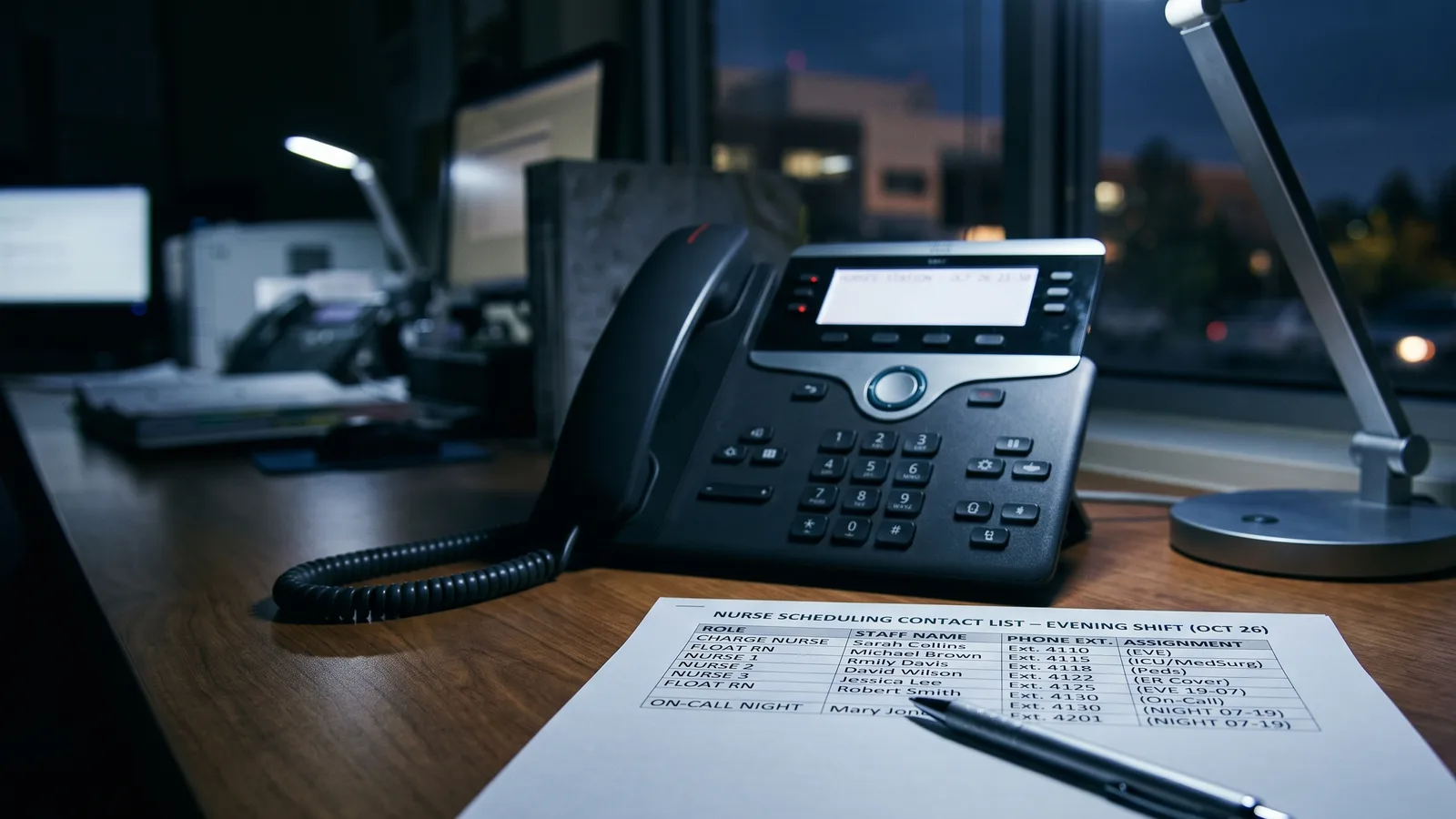
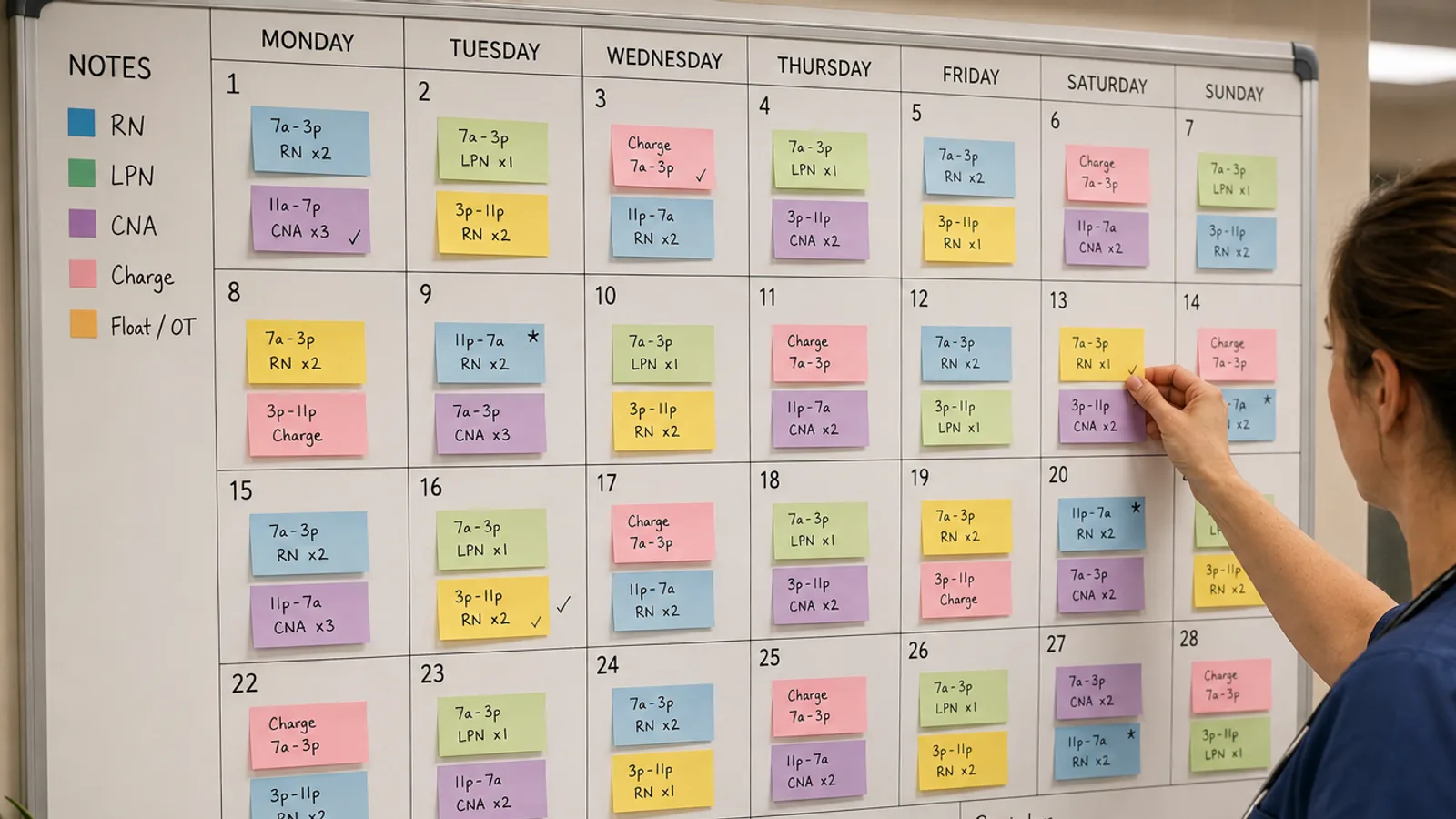
The distinction sounds academic until you sit at the desk where it lands. At a critical access hospital, the nurse manager owns the nursing grid and every nursing callout that follows it. Provider on-call usually belongs to the medical director or an administrator, and the ancillary departments have their own leads. What makes it hard is that the pools are small, the roles overlap, and no float pool exists to absorb a gap in any of them. The scheduling system the hospital bought typically covers one of the five streams.
What Is Clinical Scheduling?
Clinical scheduling assigns qualified clinical personnel to patient care shifts and on-call rotations based on clinical need, staff availability, credentials, and regulatory requirements. The staff in scope include registered nurses, licensed practical nurses, physicians and advanced practice providers, plus allied health roles such as radiologic technologists, laboratory staff, and respiratory therapists.
What separates it from scheduling in other industries is that the constraints are clinical and legal, not preferential. A retail schedule that is one person short is inconvenient. A hospital shift without the required licensed coverage is a compliance problem and a patient safety problem at the same time.
Credentials are the second difference. Availability alone does not make a nurse eligible for a shift. The right certification, the charge sign-off, and the unit-specific qualification all have to line up, which means a clinical schedule is a matching problem before it is a calendar.
How Does Clinical Scheduling Differ From Nurse Scheduling?
Nurse scheduling is a subset of clinical scheduling. It covers every nurse who works the unit: RNs, LPNs, and CNAs, on staff or per diem, plus travel and agency nurses filling a contract. Employment type changes availability and cost, not whether the shift needs covering. Clinical scheduling is the umbrella over every licensed and allied health role in the building.
The reason the distinction matters is that the rules differ by category. Here are the same five streams from the section below, seen as scheduling problems.
| Scheduling stream | Typical shape | What makes it hard |
|---|---|---|
| Nursing shifts | 8 or 12 hour blocks, rotating days and nights | Credential match, charge coverage, fair distribution |
| On-call nursing | A standby roster sitting behind the posted grid | Who can actually come in at 2 AM, and what hours they already have |
| Provider on-call | Rotations, often including contracted clinicians | Coordinating people who are not employees, response expectations |
| Ancillary departments | Weekday hours plus after-hours call | Pools small enough that one absence removes the service |
| Emergency coverage | Continuous, no gaps permitted | Highest stakes, mixed employed and contracted staffing |
Each column carries its own compliance framework and its own coverage logic. A system that models nursing shifts well may have no concept of a contracted provider’s on-call week. That is why hospitals often end up with a scheduling tool and a separate spreadsheet, and why the person who owns both is usually the nurse manager.
The overlap is also where the hours go. When a nurse manager says scheduling takes 8 to 12 hours a week, that time is rarely just building the nursing grid. Across the 30-plus nurse manager interviews we ran before building SimpleScheduleAI, securing callout and absence cover was the largest single consumer of those hours, not the initial build. Our breakdown of where those hours actually go splits them line by line.
What Scheduling Streams Does a Small Hospital Actually Run?
Five, typically, and all at once. With no float pool from a parent system, every gap in any stream has to be solved locally through per diem staff, a swap, or an on-call activation.
1. Nursing shifts
Floor nurses, charge coverage, and aides across days, evenings, and nights, seven days a week. The largest and most visible stream, and where most scheduling software focuses.
2. On-call nursing
A separate layer from the posted grid, used for volume spikes and after-hours coverage. Tracking who is on call and what hours they have already worked happens outside the schedule itself.
3. Provider on-call
Physician and advanced practice coverage, often involving part-time or contracted clinicians, which makes it harder to schedule than employed staff.
4. Ancillary departments
Laboratory, radiology, and respiratory therapy, usually shared between inpatient and outpatient work, with pools small enough that one absence removes the service.
5. Emergency coverage
The highest-stakes stream. Gaps are immediately visible, and the requirement to keep emergency services available never pauses.
Reading that list, the scheduling problem at a small hospital looks less like a calendar and more like five interacting rosters with one owner. That is the honest starting point for any tool evaluation.
Which Compliance Rules Sit Underneath Clinical Scheduling?
Two federal requirements shape the whole exercise at a critical access hospital, and both are worth knowing precisely rather than approximately.
A licensed nurse on duty whenever there is an inpatient. Under 42 CFR 485.631, a registered nurse, clinical nurse specialist, or licensed practical nurse must be on duty whenever the hospital has one or more inpatients. This is the floor no schedule may drop below, and the record has to show it was met.
Emergency services available 24 hours a day. Under 42 CFR 485.618, emergency services must be available on a 24-hour basis, which is what makes the emergency stream the one with no acceptable gap.
Separately, a registered nurse, or where State law permits a physician assistant, must supervise and evaluate the nursing care of each patient under 42 CFR 485.635. The schedule expresses that requirement through charge coverage on every shift, and our CMS compliance guide walks the documentation side. None of these are documentation exercises invented after the fact. They are the constraints the schedule has to satisfy while it is being built, and the reason the 1,388 critical access hospitals certified nationally as of July 2026 cannot treat scheduling as a purely administrative task.
What Software Handles Clinical Scheduling at a Small Hospital?
Start with the honest baseline: most small hospitals run clinical scheduling in Excel or Google Sheets. Spreadsheets are free, familiar, and endlessly customizable. What they do not do is track hours as they accumulate, flag a coverage gap before it becomes urgent, or leave an auditable record without manual effort, which is the case our Excel comparison walks through in detail.
Beyond spreadsheets, the market divides into three practical categories.
Nurse-focused scheduling platforms such as NurseGrid and Aladtec handle nursing shift scheduling and are the usual starting point, because nursing is the largest stream. Our nurse scheduling software guide compares that category in depth. Their scope is nursing; provider on-call and multi-department coordination generally sit outside it. These are self-serve tools, so configuration and upkeep belong to whoever at the hospital owns the system.
EHR-embedded scheduling modules ship inside the broader clinical platform. Coverage varies by vendor and by how the module was implemented, so the practical question is not whether the module exists but whether your implementation actually handles callout coverage and overtime visibility. Ask your vendor to demonstrate both before assuming they are included.
Scheduling services invert the model. Instead of handing the hospital a tool to configure, a team does the scheduling work and the manager approves the output. That fits facilities where nobody has the hours to own a platform, and it is the model we describe in the service versus software comparison.
For a small hospital, the most practical answer to “what do we need for clinical scheduling” is usually: cover nursing properly first, then layer in provider and ancillary coordination once the nursing grid is stable. Attempting all five streams in one implementation is how scheduling projects stall.
How Does SimpleScheduleAI Fit Into Clinical Scheduling?
SimpleScheduleAI is an AI-native nurse scheduling service for Texas Critical Access Hospitals, and it works on the nursing side of that list: the posted grid, and the replacement search that starts when someone calls out against it. The AI builds each schedule against the compliance and fairness rules configured at onboarding, a scheduling specialist checks the draft, and the nurse manager approves before anything posts. Fair distribution of weekends and holidays is tracked with a running per-nurse count, and every change lands in a timestamped log. When a nurse calls out, the service returns a ranked shortlist of qualified replacements with the reasons visible: skills, role, charge coverage, and overtime risk. That is the callout handling process run as a service rather than a phone tree, and the full cycle is on how the scheduling process works.
Being precise about scope, and about where we are not right for you: we do not schedule providers, we do not run ancillary departments, and we are not an EHR integration. Deciding who sits on your standby roster stays your call; what we take on is the search that starts once a shift opens. If your hardest problem is provider on-call or ED contracting, we are not the answer to it. Our claim is narrower and, we think, more useful: nursing is the stream that consumes the most manager hours at a small hospital, and stabilizing it first is what makes the other four manageable.
Our Take
Most scheduling tools are sold against the word "clinical" and delivered against the word "nursing". That gap is where small hospitals lose faith in software, because the tool solves a quarter of the job and the manager keeps the spreadsheet for the rest. Ask any vendor which of your five streams they actually cover, in writing, before the demo ends. A vendor that names its limits is easier to plan around than one that implies it covers everything.
What to Do This Week
- Write down your five streams and who owns each one. If the same name appears more than twice, you have found the real bottleneck, and it is a person, not a product.
- Ask your current scheduling tool three questions. Does it filter callout candidates by credential, does it show hours against the overtime threshold your hospital actually uses, and could you hand a surveyor a staffing record from it? Anything you answer no to stays manual.
- Check the nursing floor first. Confirm your last month of schedules kept a licensed nurse on duty for every inpatient hour, and that the record proves it.
- Sequence the fix, do not bundle it. Pick the stream costing the most hours, usually nursing, and stabilize that one before touching provider or ancillary scheduling.
Stabilize the nursing stream first
SimpleScheduleAI builds compliant, fair nurse schedules for your manager to approve. Flat monthly pricing, first schedule inside two weeks, no IT setup.
See how it works →Frequently Asked Questions
Q: Is clinical scheduling the same as patient scheduling?
No. Patient scheduling coordinates when patients receive care, meaning appointments, procedures, and admissions. Clinical scheduling coordinates when staff are available to deliver it. They serve different owners and use different tools, which is why a hospital that upgrades its patient scheduling module and expects the staffing problem to improve is usually disappointed.
Q: Who owns clinical scheduling at a small hospital?
Nursing scheduling generally belongs to the nurse manager or Director of Nursing, while provider on-call is often coordinated by the medical director or an administrator. At the smallest facilities one person carries both, which is exactly why the streams are worth writing down separately.
Q: Does clinical scheduling software integrate with the EHR?
Some platforms offer EHR integrations, and complexity varies by vendor and by hospital. For a small facility, a standalone scheduling system that exports cleanly to payroll is often a simpler starting point than an integration project. SimpleScheduleAI is not an EHR integration and does not connect to clinical records; it works from your roster and schedule data.
Q: Can one system cover all clinical staff categories?
Enterprise platforms aim to, and large health systems with IT teams do run them that way. At a 25-bed hospital the cost of that breadth is configuration work nobody has time for, which is why the sequence of stabilizing nursing first tends to beat a single all-streams implementation.
Sources
- 42 CFR 485.631, Conditions of Participation: Staffing and staff responsibilities. eCFR
- 42 CFR 485.618, Conditions of Participation: Emergency services. eCFR
- 42 CFR 485.635, Conditions of Participation: Provision of services. eCFR
- Flex Monitoring Team, Historical CAH Data (1,388 certified CAHs, July 2026). Flex Monitoring
Pradeep Pandey is the co-founder of SimpleScheduleAI, an AI-native nurse scheduling service built for Critical Access Hospitals in Texas. He serves as Deputy General Manager of Operations at Apollo Hospitals and holds an MBA from IIM Trichy. LinkedIn →