By Pradeep Pandey · Co-Founder · 14 min read · Updated
The Real Cost of Losing One Nurse at a Rural Hospital (With the Math)
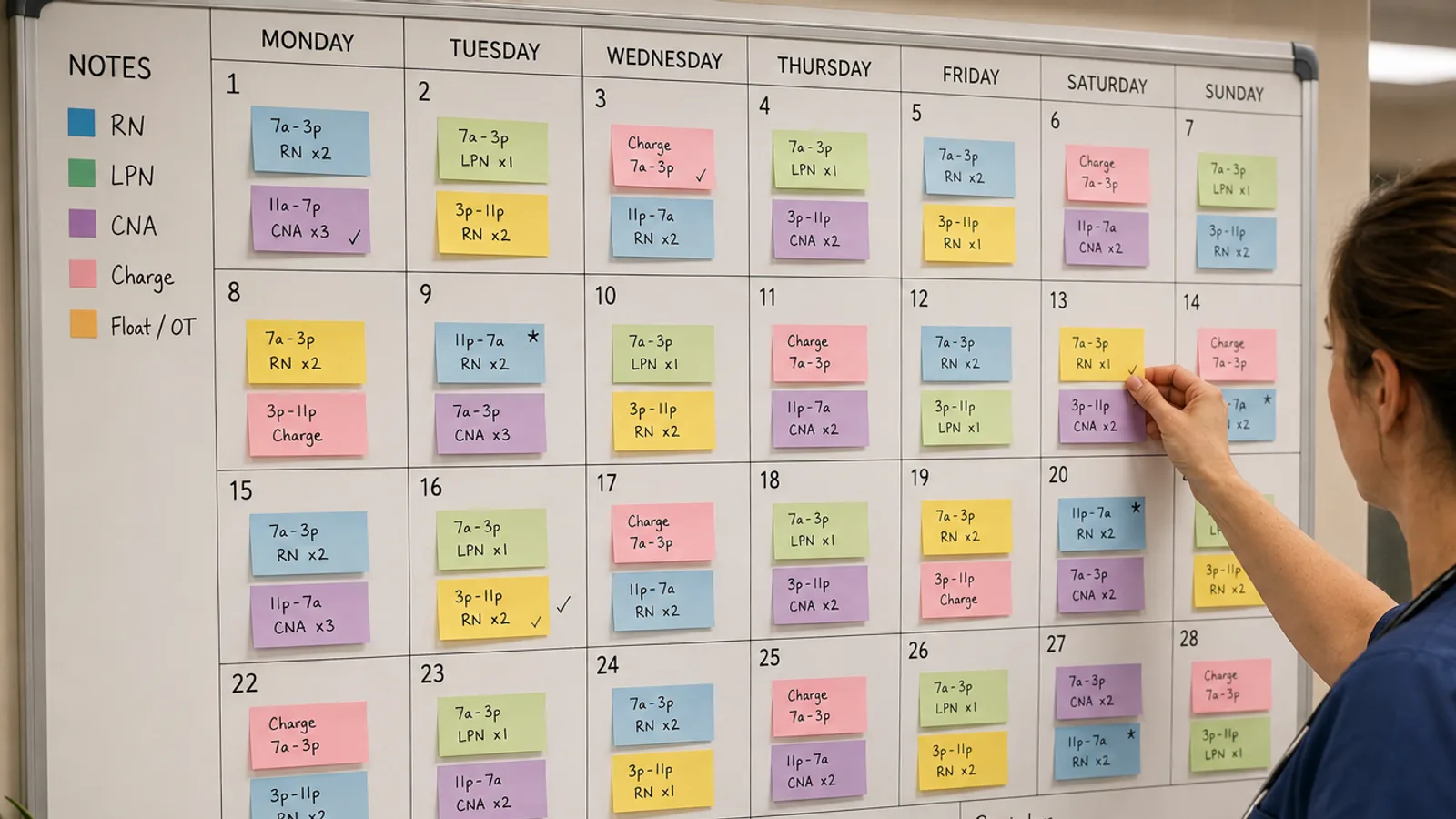
Lose one nurse at a 300-bed hospital and the float pool absorbs it. Lose one at a 25-bed hospital and the open shifts land back on the nurses who stayed. The cost of nurse turnover at rural scale is a coverage problem that outlasts a single invoice by months.
Key Takeaways
- The cost of nurse turnover is usually quoted as one national number, about $60,090 per bedside RN departure per the 2026 NSI report. That figure is only the floor at a small rural hospital.
- One RN leaving a roughly 25-nurse rural hospital is about 4 percent of the whole nursing staff gone at once. The same departure at a 300-bed system is well under one percent.
- The role does not fill overnight. It takes about 78 days to fill an RN vacancy, and a Critical Access Hospital has no float pool to cover that gap, so the open shifts fall on overtime, agency rates, and the nurses still on the roster.
- Texas Critical Access Hospitals carry the highest RN turnover of the state’s three hospital groups, about 18.2 percent, so this recurs often enough to plan around as an annual line item.
- Fair, predictable schedules are a documented retention lever, separate from recruiting. Distributing nights, weekends, and callouts evenly is one of the few turnover drivers a nurse manager can actually control.
Table of Contents
- Why Does Losing One Nurse Cost a Rural Hospital More Than a Large System?
- What Is the Cost of Nurse Turnover for a Single RN?
- What Does the Open Role Cost While You Recruit?
- How Does Fair Scheduling Connect to Nurse Retention?
- How Does SimpleScheduleAI Help Rural Hospitals Keep Nurses?
- What to Do This Week
- Frequently Asked Questions
The cost of nurse turnover usually gets quoted as one national figure, somewhere around sixty thousand dollars per departure. That number is real, but it hides what a rural hospital actually lives through when one nurse leaves. At a 25-bed hospital, one RN is a far larger share of the nursing staff than at a 300-bed system, and there is no float pool to absorb the gap.
The math below builds the cost of losing one nurse from the sourced national figure, then layers on the parts a small rural hospital feels most. Every number is either linked to a primary source or labeled as an illustrative estimate at a stated rate.
Why Does Losing One Nurse Cost a Rural Hospital More Than a Large System?
Losing one nurse costs a rural hospital more because a single RN is a much larger share of a small staff, and the facility has none of the buffers a large system uses to absorb a departure. At a roughly 25-nurse hospital, one resignation removes about 4 percent of the nursing workforce at once. At a 300-bed system, the same one nurse is well under one percent.
The proportional hit is only half of it. A large hospital has a float pool, a staffing office, and a recruiting pipeline that keeps candidates warm. A Critical Access Hospital serving a low-volume rural area has thin staffing margins by design, which the Flex Monitoring Team documents across the CAH program. When one nurse leaves, the replacement pool shrinks to a short list of individual people, and the open shifts get covered by the same nurses who are already on the schedule.
That pressure compounds where the finances are already tight, and Texas has more rural hospitals vulnerable to closure than any other state, as we break down in the 2026 rural hospital loss data. This is why turnover reads differently on a rural roster. Texas has 93 critical access hospitals, and its CAHs carry the highest RN turnover of the state’s three hospital groups at about 18.2 percent, drawn from the Texas DSHS 2024 Hospital Nurse Staffing Study. One departure a year on a small unit is the baseline to plan around.
25-bed rural hospital
One RN out of roughly 25 nursing staff is about 4% of the workforce, with no float pool to cover the gap. Illustrative staff size.
300-bed system
One RN out of several hundred nurses is well under 1%, absorbed by a float pool and a staffing office. Illustrative staff size.
What Is the Cost of Nurse Turnover for a Single RN?
The average cost to turn over one bedside RN is $60,090, per the 2026 NSI National Health Care Retention & RN Staffing Report, with average hospital RN turnover at 17.6 percent. That figure bundles separation, the cost of covering the vacancy, orientation, and onboarding for the replacement. It is a national average across 527 hospitals, so treat it as the anchor.
For a rural hospital, the anchor is only where the accounting starts. The parts a small facility feels most sharply sit around that number: the coverage gap while the role is open, the manager time spent rebuilding the schedule by hand, and the fairness cost as the open shifts pile onto the remaining staff. The table breaks down the components of one departure and marks which are sourced and which are illustrative.
| Cost Component | Figure | What It Covers |
|---|---|---|
| Replacement cost, all-in | $60,090 (sourced, NSI 2026) | Separation, vacancy coverage, orientation, and onboarding for one bedside RN, national average |
| Coverage during the vacancy | About $10,000 premium (illustrative) | Overtime or agency to backfill the open line across the roughly 11-week recruit window |
| Manager scramble time | Illustrative, not invoiced | Weeks of rebuilding coverage by hand at a facility with no staffing office |
| Fairness and retention risk | Not a dollar line | The nurses who stay absorb the open shifts, which raises the odds of the next resignation |
One honest note on the math: the NSI $60,090 already includes some vacancy coverage, so the coverage row overlaps with the anchor rather than stacking cleanly on top of it. The added rows show where a small rural hospital feels that one departure most sharply. They mostly sit inside the $60,090 already, so treat them as detail on the anchor rather than extra dollars to add up.
What Does the Open Role Cost While You Recruit?
The open role costs a rural hospital in overtime and agency premiums for as long as it takes to hire, and that window is not short. It takes about 78 days to fill an RN vacancy, roughly 11 weeks. With no float pool, every shift on that vacant line has to be covered by someone at a higher rate or by the staff already on the roster.
Here is the math, with the assumptions stated. A full-time RN line runs about 36 hours a week, three 12-hour shifts. Over the roughly 11-week vacancy, that is about 400 shift-hours to backfill. At a $50 per hour loaded rate, covering those hours at straight time would run about $20,000. Covered on overtime or agency at a $75 per hour premium rate, it runs closer to $30,000. The premium, the extra cost of covering the gap instead of having a nurse in the seat, is about $10,000. This is an illustrative figure at the stated rates only.
The premium is only the cash part. The same coverage gap concentrates overtime on a handful of nurses, which is the after-hours pattern we break down in our guide to after-hours callout coverage at small hospitals. Each of those covered shifts is also a manager building a call list by hand, at a facility with no staffing office to hand it to.
How Does Fair Scheduling Connect to Nurse Retention?
Fair, predictable scheduling connects to retention because unfair schedules are one of the few turnover drivers a nurse manager can act on directly. The American Nurses Association treats adequate, well-distributed staffing as central to keeping nurses, and frames it as one of several strategies that work together rather than a single fix. Scheduling is the lever a small hospital owns without new budget.
The mechanism is not complicated. When the same reliable nurses absorb the open shifts, the nights, and the holidays cycle after cycle, they either get used to it or they leave. At a 25-bed hospital, two or three over-burdened nurses are a resignation waiting to happen, and losing one of them restarts the $60,090 clock. We trace how that load concentrates on a few willing nurses in nurse burnout and the CAH schedule.
To be clear about the limits of this claim: no scheduling method reduces turnover by a fixed percentage, and anyone who quotes you one is guessing. What fair scheduling does is remove a known, controllable irritant. Distributing weekend and holiday load evenly before individual preferences are applied is a retention practice with no guarantee attached, and it is worth doing because it is one of the cheapest retention moves available to a rural hospital.
How Does SimpleScheduleAI Help Rural Hospitals Keep Nurses?
SimpleScheduleAI is an AI-native nurse scheduling service: the AI builds the schedule, our scheduling team checks it, you approve. For Texas Critical Access Hospitals, that means the fairness rules for weekends and holidays are applied before the manager reviews the schedule, so the load is distributed evenly instead of concentrating on the two or three nurses who always say yes. When a nurse calls out, the service produces a ranked replacement shortlist sorted by overtime exposure, skill match, and rotation fairness, which keeps the coverage gap from quietly turning into burnout.
You can see how the pieces connect across our nurse scheduling software overview, the way AI nurse scheduling builds the ranked drafts, the operational requirements behind critical access hospital scheduling, and the end-to-end walkthrough of how the service works.
One honest limitation: SimpleScheduleAI does not recruit nurses and it does not shorten the 78-day time-to-fill gap. It cannot fill a vacancy that a rural labor market cannot supply. It manages the coverage and the fairness during the gap so the departure does not trigger the next one. If your problem is purely recruiting reach, scheduling is the wrong tool for that part.
Our Take
The $60,090 number gets the headlines, but at a rural hospital the real damage is the 78 days after, when the open shifts land on the nurses covering the gap. That is where the next resignation is born. The labor market and the first departure are largely outside your control. The coverage gap that follows is the part you can steer, and it decides whether three more people burn out. That is a scheduling decision, and it is one of the few retention levers a small hospital can pull without a bigger budget.
What to Do This Week
- Put a real number on your last departure. Start with the $60,090 replacement anchor as your floor, then look at your own overtime and agency spend for the weeks the line sat open, remembering the NSI figure already absorbs part of this cost. Our ROI calculator helps translate those inputs into a facility-specific figure. Most rural hospitals track only the agency invoice and miss the rest.
- Map who covered the gap. Pull the last vacancy and list which nurses picked up the open shifts. If the same two or three names carry it, you have a retention risk on top of the coverage one.
- Set a fairness floor before the next cycle. Cap undesirable-shift load per nurse per cycle, and distribute weekends and holidays before anyone self-picks. This is a policy change you can make without software.
- Check your recruiting clock against 78 days. If your average time-to-fill is longer, the coverage-premium math above is understating your cost. Plan the coverage for a full quarter.
- See how SimpleScheduleAI works if you run a Texas Critical Access Hospital. The service distributes the load fairly and ranks callout replacements so one departure does not cascade into three. Start at how it works, or book a call to talk through your roster.
One departure should not cost you three more nurses
SimpleScheduleAI distributes weekends and holidays fairly and ranks callout replacements, so the coverage gap after a resignation does not burn out the nurses who remain. Built for Texas Critical Access Hospitals.
See how it works →Frequently Asked Questions
The Numbers
Q: How much does it cost to replace one nurse?
The 2026 NSI National Health Care Retention & RN Staffing Report puts the average cost to turn over one bedside RN at $60,090, covering separation, vacancy coverage, orientation, and onboarding. Because that figure already bundles vacancy coverage, a rural hospital’s own overtime and agency spend for the roughly 11-week window the line sits open, an illustrative $10,000 or so at a $75 per hour premium rate, is mostly baked into the $60,090 rather than additive to it.
Q: Why does one nurse leaving hurt a small hospital more?
At a roughly 25-nurse rural hospital, one RN is about 4 percent of the nursing staff, versus well under one percent at a 300-bed system. A Critical Access Hospital also has no float pool or staffing office, so the nurses already on the roster absorb the open shifts themselves. The same departure lands proportionally harder.
Scheduling and Retention
Q: Can better scheduling actually reduce nurse turnover?
Fair, predictable scheduling is a documented retention lever with no guaranteed percentage attached. The American Nurses Association treats well-distributed staffing as central to keeping nurses. Distributing nights, weekends, and holidays evenly removes a known, controllable irritant. No honest vendor will quote you a fixed turnover reduction, because the outcome depends on your roster and your labor market.
Q: Does SimpleScheduleAI help us recruit nurses faster?
No. SimpleScheduleAI does not recruit and it does not shorten the roughly 78-day window to fill an RN vacancy. It manages the coverage and the fairness during the gap so one departure does not burn out the nurses who stayed and trigger the next resignation. Recruiting reach is a separate problem that scheduling does not solve.
Sources
[1] Average cost to turn over one bedside RN ($60,090), hospital RN turnover (17.6%), and time to fill an RN vacancy (78 days). NSI Nursing Solutions, 2026 National Health Care Retention & RN Staffing Report.
[2] Texas Critical Access Hospital RN turnover (18.2%, highest of the three hospital groups). SimpleScheduleAI Rural Hospital & CAH Nurse Staffing Statistics, drawn from the Texas DSHS 2024 Hospital Nurse Staffing Study.
[3] Texas critical access hospital count (93). Rural Health Information Hub, Texas state guide.
[4] Nurse staffing as a retention factor. American Nurses Association, Nurse Staffing.
[5] Thin rural staffing margins in the Critical Access Hospital program. Flex Monitoring Team.
Pradeep Pandey is the co-founder of SimpleScheduleAI, an AI-native nurse scheduling service built for Critical Access Hospitals in Texas. He serves as Deputy General Manager of Operations at Apollo Hospitals and holds an MBA from IIM Trichy (Operations and Marketing). His work focuses on workforce optimization and scheduling operations for small and rural hospitals. LinkedIn →