By Pradeep Pandey · Co-Founder · 25 min read · Updated
What Is Symplr Smart Square? Owner, Go App and Fit for Small Hospitals (2026)
When a nearby health system runs its nurse schedule in Smart Square, your administrator may ask whether your hospital should too. This is what symplr documents, what it leaves unpublished, and what a 25-bed hospital should ask in a demo.
Key Takeaways
- symplr Smart Square is nurse and staff scheduling software for hospitals and health systems. symplr says it combines “predictive analytics, automation, and flexible scheduling tools” (symplr.com). Its earlier name was Avantas Smart Square.
- symplr owns it now. AMN Healthcare sold Smart Square to symplr, and AMN’s Q2 2025 earnings release, filed with the SEC, says the sale closed on July 1, 2025. In February 2026, symplr said it is integrating Smart Square and symplr Workforce into a single workforce management platform.
- On scheduling, symplr claims Smart Square can forecast staffing needs “up to 120 days in advance with 96 percent accuracy”. It also describes staff self-scheduling and open shifts that can carry extra pay to get them filled early.
- Smart Square Go, the staff phone app, is free to download. Both app store listings say it “requires an active Smart Square account”, so it only works for someone who already has a Smart Square account.
- symplr does not publish a price, an implementation timeline, or a Critical Access Hospital reference customer for Smart Square. On Capterra it holds 4.6/5 from 19 reviews, a small sample.
Table of Contents
- What Is Symplr Smart Square?
- Who Owns Smart Square, and What Changed After symplr Bought It?
- How Does Smart Square Scheduling Work?
- What Is Smart Square Go, and Is Smart Square Free?
- What Is the Difference Between symplr Workforce and Smart Square?
- How Is Smart Square Different From SmartLinx?
- What Do Smart Square Reviews Say About Support and Onboarding?
- Which Hospitals and Industries Use Smart Square?
- What Does Smart Square Cover, and What Stays With the Nurse Manager?
- What Should You Ask symplr to Show in a Smart Square Demo?
- How Does SimpleScheduleAI Differ From Smart Square?
- What to Do This Week
- Frequently Asked Questions
A new hire may tell you their last hospital scheduled everyone in Smart Square. Or your administrator may have seen symplr Smart Square on a vendor list and wants to know what it is. This guide covers who owns Smart Square now, how its scheduling works, what the staff app does, and what it would leave on a nurse manager’s desk at a 25-bed hospital. Every capability answer comes from symplr’s own pages, AMN Healthcare’s filings, or verified Capterra reviews. Where symplr publishes nothing, this guide says so and puts the question on the demo list.
What Is Symplr Smart Square?
symplr Smart Square is scheduling software for nurses and other hospital staff. symplr sells it to hospitals and health systems under the label “Smart Square® Scheduling and Staff Planning”. Its product page sums it up in one line: “Smart Square® combines predictive analytics, automation, and flexible scheduling tools to help healthcare organizations improve coverage, efficiency, and staff satisfaction” (symplr.com).
The pitch on that page is about cost and coverage. It promises to “reduce premium labor”, which is hospital shorthand for hours paid above the normal rate, such as overtime and agency shifts.
The product is older than its current owner. It began as Avantas Smart Square. Avantas was a clinical labor management company in Omaha, Nebraska, and AMN Healthcare announced it had bought Avantas in December 2014 (AMN Healthcare). The Smart Square name has stayed through AMN and now symplr.
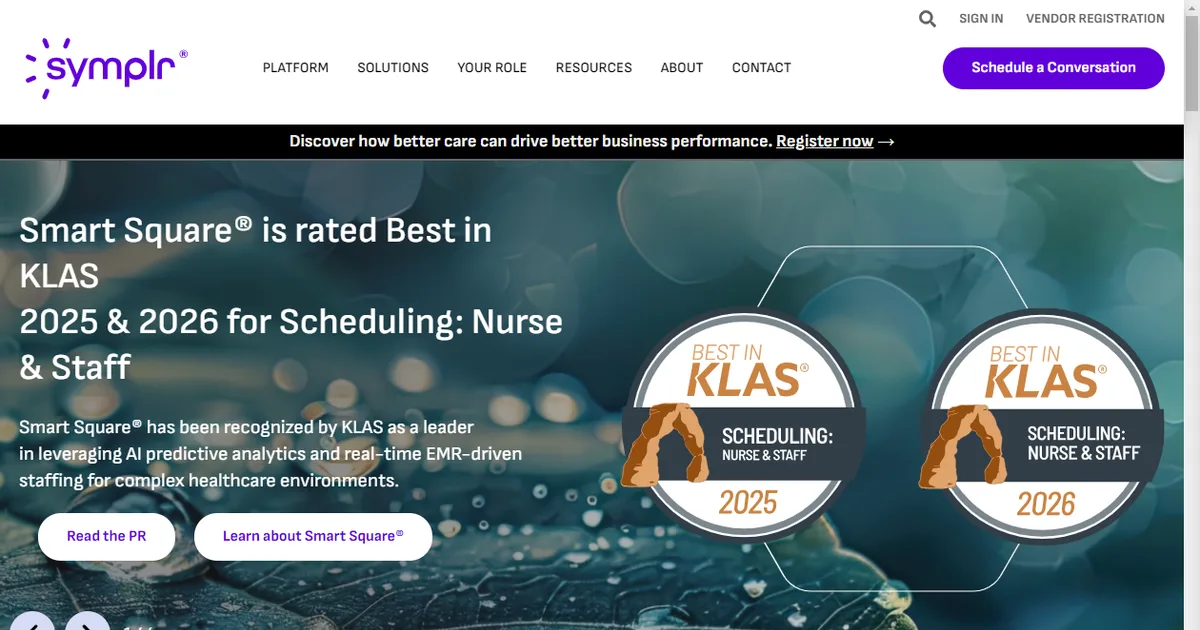
Smart Square was named Best in KLAS for Scheduling: Nurse & Staff in 2025 (AMN Healthcare) and again in 2026 (symplr). KLAS Research rates healthcare software; both announcements are vendor press releases.
Who Owns Smart Square, and What Changed After symplr Bought It?
symplr owns Smart Square. AMN Healthcare sold it to symplr for $75 million (AMN Healthcare). AMN’s Q2 2025 earnings release, filed with the SEC, says “The transaction closed on July 1”. The sale was announced on July 2, 2025.
In its 2026 award release, symplr describes itself as “a leading provider of enterprise healthcare operations software”. AMN Healthcare is a healthcare staffing and workforce company. Alongside the sale, AMN’s release says “symplr and AMN have entered into a commercial partnership”.
The bigger change came in 2026. At the ViVE conference on February 23, 2026, symplr announced plans to combine two products (symplr). In its words, symplr “is integrating symplr Workforce and symplr Smart Square into a single workforce management platform”. symplr sells a second product, symplr Workforce, that adds time and attendance, meaning the time clock staff use to clock in and out. The difference between the two is covered below.
As of October 2026, Smart Square still has its own product page on symplr.com. For a hospital looking at it today, that raises a practical point. Ask which product the contract names, and what happens to it once the two are combined.
How Does Smart Square Scheduling Work?
symplr does not publish a step-by-step view of a nurse manager’s week in Smart Square. What it documents is four features: staffing forecasts, staff self-scheduling, open shifts that can carry extra pay, and on-call. Ask symplr to walk through your own scheduling week in the demo. The numbers below are symplr’s own claims from its Smart Square page, checked in October 2026.
Forecasting. symplr claims Smart Square can forecast staffing needs “up to 120 days in advance with 96 percent accuracy”. In plain terms, the software predicts patient volume and the staff it will need, about four months out. At a 25-bed hospital, two admissions can change a night’s staffing. Ask symplr how the accuracy figure is measured, and on what size of unit.
Self-scheduling. Self-scheduling means nurses choose their own shifts first, inside limits the hospital sets, before the manager finishes the schedule. symplr’s feature text reads: “Give staff flexibility and fairness while maintaining coverage requirements. Support both union and non-union scheduling environments.” symplr does not publish how long the self-scheduling window runs or how approvals work. Self-scheduling on a small roster has its own problems, covered in self-scheduling at a critical access hospital.
Open shifts. symplr lists “Patented open shift management”, built on “an automated variable incentive model”. In plain terms, a hard-to-fill shift can carry an incentive, the amount can vary, and the software automates it. symplr claims this can “fill up to 75 percent of open hours early.” It does not publish a patent number. An incentive fills a shift only when someone is free to take it, and on a roster of 30 that may be a short list.
On-call. The on-call feature reads: “Manage pre-scheduled on-call needs and send rapid notifications for last-minute openings.” symplr does not say which roles it covers.
Connections to other systems. A badge on the page reads “Integrates with 30+ HR, payroll, and EMR systems”. The page does not name those systems. If your payroll or time clock vendor matters, ask for it by name.
What Is Smart Square Go, and Is Smart Square Free?
Smart Square Go is the staff phone app for Smart Square, published by symplr. It is free on the App Store and Google Play. Both listings add one condition: “Smart Square Go requires an active Smart Square account for access to its powerful features”. So the download is free, but the app needs an active Smart Square account behind it.
The app is written for clinicians. The App Store listing says nurses can “pick up available shifts that fit your schedule” and sync shifts to a personal calendar. It also lists this feature: “Submit time-off requests, trade shifts, and request to work in real-time, all within the app.”
Logins run per organization; ask your staffing office, or whoever administers Smart Square for your hospital, for the link. Neither store listing describes what a manager can do in the app, so ask symplr to show it. In October 2026 the App Store version was rated 3.0 from 610 ratings. The Google Play version was rated 2.7 from 150 reviews.
On the hospital side, there is no public price. Capterra lists Smart Square as “Contact vendor for pricing” and “Free trial not available”. symplr’s product page offers only a “Request a demo” button. It does not publish the license model, any implementation fee, or a minimum term.
What Is the Difference Between symplr Workforce and Smart Square?
symplr Workforce combines timekeeping and scheduling in one product. Smart Square is symplr’s scheduling and staff-planning product. symplr’s menu describes Workforce as time and attendance plus scheduling, and Smart Square as scheduling and staff planning. Timekeeping means staff clocking in and out, which feeds payroll.
A hospital does not need Workforce to run Smart Square, according to symplr. The symplr Workforce page asks, “Is there a standalone scheduling solution available?” Its answer: “Yes. Smart Square can integrate with leading third-party timekeeping systems, allowing healthcare organizations to modernize scheduling workflows without replacing their existing timekeeping investments.”
| Question | Smart Square | symplr Workforce |
|---|---|---|
| What symplr calls it | Scheduling and Staff Planning | Time and Attendance Staffing and Scheduling |
| Tracks staff clocking in and out | Can connect to third-party timekeeping systems, per symplr's FAQ | Yes, timekeeping is part of the product |
| Where it came from | Avantas, then AMN Healthcare, bought by symplr in 2025 | symplr's own product; its Capterra reviews from before 2020 describe an earlier GE version |
| Capterra rating, October 2026 | 4.6/5 (19 reviews; small sample) | 4.1/5 (13 reviews; small sample) |
| Plan announced February 2026 | To be combined with symplr Workforce into one platform | To be combined with Smart Square into one platform |
Read the Workforce rating with care. Its Capterra listing includes reviews from before 2020 of an earlier version under the GE name. One of them praises “GE’s Customer Service”.
How Is Smart Square Different From SmartLinx?
The two are aimed at different care settings. symplr sells Smart Square to hospitals and health systems. SmartLinx aims its scheduling at senior care. Its scheduling page headline reads “Smarter Employee Scheduling Software for Senior Care Teams” (smartlinx.com).
SmartLinx is explicit about the market it serves. Its homepage says “Our platform is purpose-built for the senior care ecosystem.” Its “Built for Your Operation” menu lists skilled nursing, assisted living, senior living and continuing care among its categories. SmartLinx holds 4.5/5 on Capterra from 6 reviews, a very small sample.
So the choice between them starts with the care setting. A hospital looking at SmartLinx should ask for a hospital reference customer. If SmartLinx is already on your list, the SmartLinx alternatives guide covers where it fits and what to compare it against.
What Do Smart Square Reviews Say About Support and Onboarding?
On support, Smart Square’s Customer Service sub-score on Capterra is 4.9 out of 5 from 18 reviewer ratings (checked October 2026). On onboarding, the reviews give no time frame. One hospital COO advises spending time up front on installation. The overall rating is 4.6, and 18 of the 19 reviews are dated November 2022.
The reviewers’ job titles include System Administrator, Labor Management Analyst, Director of Labor Management, and COO. Three work on the nursing side: an RN, a Director of Nursing, and a Clinical Float Pool Manager. None describes a critical access hospital or a hospital of 25 beds or fewer. The quotes below are verbatim, with the reviewer role and date as Capterra shows them.
On setup, the COO gave this advice in the cons field of a 5-star review:
“It is very important to spend time on the front end in the installation process to make sure that the users understand fully the design decisions and their impact.”
Ginger H., COO, Hospital & Health Care, November 16, 2022, Capterra
A system administrator described the manager side:
“SS can do all necessary functions and then some as a whole, and great for the end user, but I must say is not intuitive for the leaders managing it. Simplicity has been lost in the development of the new UI in my opinion.”
Stephanie T., System Administrator, Hospital & Health Care, November 23, 2022, Capterra
The praise centers on seeing gaps early and seeing staff across units:
“The software allows you too [sic] proactively know where you have staffing/scheduling gaps.”
Betsy W., Director of Nursing, Hospital & Health Care, November 17, 2022, Capterra
“You can see staff on all units in real time so you are able to balance resources.”
Wanda C., Director, Hospital & Health Care, November 10, 2022, Capterra
The newest review, from a hospital RN, flags connections to other tools:
“Limited Integration with Other Tools: While SmartSquare offers a range of scheduling and timeoff management features, it lacks integration with other essential tools that employees may use, such as payroll systems, HR platforms, and communication apps.”
Hanna N., RN, Hospital & Health Care, July 15, 2024, Capterra
Balancing staff across units is a multi-unit job. A hospital with one inpatient unit has less to balance, and it fills gaps from a small shared pool of nurses, as float pool nursing at small hospitals explains. For setup times across scheduling tools, including a Smart Square system administrator’s view, see nurse scheduling software implementation time.
Which Hospitals and Industries Use Smart Square?
symplr sells Smart Square to hospitals and health systems. Its product page names Hackensack Meridian Health and Penn State Health, and cites results from “a multi-hospital system”. symplr does not document a critical access hospital reference customer for Smart Square as of October 2026.
The page addresses “healthcare organizations”, “health systems” and “hospitals”. It does not say whether Smart Square is used in senior living or long-term care. On Capterra, one reviewer works in mental health care and one in an outpatient surgery center.
Physician scheduling is a separate symplr product, symplr Physician Scheduling, which the Smart Square page describes as serving “physicians, practices, and health systems”. symplr does not say whether Smart Square itself schedules physicians.
The table below sorts common situations by how well they match what symplr documents.
| Your situation | Fit | Why |
|---|---|---|
| Your hospital belongs to a health system that already runs Smart Square | Likely fit | The system's contract, setup and support staff may already cover your hospital; ask the system office first |
| A staffing office schedules several units with a dedicated administrator | Likely fit | symplr's named customers and its reviewers' job titles describe this setup |
| Nurses want to pick up extra shifts for incentive pay from their phones | Likely fit | The Go app shows incentivized shifts when the hospital offers them |
| A standalone 25-bed hospital where the nurse manager builds the schedule between floor shifts | Ask for a reference | No documented reference customer at this size; one reviewer advises spending time up front on installation |
| You keep your current time clock and payroll vendor | Test first | symplr says Smart Square connects to third-party timekeeping; one RN reviewer reported gaps with payroll and HR tools |
| You need physicians and nurses on one schedule | Ask first | symplr sells physician scheduling as a separate product |
Key to the Fit column: “Likely fit” means symplr’s published material describes this setup. The other labels mean symplr’s pages leave that point open, so confirm it before you sign.
If you want a smaller, self-serve tool with a published price for comparison, see what NurseGrid Manager is and what it leaves with the manager.
What Does Smart Square Cover, and What Stays With the Nurse Manager?
The table below puts each scheduling job next to what symplr documents about Smart Square and what the nurse manager should still check. “Not documented” means symplr’s public pages did not describe it as of October 2026. It does not mean the feature is missing, so ask.
| Scheduling job | What symplr documents | What the nurse manager should still check |
|---|---|---|
| Predict staffing needs | Forecasts "up to 120 days in advance with 96 percent accuracy" (symplr's claim) | Whether the forecast holds on a unit where two admissions change a night |
| Let nurses pick shifts | Self-scheduling "while maintaining coverage requirements", union and non-union | Window length and approval steps, which symplr does not publish |
| Fill an open shift | Automated variable incentives; "fill up to 75 percent of open hours early" (symplr's claim) | Who sets the incentive amounts, and what happens when nobody takes the shift |
| Cover a last-minute callout | On-call management and "rapid notifications for last-minute openings" | Who gets notified first, and whether overtime is weighed; not documented |
| Charge nurse on every shift | symplr's July 2025 acquisition release cites "nurse competency integration"; a charge rule is not documented | Whether a shift with no charge nurse is flagged before posting |
| Fair weekends over time | Self-scheduling copy mentions "flexibility and fairness"; a per-nurse running count is not documented | A report of weekends worked per nurse across schedule periods |
| Staff app | Smart Square Go, free, "requires an active Smart Square account" | What managers can do from a phone; the listings describe the clinician side only |
Read the right-hand column as the list of things to see working in a demo before you sign.
What Should You Ask symplr to Show in a Smart Square Demo?
Eight questions cover what symplr’s public pages leave open. Ask to see each one done on a schedule shaped like yours: your roster size, your charge nurse list, and your 12-hour shifts if you run them.
- Can you walk through one week of our schedule in Smart Square? symplr does not publish a step-by-step view of a nurse manager’s week. Ask to see the schedule built, staff requests approved and a callout covered, with your roster loaded.
- What does Smart Square cost for a hospital our size? symplr publishes no price, and Capterra says “Contact vendor for pricing”. Ask for the license model, any implementation fee, and the minimum term in writing.
- How long does implementation take for one hospital with one inpatient unit? symplr does not publish a Smart Square timeline. A 14-week figure appears in a Henry Community Health case study, but that customer uses symplr Workforce, not Smart Square. Ask who on your staff does the setup work.
- Can you name a reference customer of 25 beds or fewer? symplr documents none for Smart Square. Ask for a phone call with a nurse manager at a hospital your size.
- How does the forecast perform on a small unit? Ask how symplr measures its forecast accuracy, and show them a month of your own census swings.
- How does self-scheduling work, step by step? Ask how long the window runs, who approves requests, and what happens to the night shift nobody picks.
- What happens when an open shift goes unclaimed? Ask who sets the incentive amounts and who gets called next on a roster of 30.
- Which product will we be on once the two are combined? symplr announced in February 2026 that Smart Square and symplr Workforce are being combined. Ask what changes for a new customer, including price.
How Does SimpleScheduleAI Differ From Smart Square?
SimpleScheduleAI is AI-native nurse scheduling software, delivered as a service: the AI builds the schedule, a scheduling team checks it, the nurse manager approves. It is built for Texas Critical Access Hospitals. The main difference from Smart Square is who does the scheduling work. Smart Square is software the hospital runs, with staff choosing and trading shifts in it. With SimpleScheduleAI, the schedule arrives built.
The hospital sends its staff list and shift structure by Excel, and the team configures the rules before the first cycle. Each cycle, the AI builds three draft options to choose from. The scheduling team checks them, and the nurse manager approves by email or another agreed channel. When a nurse calls out, the hospital tells the scheduling team through the channel agreed at onboarding. The system then generates the top 3 replacement candidates with reasons, ranked by skill match, competency for the unit, charge coverage, and overtime risk.
SimpleScheduleAI is not the right fit for every hospital that looks at Smart Square:
- There is no staff app. Nurses do not self-schedule, trade shifts or pick up open shifts in SimpleScheduleAI.
- Shift incentives and months-ahead patient volume forecasts are not offered.
- Nothing connects to payroll, a time clock, or the EHR.
- Its published pricing covers rosters of up to 40 nurses.
- As a new service, it has no public rating and no customer references yet.
That last point matters for the demo list above. A hospital asking symplr for a reference its size should know SimpleScheduleAI cannot offer one either. What it does publish is its price and setup time. Onboarding takes 3 to 5 business days. First schedule inside two weeks.
Cost: Flat monthly price by roster size: $1,000/month for up to 20 nurses, $1,500/month for 21 to 40 nurses. No per-nurse fees, no setup fees. See pricing.
For a side-by-side table of Smart Square against SimpleScheduleAI and four other options, see Smart Square alternatives for small rural hospitals. For the rest of the model, see how SimpleScheduleAI works, the nurse scheduling software guide, the rules behind critical access hospital scheduling, and how AI nurse scheduling builds a draft. To watch a schedule being built, try the interactive simulator.
Our Take
Smart Square has two Best in KLAS awards and named health-system customers behind its reputation. Its named customers are health systems, and its Capterra reviewers include labor management analysts and system administrators. A standalone 25-bed hospital may have no such staff, and symplr documents no reference customer that size. If your hospital belongs to a system that already runs Smart Square, start there. If you are standalone, have symplr show the eight demo answers on your own roster before you sign.
What to Do This Week
- Check for an existing route to Smart Square. If your health system licenses it, ask its staffing or IT office whether your hospital can join that contract. If you are standalone, you would be a new symplr customer. Every demo question above applies.
- Write down how many nurses could take your hardest shift to fill. If the answer is four or five, ask symplr how its incentive model works with a pool that small.
- Pull last month’s census and mark the nights two admissions changed your staffing. In the demo, ask symplr to run its forecast against your own past census. A useful answer shows the forecast next to what happened, and how far off it was.
- Send symplr the eight demo questions before the call. Ask for the price, the implementation plan and a reference customer your size in writing.
- Time your next schedule build, including callout cover. That gives you a baseline before any demo. From our interviews with more than 30 nurse managers, we estimate that work at 8 to 12 hours a week by hand (how that week breaks down).
The schedule, built and checked, before Thursday
SimpleScheduleAI builds three drafts against your rules, checks them, and sends you the options to approve. Charge coverage and overtime handled before you see it. Built for Texas Critical Access Hospitals.
See how it works →Frequently Asked Questions
Basics
Who owns Smart Square?
symplr owns Smart Square. AMN Healthcare sold it to symplr for $75 million, and AMN’s Q2 2025 earnings release says the sale closed on July 1, 2025. Before AMN, it belonged to Avantas. In February 2026, symplr announced it is combining Smart Square and symplr Workforce into one platform.
Is Smart Square free?
The Smart Square Go staff app is free to download, but it “requires an active Smart Square account”. Smart Square itself has no published price. Capterra lists it as “Contact vendor for pricing” and notes that a free trial is not available. symplr’s product page offers only a demo request.
How do I log in to Smart Square?
Logins run per organization; ask your staffing office, or whoever administers Smart Square for your hospital, for the link. The Smart Square Go app also needs an active Smart Square account.
How Smart Square works
Does Smart Square do self-scheduling?
Yes, according to symplr. Its product page says Smart Square gives staff “flexibility and fairness while maintaining coverage requirements” and supports “both union and non-union scheduling environments”. symplr does not publish how long the self-scheduling window runs or how requests get approved, so ask to see both in a demo.
Does Smart Square schedule physicians?
symplr does not say. It sells a separate product, symplr Physician Scheduling, for “physicians, practices, and health systems”. If your hospital wants doctors and nurses on one schedule, ask symplr which product covers which group and whether they share one calendar.
Smart Square vs SimpleScheduleAI
Can a 25-bed hospital use Smart Square?
Nothing published rules it out, but symplr documents no reference customer that small. Its named customers are health systems, and its Capterra reviewers include system administrators and labor management analysts. A standalone 25-bed hospital should ask for a reference its size, a written price and an implementation plan before signing.
Which costs less, Smart Square or SimpleScheduleAI?
That cannot be compared from public data, because symplr does not publish Smart Square’s price. SimpleScheduleAI costs $1,000 to $1,500 a month, by roster size. One price per hospital, not per nurse. The two prices buy different things: software your staff run, or a schedule built and checked for the manager to approve.
Sources
[1] symplr, Smart Square product page. symplr.com/products/smart-square. Verified 2026-10-06.
[2] symplr, symplr Workforce product page and FAQ. symplr.com/products/symplr-workforce. Verified 2026-10-06.
[3] AMN Healthcare, sale of Smart Square to symplr, July 2, 2025. ir.amnhealthcare.com. Verified 2026-10-06.
[4] AMN Healthcare, Q2 2025 earnings release, SEC Form 8-K Exhibit 99.1. sec.gov. Verified 2026-10-06.
[5] symplr, ViVE 2026 press release, February 23, 2026. symplr.com. Verified 2026-10-06.
[6] symplr, 2026 Best in KLAS press release, February 4, 2026. symplr.com. Verified 2026-10-06.
[7] AMN Healthcare, 2025 Best in KLAS press release, February 5, 2025. ir.amnhealthcare.com. Verified 2026-10-06.
[8] AMN Healthcare, acquisition of Avantas, December 22, 2014. prnewswire.com. Verified 2026-10-06.
[9] Smart Square Go listings. App Store and Google Play. Verified 2026-10-06.
[10] Smart Square on Capterra, 4.6/5 across 19 reviews. capterra.com/p/275941/Smart-Square/reviews. Rating and quotes verified 2026-10-06.
[11] symplr Workforce on Capterra, 4.1/5 across 13 reviews. capterra.com/p/241148/symplr-Workforce/reviews. Verified 2026-10-06.
[12] SmartLinx homepage and scheduling page. smartlinx.com and smartlinx.com/solutions/scheduling. Verified 2026-10-06.
[13] symplr, Henry Community Health case study (symplr Workforce), July 28, 2025. symplr.com. Verified 2026-10-06.
Methodology note: Every Smart Square capability statement above comes from symplr’s own product pages, press releases or app store listings, and every number is symplr’s or AMN’s own claim. “Not documented” means the public pages did not describe it on the verification date, never that the feature is absent. KLAS comments sit behind a subscriber login, so only the vendors’ award announcements are cited. Confirm current details with symplr before deciding.
Pradeep Pandey is the co-founder of SimpleScheduleAI. He serves as Deputy General Manager of Operations at Apollo Hospitals and holds an MBA from IIM Trichy (Operations and Marketing). His work focuses on workforce optimization and scheduling operations for Critical Access Hospitals and other small rural facilities. LinkedIn →