By Pradeep Pandey · Co-Founder · 8 min read · Updated
What Is a Nurse Manager? Role and Scheduling Duties
A nurse manager is the RN who runs a nursing unit: staff, budget, compliance, and the schedule. Here is what the job covers, how it changes at a 25-bed hospital, and where the hours actually go.

Key Takeaways
- A nurse manager is a registered nurse with administrative authority over a nursing unit: hiring, budgets, compliance, and the forward schedule. A charge nurse runs a single shift.
- The scheduling side of the job breaks into five recurring duties: building each cycle’s schedule, processing requests, covering callouts, tracking overtime, and keeping records a surveyor can follow.
- Federal critical access hospital rules require no nurse manager and no director of nursing. At a Texas hospital, the nursing leadership layer exists because state licensing (26 TAC 505.41) requires a chief nursing officer who is an RN.
- In our interviews with more than 30 nurse managers, scheduling takes 8 to 12 hours a week. The activity split shows that covering callouts, not building the schedule, takes the biggest share of those hours.
- At a small hospital the same person may hold the manager and charge roles at once, and often carries a patient assignment on short-staffed shifts.
Table of Contents
- What Is the Nurse Manager Role at a Critical Access Hospital?
- Is a Nurse Manager the Same as a Charge Nurse?
- What Are the Scheduling Duties of the Nurse Manager?
- Frequently Asked Questions
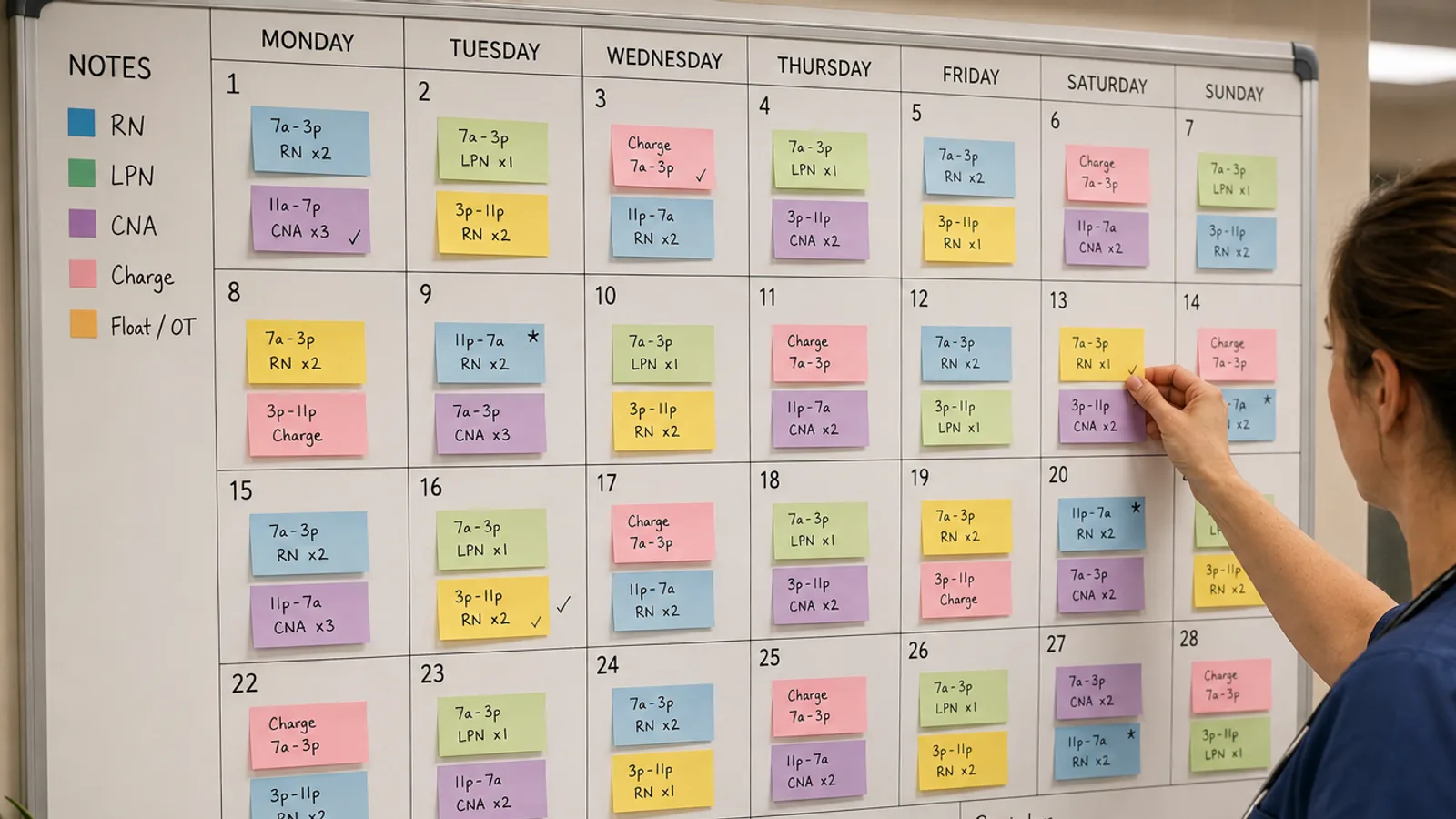
A nurse manager is a registered nurse (RN) with management responsibilities over a nursing unit, department, or facility. They oversee clinical staff hiring, performance, and scheduling; manage departmental budgets; ensure compliance with regulatory requirements; and serve as the operational bridge between frontline nursing staff and hospital administration. The nurse manager owns the nurse scheduling process for their unit, building each cycle’s schedule, managing callouts, tracking overtime, and resolving last-minute coverage gaps. At critical access hospitals, these administrative duties frequently coexist with direct patient care responsibilities, creating a role that spans clinical practice and operational management simultaneously.
What Is the Nurse Manager Role at a Critical Access Hospital?
At a large hospital, the nurse manager is a dedicated administrative position. At a 20-bed critical access hospital, the reality is often different. The nurse manager, or the DON filling an equivalent role, may also serve as a frontline nurse during understaffed shifts. They participate in care delivery alongside the staff they supervise, and they handle administrative functions without a dedicated HR generalist, scheduling coordinator, or workforce analyst behind them.
In that setting, scheduling is not a background task that happens between other duties. For many nurse managers at small hospitals, scheduling occupies a significant and measurable share of their workweek.
How much of the week does that take? In our interviews with more than 30 nurse managers, the consistent answer was 8 to 12 hours in a typical week, as an average across the 4-6 week scheduling cycle. The rhythm is lumpy: the schedule build lands once per cycle, while swap requests and callout cover can land in any week. That is an estimate from those conversations, not a measured time study. The activity-by-activity split is in our guide to where nurse manager scheduling time actually goes.
Put your own rate against it and the number gets concrete. At an illustrative $50 an hour loaded rate, 10 hours a week is about $26,000 a year of leadership time going into a task most facilities have never formally measured. Run that math with your own figure rather than ours. It also excludes the downstream cost of scheduling errors, unnecessary overtime, compliance gaps, and the retention effect of a schedule staff consider unfair.
Is a Nurse Manager the Same as a Charge Nurse?
No. The nurse manager owns the forward schedule, the budget and the staff. The charge nurse runs a single shift and hands it over at the end of it. At a small hospital the same person often does both, which is where the confusion starts.
We cover the full comparison separately, including whether a charge nurse counts as a supervisor and who owns which schedule document: nurse manager vs charge nurse.
What Are the Scheduling Duties of the Nurse Manager?
The nurse manager’s scheduling work breaks down into several distinct tasks, each with its own time and complexity profile:
Schedule construction: Building the initial draft schedule for the next 4-6 week period. This involves matching staff availability, credential requirements, contract constraints (maximum hours, minimum rest periods), and patient coverage requirements. In our interview-based model, the initial build at a 20-nurse critical access hospital working in Excel takes 4 to 6 hours per cycle.
Request management: Processing time-off requests, shift swap requests, and availability changes from staff. These arrive continuously and require the manager to update the schedule, verify that coverage remains intact, and communicate decisions back to staff.
Callout response: A callout is the highest-urgency scheduling event. The nurse manager must identify and contact available coverage, work through the per diem list, and update the schedule within a narrow time window. In our interviews, a typical week brings 2 to 3 callout or absence events, and securing cover runs 1 to 3 hours per event when it is worked by phone.
Overtime tracking: Monitoring cumulative hours across the team to avoid triggering FLSA overtime without awareness. Manual spreadsheets do not automatically flag nurses approaching the 40-hour threshold, so overtime often accumulates before it is caught.
Compliance documentation: Keeping records that show a surveyor who actually worked each shift, not just who was originally assigned. Federal rules put critical access hospital nursing services under 42 CFR 485.635(d), and Texas licensing separately requires an RN on duty in each building that contains a nursing unit with patients present (26 TAC 505.41). The posted schedule and its change history are usually the documents that carry this.
Every one of these tasks is work that nurse scheduling software promises to reduce. The practical question for a small hospital is who does the part the tool leaves behind; how our service handles the full cycle shows one answer to that question.
Frequently Asked Questions
Q: What does a nurse manager do on a daily basis? A nurse manager’s typical day includes reviewing staffing for the current and upcoming shifts, responding to callouts, and handling staff scheduling requests. It also includes addressing clinical concerns escalated by the charge nurse, administrative meetings, and work on the forward schedule. At a critical access hospital, they may also provide direct patient care on short-staffed shifts. Scheduling tasks surface throughout the day, not just during a dedicated block of administrative time.
Q: How much time do nurse managers spend on scheduling? Our own interviews with more than 30 nurse managers put it at 8 to 12 hours per week across all the related tasks: schedule construction, callout management, swap requests, and overtime tracking. At an illustrative $50 an hour loaded rate, 10 of those hours a week works out to roughly $26,000 a year of leadership time, which could otherwise go to staff development, patient care, or planning. Use your own rate to get your own number.
Q: How much does a nurse manager make? There is no federal wage figure for the title. The 2018 Standard Occupational Classification list contains no entry for nurse manager; BLS counts the role inside medical and health services managers (SOC 11-9111), where the median annual wage was $117,960 in May 2024. For comparison, registered nurses (SOC 29-1141) had a median of $93,600 in May 2024. Salary sites quoting a precise nurse manager salary are averaging job postings, not citing the federal survey.
Q: Who does the nurse manager report to? At most hospitals the nurse manager reports to the director of nursing or the chief nursing officer. At a Critical Access Hospital those layers often collapse, and the nurse manager may be the director of nursing, reporting straight to the administrator or CEO. In Texas the top of that chain is set by state licensing, which requires nursing services under a chief nursing officer who is an RN. The federal critical access hospital rules require no nursing leadership title at all.
For more on how SimpleScheduleAI supports nurse managers at critical access hospitals, see: Critical Access Hospital Scheduling.
The schedule, off the nurse manager's plate
Our AI builds it, our scheduling team checks it, your manager approves. Onboarding takes 3 to 5 business days and your first schedule lands inside two weeks.
See how it works →Sources
[1] Medical and health services managers, median annual wage $117,960 in May 2024, SOC 11-9111. U.S. Bureau of Labor Statistics. The 2018 Standard Occupational Classification detailed occupation list contains no entry for “nurse manager” or “charge nurse”: bls.gov/soc. Verified 2026-08-19.
[2] Registered nurses, median annual wage $93,600 in May 2024, SOC 29-1141. U.S. Bureau of Labor Statistics, Occupational Outlook Handbook. Verified 2026-08-19.
[3] U.S. Department of Labor, Wage and Hour Division, Fair Labor Standards Act. dol.gov.
[4] Critical access hospital Conditions of Participation: staffing at 42 CFR 485.631, provision of services at 42 CFR 485.635.
[5] Texas hospital licensing, nursing services: 26 Texas Administrative Code § 505.41(o), transferred from 25 TAC § 133.41 effective 2025-01-31. Cornell LII. Verified 2026-08-19.
Pradeep Pandey is the co-founder of SimpleScheduleAI, an AI-native nurse scheduling service built for Critical Access Hospitals in Texas. He serves as Deputy General Manager of Operations at Apollo Hospitals and holds an MBA from IIM Trichy. LinkedIn →