By Pradeep Pandey · Co-Founder · 17 min read · Updated
What Rural Texas Hospitals Are Actually Using for Nurse Scheduling in 2026
Ask which nurse scheduling tools rural Texas hospitals actually use and you hit a wall: nobody publishes the data. Public rural-health evidence still points somewhere specific. Here is a directional read on what the state's 93 critical access hospitals likely run in 2026, with the guesswork labeled as guesswork.

Key Takeaways
- Texas has 93 critical access hospitals, most concentrated in rural communities where the nearest alternative facility can be a long drive away.
- Public rural-health data documents that small rural facilities operate with thin margins and without dedicated IT departments. Facilities in that position commonly rely on the simplest available tools: spreadsheets, a whiteboard, and a phone. We cannot measure the exact split at Texas facilities, so treat any tool ranking as directional inference from public evidence, not a measured market share.
- When a small rural hospital does buy purpose-built scheduling software, ease of setup and direct support tend to matter more than feature breadth. Some publicly reviewed scheduling tools, such as Aladtec, built their reputations on exactly those attributes.
- Structured software evaluation rarely happens where no one owns the task and there is no dedicated budget line, a plausible reason many small rural hospitals have not adopted a tool recently. This is inference from documented staffing constraints, not a survey result.
- The market gap is directional but real: enterprise scheduling vendors publicly position and reference large health systems, not standalone Texas rural hospitals, and none publicly documents a product built specifically for the Texas Critical Access Hospital compliance environment (HHSC, FLSA, CMS CoP).
Table of Contents
- How Many Texas Critical Access Hospitals Are There, and What Are They Facing?
- What Scheduling Systems Are Most Common at Texas CAHs?
- Why Haven’t More Texas CAHs Adopted Scheduling Software?
- What Scheduling Software Is Being Evaluated by Texas Rural Hospitals?
- What Does the Texas Compliance Environment Require That Most Software Ignores?
- What SimpleScheduleAI Is Building for the Texas Critical Access Hospital Market
- What to Do This Week
- Frequently Asked Questions
Scheduling software companies publicly focus their sales and marketing on health systems, large hospital networks, and the long-term care sector. Small rural hospitals are a thin slice of that public record rather than an absent one. The clearest counterexample we found is a vendor case study on Sarah D. Culbertson Memorial Hospital, a 22-bed Critical Access Hospital in Rushville, Illinois, published by AONL in 2019 and now seven years old, and we found no equivalent for a Texas facility. That means a nurse manager at a small rural hospital is often making a scheduling tool decision with limited proactive vendor guidance: asking a colleague at another facility what they use, running a Google search, or attending a rural health conference session. The result is a directional market gap. The sections below lay out what public rural-health evidence supports, and label clearly where we are inferring rather than measuring.
How Many Texas Critical Access Hospitals Are There, and What Are They Facing?
Texas has 93 critical access hospitals, making it one of the largest CAH states in the country. You can see every hospital on the federal list, with its bed count and certification year. They are distributed across rural communities throughout West Texas, the Panhandle, East Texas, and South Texas, often serving counties where the next closest hospital is a long drive away.
Critical access hospitals are federally designated rural facilities with 25 or fewer acute care beds. In Texas, they are also subject to Texas Health and Human Services Commission (HHSC) hospital licensing and staffing standards, Texas Payday Law wage-payment provisions, and CMS Conditions of Participation, creating a specific compliance environment that generic scheduling software does not address.
Public rural-health data documents the operating pressure these facilities are under. The Rural Health Information Hub reports that workforce shortages are very common in rural communities, with far fewer health professionals per capita than metro areas and higher exposure to burnout and turnover. The state’s own numbers show the pattern plainly: Texas critical access hospitals fill their positions well but lose those nurses fastest, as the 2026 Texas nurse staffing numbers lay out. Many small rural hospitals also run on thin margins, a pressure we quantify for Texas specifically in what the 2026 rural hospital loss data means for nurse staffing. In September 2026 a Medicaid payment stream these hospitals sit inside stopped for seventeen days. The typical facility of this size does not carry a dedicated HR or IT department. In that environment, technology procurement decisions usually fall to the administrator or nurse manager, often without a structured evaluation framework.
Taken together, those documented constraints (workforce shortage, thin margins, limited internal staff) are a reasonable explanation for why many small rural hospitals stay in a scheduling status quo for years. That is inference grounded in public evidence, not a measured claim about any specific facility.
What Scheduling Systems Are Most Common at Texas CAHs?
There is no public dataset that ranks the exact scheduling tools in use across Texas critical access hospitals, so treat what follows as directional inference from public evidence, not a measured market share.
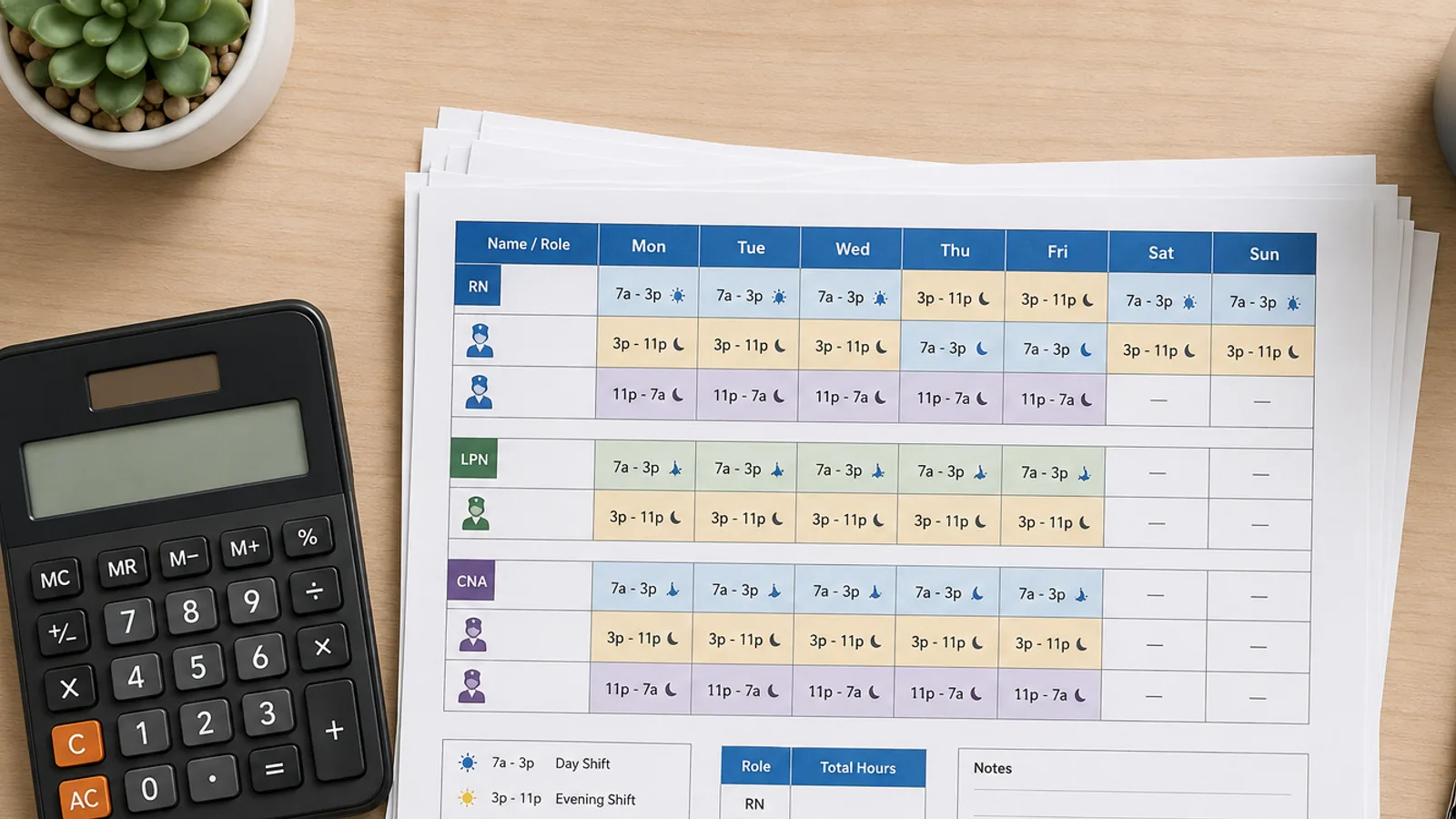
Rural hospitals without dedicated IT commonly rely on the simplest tools available: a spreadsheet, a whiteboard, and a phone. That is a reasonable read of the same limited-IT, constrained-budget facilities described above. Spreadsheets tend to persist not because they are the best tool but because they were the tool on hand when the process was first set up, and switching costs are real. A nurse manager who has built schedules the same way for years has a configured process that clears the minimum bar of producing a schedule each cycle.
When a small rural hospital does adopt purpose-built scheduling software, ease of setup and responsive support tend to weigh more heavily than feature breadth, because there is no IT team to absorb a complex rollout. Aladtec is one publicly reviewed platform that built its reputation on exactly those attributes. Now sold by TCP Software, it is marketed to fire, EMS, law enforcement and corrections agencies. TCP markets a different product, Humanity Schedule, to healthcare. Some facilities instead use basic time and attendance systems with a schedule module attached. A small number, typically part of a larger health system, run an enterprise platform such as UKG that the parent system rolled out centrally rather than the facility choosing it, which is a common pattern in health-system acquisitions.
| Scheduling approach | Why a small rural hospital uses it | The trade-off it carries |
|---|---|---|
| Spreadsheet, whiteboard, and phone | Already on hand, no license cost, and familiar to whoever set it up | No compliance documentation, strains under callouts, and tied to one person |
| Time-and-attendance module | Often bundled with the payroll or timekeeping system already in place | Built for timekeeping, not shift-scheduling logic or CAH compliance |
| Inherited enterprise platform | Rolled out centrally by a parent health system after an acquisition | Sized and priced for large systems, heavy to configure for 20 nurses |
| Purpose-built scheduling tool | Chosen for easier setup and direct support when a facility does buy one | Texas CAH compliance coverage still has to be verified with the vendor |
This is a taxonomy of approaches, not a measured ranking. The mix at any given facility is the directional inference described above, not a market share we can source.
Why Haven’t More Texas CAHs Adopted Scheduling Software?
Documented staffing and budget constraints point to four interconnected reasons small rural hospitals have not adopted scheduling software at higher rates: limited IT to evaluate and implement, no dedicated budget line, limited proactive vendor outreach to their segment, and prior evaluation attempts that did not produce a usable fit. These are inferences from public evidence, not survey findings.
No IT staff. As noted, facilities of this size rarely carry a technical role to run an evaluation, manage a rollout, and troubleshoot ongoing issues. The nurse manager who would benefit most from scheduling software is often the same person who would have to implement it while covering a clinical schedule.
No budget line. Software purchases at small hospitals require administrator or board approval, and scheduling software does not have an obvious budget line in most small rural hospital operating budgets. The return-on-investment case is compelling when someone builds it, but the initiative to build it typically needs a trigger, such as a CMS survey finding or a staffing crisis.
Limited vendor outreach. Enterprise scheduling vendors publicly target health systems, large long-term care networks, and healthcare staffing agencies. An administrator who is not actively searching for a solution is unlikely to encounter proactive outreach for one.
Prior evaluation friction. An administrator who has tried to evaluate scheduling software may have walked away because the options found were too complex to implement, priced for far more than 20 seats, or structurally sized for larger facilities. A frustrating evaluation produces skepticism that discourages the next attempt.
What Scheduling Software Is Being Evaluated by Texas Rural Hospitals?
Because there is no public evaluation dataset for this segment, the platforms below are ones that surface in publicly reviewed rural and small-hospital scheduling contexts, not a measured ranking of what Texas administrators choose.
Aladtec surfaces in these contexts because it offered an accessible initial setup path. It is worth pairing that with what reviewers actually flag. On Capterra, one nurse manager noted the editing workflow can be click-heavy:
“When editing the schedule there are a lot of clicks involved.”
Amanda F., Nurse Manager, Hospital & Health Care, October 13, 2020, Capterra
Another reviewer flagged the administrator-side setup:
“It was a bit complicated to figure out from the administrator side.”
Jeanne C., Administrative Coordinator, May 7, 2019, Capterra
Aladtec’s Capterra reviews skew toward fire, EMS, and law enforcement users, and the most recent hospital-nursing reviews are several years old, so weigh them as directional for a hospital audience. Verify current setup and support experience directly with the vendor before committing.
NurseGrid is a nurse-facing app that surfaces primarily for its staff-side features, such as nurses viewing and managing their own schedules on mobile, rather than as a full scheduling management platform. Two limitations matter for a small hospital evaluating it as a primary system. Reviewers reported the manager-facing mobile app was removed:
“It no longer has the manager app so I have to login to desktop.”
Chief Nursing Officer, Hospital & Health Care, June 13, 2024, Capterra
And cost has been flagged as a barrier at small facilities:
“cost is too expensive for small centers.”
Administrator, Hospital & Health Care, June 17, 2024, Capterra
Other platforms, including hospital-oriented tools such as ShiftWizard and senior-care-oriented tools such as OnShift, can appear when an administrator has seen them referenced in a hospital association resource or a rural health conference session. Both are legitimate platforms for certain use cases. The evaluation challenge for a small rural hospital is judging whether a platform sized for larger facilities fits a 20-nurse roster, and vendor product pages are the place to confirm that fit. Verify Texas compliance coverage and small-facility fit with each vendor directly.
SimpleScheduleAI is early to this market and built specifically for the Texas Critical Access Hospital context. It is not a category leader here. The rural Texas segment is early and largely uncontested, which is the reason it can be built for rather than adapted to.
What Does the Texas Compliance Environment Require That Most Software Ignores?
Texas critical access hospitals operate under a specific compliance stack that most nurse scheduling software does not address by default: Texas HHSC hospital licensing and staffing standards, FLSA overtime rules as applied to Texas nursing practice, Texas Payday Law provisions, and CMS Conditions of Participation for CAH designation.
Most scheduling software is built for a generic healthcare compliance environment. It handles FLSA overtime thresholds generally but does not specifically track the Texas provisions that apply to CAH operations. CMS CoP documentation requirements for these facilities, including the requirement for a registered nurse, clinical nurse specialist, or licensed practical nurse on duty whenever the CAH has inpatients, are not specifically addressed in most scheduling platforms.
Texas also has specific Payday Law requirements for how shift premiums and overtime are documented. A scheduling tool that logs shift data but does not generate documentation suitable for a Texas Payday Law review leaves a gap the nurse manager has to fill by hand.
For a Texas administrator evaluating scheduling tools, the compliance question should be explicit: does this platform account for Texas HHSC requirements, and can it generate the documentation I would need for a CMS survey or a Texas HHSC compliance review? If the vendor cannot answer that specifically for Texas, the compliance feature set is built for a generic environment, not the Texas CAH context.
What SimpleScheduleAI Is Building for the Texas Critical Access Hospital Market
SimpleScheduleAI is an AI-native nurse scheduling service built specifically for the Texas critical access hospital context. Texas HHSC and FLSA overtime compliance is the default, not an add-on configuration. CMS CoP documentation requirements are addressed through the audit trail the service maintains automatically.
The service is designed for the operating reality documented across rural facilities of this size: a nurse manager with a dual clinical and administrative role, and a scheduling problem that needs to be solved without a six-month implementation project or a large software budget. You can see how it works end to end before you commit.
The service model means setup is handled by the specialist, not the nurse manager. The Texas compliance requirements are configured by someone who knows them, not translated from generic software documentation by an administrator without a compliance background.
The 93 Texas critical access hospitals are the specific market SimpleScheduleAI was built to serve, designed as a Texas CAH scheduling service from that operating context rather than adapted to Texas from a generic tool.
This focus is also a limitation, and it is worth naming plainly. SimpleScheduleAI is not the right fit for a large health system that wants to self-administer an enterprise platform across dozens of departments, or for a facility outside Texas that needs another state’s compliance rules out of the box. If your hospital already runs a well-supported enterprise scheduler and has the IT staff to maintain it, a purpose-built Texas CAH service is not what you need. The fit is a small rural Texas hospital that wants the scheduling and compliance work handled, not another tool to administer.
For more on what Texas-specific requirements apply to CAH nurse scheduling, see The Complete Guide to Critical Access Hospital Scheduling.
Our Take
Nobody has a clean dataset on what rural Texas hospitals run for scheduling, so anyone claiming a precise market share is guessing with confidence. What the public evidence does support is narrower and more useful: facilities with limited IT and thin margins default to the simplest tools that clear the bar, and enterprise vendors do not build for them. What the evidence supports is a statement about the market rather than a ranking of products: the segment is underserved, ease of setup beats feature breadth every time here, and the question that matters for an administrator is which tool will actually run without an IT team to babysit it.
What to Do This Week
- Write down how your schedule is actually built today, including the spreadsheet, whiteboard, or phone tree steps, and how many hours a cycle it takes your nurse manager. You cannot evaluate a replacement until the current cost is on paper.
- List your must-have compliance outputs: the documentation you would need for a CMS survey and a Texas HHSC or Texas Payday Law review. That list is your evaluation filter.
- For any tool you consider, ask the vendor two direct questions: does it account for Texas HHSC requirements, and can it generate the documentation those reviews need. If the answer is generic, the feature set is generic.
- Ask peer facilities through a rural health network, such as the Texas Organization of Rural and Community Hospitals (TORCH) or the Texas Rural Health Association, what they evaluated and what they would do differently.
- Book a call with our team to see how a service built for the Texas CAH context would handle your roster and your compliance documentation.
Built specifically for the 93 Texas critical access hospitals.
Texas HHSC compliance built in. No IT setup. Operational in 3 to 5 business days.
See how it works →Frequently Asked Questions
Q: Are there any scheduling tools specifically designed for Texas rural hospitals?
SimpleScheduleAI is the only AI-native nurse scheduling service we are aware of that was designed specifically for the Texas critical access hospital context, with Texas HHSC compliance and CMS CoP documentation built in by default. Most general scheduling platforms can be configured for Texas compliance requirements, but the configuration requires someone with the relevant compliance knowledge to set it up correctly. For a small rural hospital with no IT or compliance staff, a service that builds this in by default reduces implementation risk.
Q: How do Texas rural hospital administrators find scheduling software?
Word of mouth from peer hospitals is a common discovery channel: a nurse manager at one facility asks a colleague at another what they use. Rural health association networks (Texas Organization of Rural and Community Hospitals, or TORCH, and the Texas Rural Health Association) are secondary channels. Online search and vendor outreach are less common paths because enterprise vendor sales motions rarely target this specific segment. If you are in the middle of an evaluation, asking TORCH peers what they evaluated and what they would do differently is one of the most direct ways to get useful, unfiltered information. Some rural hospitals go a step further and band into a network to share staff and services; what that does and does not change for nurse staffing is covered in rural hospital networks and nurse staffing.
Q: Do Texas CAHs have specific scheduling software requirements that other states don’t?
Texas-specific requirements include Texas HHSC hospital staffing standards and Texas Payday Law provisions for how and when wages, including any overtime owed, must be paid and documented. Overtime itself is calculated under the federal FLSA; Texas has no separate state overtime law. CAH designation adds CMS Conditions of Participation, which are federal, not state-specific. A scheduling tool built for the Texas CAH context should track FLSA overtime thresholds and produce the staffing and wage documentation these frameworks expect.
Sources
- Rural Health Information Hub, Rural Healthcare Workforce Overview
- Rural Health Information Hub, Texas State Guide (Texas critical access hospital count)
- Health Resources and Services Administration (HRSA), Federal Office of Rural Health Policy
- Centers for Medicare and Medicaid Services, Critical Access Hospitals
Pradeep Pandey is the co-founder of SimpleScheduleAI, an AI-native nurse scheduling service built for Critical Access Hospitals in Texas. He serves as Deputy General Manager of Operations at Apollo Hospitals and holds an MBA from IIM Trichy. LinkedIn →